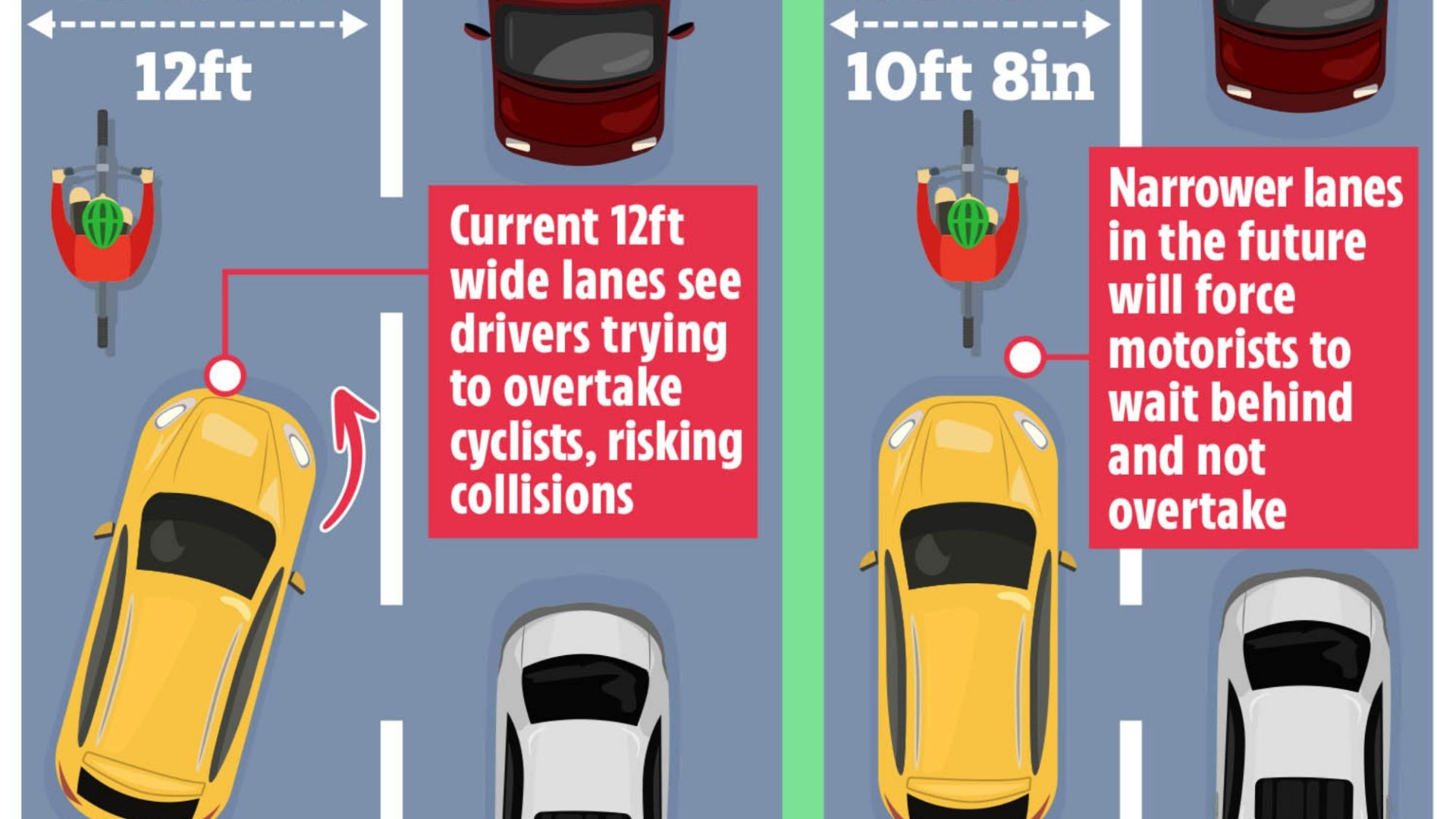
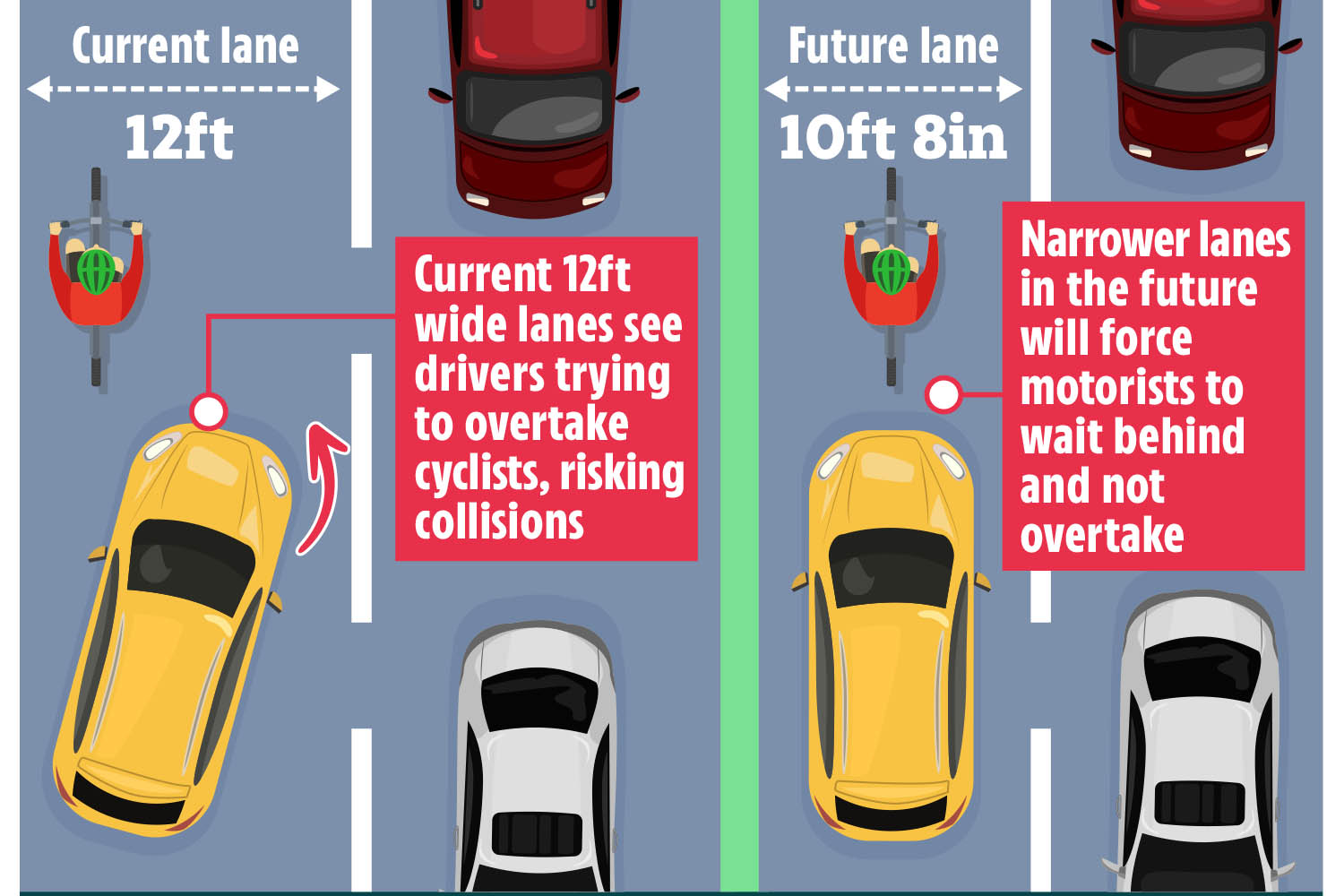
ROADS are to become narrower across the country in order to stop drivers from overtaking cyclists.
The Government is looking to shrink road lanes as it will improve safety for cyclists by making it clearer to drivers that they can’t overtake.
The new guidance suggests that roads should be reduced to 3.25m or under, a new report from Active Travel England (ATE) revealed.
ATE found that lanes between 3.25m and 3.90m wide have the highest risk of a crash.
“Motorists may try to overtake cyclists when there is not enough space, therefore increasing the risk of ‘shunt’ or ‘clip’ collisions. Where this is the case, it is a critical issue.”
Using a 2020 study in partnership with TFL, ATE recommended that the typical 3.65m (12 ft) lane should be either slimmed down to 3.25m or widened to 4.05m.

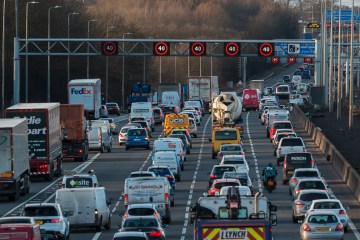
In the case of two opposing lanes of 3.65m, ATE said one should be widened and the other lane narrowed.
ATE said narrowing the lanes will encourage cyclists to ride in the middle of the lanes.
This comes after the Highway Code changed in 2022 to instruct drivers to leave at least 5ft when passing a cyclist.
The TFL study found that advisory cycle lanes which allow cars to enter, increased injury odds by 34 per cent.
There was also evidence that junctions can triple injury odds as well as more pedestrians.
Brian Gregory, policy director at the Alliance of British Drivers, told the Mail on Sunday: “If you slow everybody down to the speed of cycles on narrow roads that is a huge economic cost to the country in wasted time.
“The whole idea is just to make driving unpleasant instead of trying to get everybody to co-operate and work together to use roads safely. It’s all about penalising motorists. It’s completely stupid.”
Elsewhere in ATE’s updates guidance published this month, the department advised reducing the speed of drivers from 30mph in order to protect cyclists and pedestrians running across the road.
The report aid alternatively crossing time could be extended as “those who move at a slower pace due to age or ability, are not given time to cross safely”.
Another way of reducing collisions would be reducing the number of cars on the road and providing more crossings for pedestrians.
The risk of a collision increases, the report said, when there are more than 1,000 vehicles on the road in the busiest hour.
Additionally, when there are more than 500 vehicles at least 5 per cent of them are HGVs and buses the risk again increases,


A spokesman for the Department of Transport said: “There has never been legally binding standards for road widths and that remains the case.
“The Government is absolutely on the side of drivers. Over the past year alone, we invested an extra £500 million to help local authorities maintain their road networks, committed £1 billion to repair bridges, flyovers and tunnels, and gave the green light to over 30 road schemes to improve journeys across the country.”