The BBC has helped to fund a brutally anti-British film about Palestine, now in cinemas in Britain and soon to be released in the US.
Viewers in Britain will be shocked to see British soldiers portrayed as little better than Nazis, in one scene humiliating an Arab priest and his young son and robbing them.
The film also makes a ferocious personal attack on Captain Orde Wingate, the British officer later famous for his role in the Burma war and his ‘Chindit’ guerrilla units.
An organisation called BBC Film, an arm of the Corporation, has confirmed to me that it ‘has provided funding alongside many other UK and international partners’.
The London-based website magazine Middle East Eye has praised Palestine 36 in a generous review saying: ‘It may not surprise Palestinians, but the film is bound to shock nearly every Briton who watches it, owing to the stunning omissions from this period in the country’s history curriculum.’
True enough. It is shocking, to a British patriot, to learn of some of the unquestioned atrocities which were committed by British troops in Palestine in the 1930s. But the drama itself omits some important things too.
Middle East Eye argues: ‘The film details the crimes and duplicity of British officials in Palestine in the 1930s. It also explores what drove many Palestinians to violent resistance. British soldiers are shown killing innocent people and burning entire villages.’
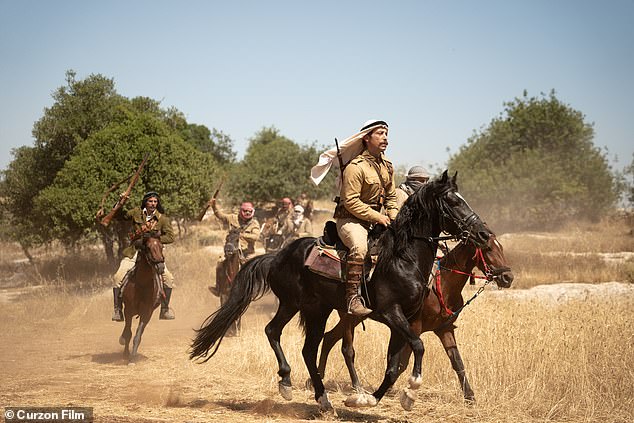
Website magazine Middle East Eye says Palestine 36 ‘details the crimes and duplicity of British officials in Palestine in the 1930s. It also explores what drove many Palestinians to violent resistance’
This is an accurate account, as far as it goes. And the period is poorly understood and little-known in this country.
But by leaving out the context and background, it gives – in my view – a deeply unbalanced and partial view of what happened. And witnesses are required to tell the whole truth, not just a bit of it.
British forces did commit atrocities while trying to suppress a major Arab revolt in what was then the British Mandate of Palestine.
But these actions followed a long, cruel, violent and destructive build-up which is simply not explained. Some – but not all –Arabs in 1930s Palestine opposed the arrival of Jews, who were allowed by Britain to migrate to the region as part of the ‘National Home’ promised by this country in the Balfour Declaration of 1918.
Long before the film begins in 1936, Arabs hostile to the Balfour plan had violently attacked Jews.
For instance, in riots in August 1929, 133 Jews were killed by Arabs, and 339 Jews were injured. There had also been destructive attacks on Jewish farms and settlements.
A serious account of the events might also at least touch on the involvement of the Italian Fascist leader Benito Mussolini, in stirring up and financing the tension. There isn’t much doubt this took place.
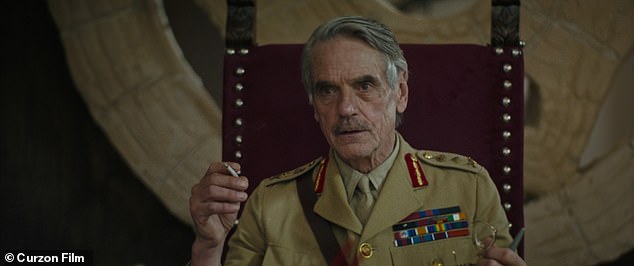
Imperial Britain is caricatured through the figure of General Sir Arthur Wauchope, the colonial High Commissioner, played by Jeremy Irons as a stiff-necked old buffer encrusted with medals, writes Peter Hitchens
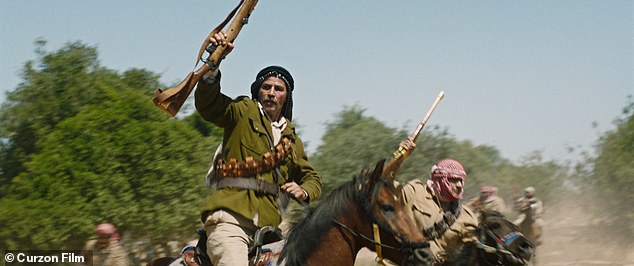
There is hardly a single major Arab character who is not portrayed as good, patient, tolerant, humane and wise, even while they rob the passengers of a raided train, writes Peter Hitchens
I don’t object to the film itself. Such things at least stimulate interest in a fascinating period, far too little-known. Another recent movie on this era, Shoshana, examines the British conflict with Jewish Zionist terrorists, which also needs some light shed on it.
It is the BBC support for Palestine 36 that I think is wrong, given the BBC’s explicit commitment to impartiality.
For this film is not impartial, or even remotely fair, about one of the most bitterly contentious quarrels in modern history. And I don’t think its makers would claim that it is.
There is hardly a single major Arab character who is not portrayed as good, patient, tolerant, humane and wise, even while they rob the passengers of a raided train (the passengers are politely asked by armed men to contribute to the cause).
The one exception is an Arab discovered to be taking money from Zionists in return for slipping pro-Jewish propaganda into his newspaper.
There is no major Jewish character in the film at all. Imperial Britain is caricatured through the figure of Sir Arthur Wauchope, the colonial High Commissioner, played by Jeremy Irons as a stiff-necked old buffer encrusted with medals.
Captain Wingate, who was indeed a harsh and biased officer, fanatically pro-Zionist, and eventually ordered home when his fanaticism got out of hand, is shown as a near-diabolical figure.
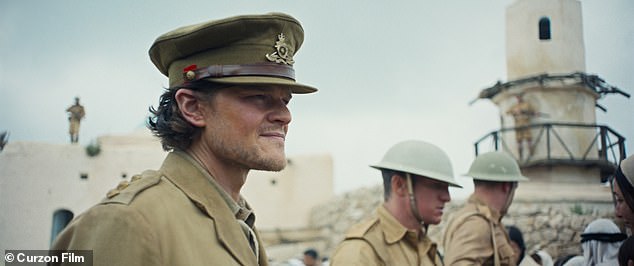
Captain Orde Wingate (played by Robert Aramayo), who was indeed a harsh and biased officer, fanatically pro-Zionist, and eventually ordered home when his fanaticism got out of hand, is shown as a near-diabolical figure, writes Peter Hitchens
By contrast the only important British character who is treated kindly is an official called ‘Thomas Hopkins’, who I think is invented.
He is plainly pro-Arab, as many British colonial officials of the era definitely were. But he is portrayed as powerless and over-ridden, at one point, rather incredibly, swearing like a 21st Century lout, at High Commissioner Wauchope.
The movie makes an enormous fuss about the Peel Commission of 1937, an attempt to dodge the problem by splitting the difference, and carving up the territory between Jews and Arabs.
I think this was the first suggestion of the ‘two-state solution’ which all fashionable opinion (not me) now endorses as the best way to bring peace to the region. The Arab leadership of the time rejected it angrily. Well, they had reason to do so.
But their refusal to compromise led pretty much directly to the far crueller partition when Israel became independent in 1948.
But what of the eventual outcome of all this, the 1939 White Paper which more or less banned further Jewish immigration into the British Palestine Mandate?
This huge retreat by the British colonial power was the true end of the Arab revolt of 1936, not the rejected Peel report.
A BBC source said: ‘BBC Film was approached about the film in 2022 and became committed in early 2023 through the UK co-producers’. It will be made available to licence payers on BBC iPlayer two years after release – as is standard for projects backed by BBC Films.
A spokeperson told me: ‘The film will comply with our editorial guidelines when shown on the BBC.’ It will be interesting to see how they manage to do so. I’ll give it a watch to see how they fare.