When Phillip Eng became general manager of the Massachusetts Bay Transportation Authority, the sprawling state agency that operates Greater Boston’s network of buses, trains, and ferries, he had a great deal to prove. The MBTA, which at the time ran some 740,000 rides each day, had become defined by its unreliability. Trains crawled as slowly as 3 miles per hour and sometimes caught fire. In 2022, the Federal Transit Administration launched an investigation after a series of accidents, including a train malfunction that killed a passenger.
Past efforts to repair the beleaguered system had accomplished little. Trust had reached a nadir. Mr. Eng, who has led the agency since April 2023, knew he couldn’t afford to deliver anything less than hard results.
And deliver he has.
Why We Wrote This
The T, as Bostonians call it, has seen a remarkable turnaround in just over two years. Many now see America’s oldest subway system as a model for repairing the country’s crumbling transportation infrastructure.
In November 2023, only about 25% of those riding the Red, Blue, and Orange lines reached their destination on time, on average. Today, that number hovers around 92%. (The Green Line, the city’s fourth subway line, runs a different type of vehicle.) Most train lines on the T, as it’s nicknamed, run faster than in 2023, and they all run more frequently. In an October survey of riders conducted by the MBTA, 74% of respondents said they were somewhat, very, or extremely satisfied with service. That’s up from 37% two years ago.
“Boston has followed a whole lot of best practices in terms of getting the trains to run on time that I think other troubled transit systems could learn from,” says Jake Berman, author of “The Lost Subways of North America,” a book on the history of public transit. “Phillip Eng has done an excellent job, full stop.”
It’s a remarkable turnaround for an organization Bostonians have long eyed warily – and a bright spot in a dim landscape for American transit. Public transportation systems have faced existential struggles since the pandemic, which dragged ridership to new lows and strained already shaky finances.
Earlier this year, Philadelphia’s system slashed service by 20% to stave off a $213 million shortfall – though a judge later reversed those changes. In October, Illinois lawmakers passed a bill to close a $200 million budget gap for Chicago’s system, which had warned it would cut up to 40% of service without more funding. New York’s subway system has recorded more assaults since 2009 – though the violent crime rate fell in 2025 compared with last year. (The overall crime rate remains low, at about 1.6 major crimes for every 1 million rides.)
Many see efforts to get the oldest subway system in the United States back on track as a model for success amid those challenges. To be sure, the T is still prone to delays and breakdowns. And some argue that the MBTA is spending too much, too fast. Still, other agencies have taken notice of the system’s recent success, Mr. Eng says, and they often contact him for guidance on how to tackle staffing shortages and disrepair.

Melanie Stetson Freeman/Staff
Mr. Eng, who was appointed the state’s interim Transportation Secretary in October, says it’s about a laser-focus on one goal: improving the system for riders. And he says his work is far from finished.
“One of the things that I’m striving for is not only streamlining schedules, but making sure that when we get precious taxpayer dollars, we are giving the results that the public needs,” Mr. Eng tells the Monitor. “We’re just scratching the surface.”
“Really restored trust in the system”
Over half of the country’s rail stations were overdue for replacement in 2014, according to the Department of Transportation. And 96% of 190 transportation agencies surveyed by the American Public Transportation Association in 2022 said they did not have enough workers.
Boston’s campaign shows that fixing these problems is expensive – but possible. The MBTA says it has done 40 years worth of work in just 14 months as it seeks to make up for decades of deferred maintenance.
“The T has struggled for years because of decades of underinvestment in the system,” says Kate Dineen, president and CEO of A Better City, a local nonprofit focused on infrastructure and transportation. “The T is working differently now, and the leadership at the T has really restored trust in the system.”
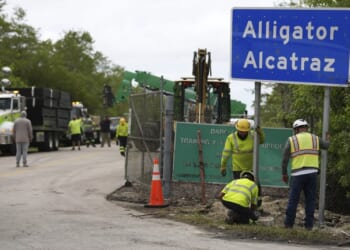
Between 2023 and 2024, the agency replaced 250,000 feet of aging subway track to eliminate “slow zones” – stretches where trains can’t operate at full speed due to poor track conditions – that once covered a quarter of the system. In 2023, it raised sign-on bonuses from $4,500 to $7,500 and increased starting wages for bus drivers. The headcount has since surged from 5,700 people to just over 8,000 today.

Melanie Stetson Freeman/Staff
It has made a difference. Trips on the Red Line, the system’s busiest, are nearly a half hour faster. Across the four main lines, the T ran 278 more trains per day, on average, in October 2025 than two years prior.
But the real change has been a cultural shift, says Caitlin Allen-Connelly, executive director of local nonprofit TransitMatters. The MBTA today is more focused on safety and providing for its riders, she says.
“Not only did [Mr. Eng] hire the right people and focus on getting the job done, he also began to work at the culture of the T,” she says. “People felt more comfortable talking about problems that are happening in the system.”
All of those initiatives have made Mr. Eng a local celebrity – an unlikely feat, especially for a Mets fan in Red Sox territory. Baseball allegiances aside, riders of the T clamor to take selfies with Mr. Eng, who often rides the subway, and thank him for the improvements.
Mr. Eng says he’s grateful for the public’s trust – and patience – as he and the MBTA have worked to repair the system. “The success of these things is about communication and partnerships,” he says.
“It’s a lot better”
At the heart of the misadventures of the T, and many American transit systems, is a lack of money.
The lion’s share of the MBTA’s funds come from a 2000 law that, under current tax rates, apportions 16% of the state’s sales tax revenue to the T – about $1.4 billion for this fiscal year. That system, amid slower-than-expected tax revenue growth, has left the T with shallow pockets. Last year, the agency stared down a nearly $700 million budget gap.
Part of the agency’s recent success, then, has been in convincing state leaders that the T is worth funding, says Brian Kane. He’s the executive director of the MBTA Advisory Board, an independent group that advocates for the municipalities the system serves.

Melanie Stetson Freeman/Staff
“As Phil has been able to demonstrate results, the legislature and the administration has rewarded that with additional resources, which he is then using to get additional wins,” Mr. Kane says. “His leadership has created a virtuous cycle.”
This year, lawmakers allocated some $470 million “to stabilize the MBTA.” It also apportioned $548 million from the state’s “millionaires’ tax,” which funds transportation and education. That money, Mr. Eng says, has balanced the MBTA’s budget.
In July, the Pioneer Institute, a Boston-based think tank, criticized the agency for its spending. Between 2021 and 2024, overtime pay at the MBTA rose by 48% to $126.4 million, and operating expenses increased by 35% to some $2.2 billion. Mr. Eng has dismissed those concerns, arguing that the sheer scale of the repairs necessitated increased spending.
“Agencies hesitate to take something out of service and do the right work,” he says. That, he adds, tends to worsen decay and increase repair costs. “When you have a facility in good condition – keep it in good condition.”
In September, U.S. Secretary of Transportation Sean Duffy sent a letter to Mr. Eng asking about the MBTA’s efforts to combat fare evasion and crime amid the department’s “ongoing focus on safety and security.” A month earlier, Mr. Duffy publicly mused about a federal takeover of Boston’s South Station – as happened with Washington’s Union Station. Such a move would be illegal because South Station is not a federal facility.
In a 12-page response, Mr. Eng defended the system’s track record. He pointed to a 16% reduction in crime between January and September 2025 compared with the same period last year, and highlighted $512 million the agency has spent since 2012 to upgrade surveillance systems and operate a 24-hour security hub.
The Green Line, a sprawling subway and trolley line that snakes from downtown into the suburbs, remains a sore spot. It remains a slow experience overall, moving at just over 11 miles per hour, on average. That’s in part due to stops that are close together, which limits how fast trains can move.
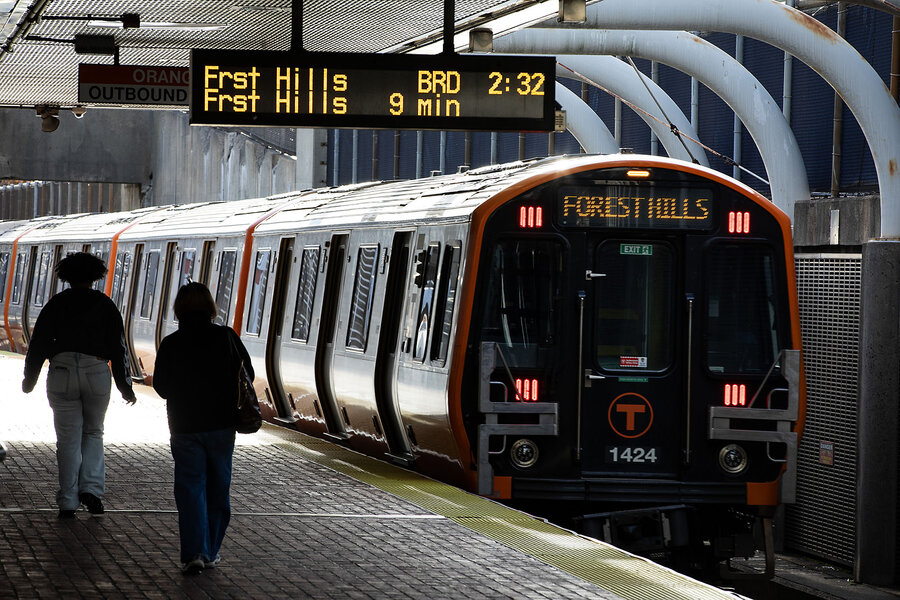
At an Orange Line station in the heart of the city, Andre Botticello waits for his train. Passengers mill around him, heading for work, school, or wherever else the T might take them.
The Orange Line was once a symbol of the T’s dysfunction. In 2022, a train suddenly caught fire on a bridge, prompting one woman to leap into the Mystic River below and swim to shore. No one was injured, but the incident further battered trust.
Today, Mr. Botticello says he’s happy with the Orange Line, which he has used to crisscross Boston for 30 years. “I’m not getting stranded like I used to get stranded,” he says. “It’s a lot better.”
With the squeak of steel on steel, Mr. Botticello’s train pulls into the station, right on time. He and a handful of others clamber on board. The train pulls out of the station, without incident.