In December 2022, police officers paid a visit to the popular Chinese restaurant Loon Fung on Sauchiehall Street in Glasgow.
Sauchiehall is one of the busiest shopping streets in the city and Loon Fung one of its most popular businesses.
But the officers weren’t there for a chow mein. Rather, they were investigating the shocking claim – made by the charity Safeguard Defenders – that ‘a secret Chinese police station’ was being covertly run from the restaurant and used to monitor foreign dissidents as well as influence senior politicians.
Police Scotland found no evidence of any crimes taking place on the premises. But a subsequent media investigation found that an individual linked with Loon Fung had met with then-Prime Minister Boris Johnson as well as Labour leader Jeremy Corbyn and Scottish First Minister Alex Salmond. Requests for meetings were also allegedly repeatedly sent to Salmond’s successor, Nicola Sturgeon.
The Chinese Embassy has always denied operating ‘secret police stations’. But the then Security Minister Tom Tugendhat said that any further allegations of criminal espionage on behalf of the Chinese Communist Party would be ‘swiftly investigated in line with UK law’.
The Chinese government retorted that the ‘police stations’ were in fact ‘service centres’ set up to help overseas Chinese nationals – unable to return home due to Covid-19 – with tasks ‘such as renewing their driving licences’.
Safeguard Defenders, however – who also identified a further two such bases in London – claim the stations had been in operation several years prior to the pandemic.
Two years on and, not only does Loon Fung continue to operate, but today the Daily Mail can reveal a bizarre anomaly in the distribution of Chinese restaurants across the country.
For it emerges that a disproportionate number appear to surround some of the UK’s most sensitive military bases.
According to the business analytics firm Poidata, there are just shy of 15,000 Indian restaurants in Britain compared with closer to 12,000 Chinese establishments.
All things being equal, therefore, you would expect slightly more curry houses than noodle bars in any given town.
However, around some of our most secretive sites, there is a surprisingly high number of Chinese restaurants.
Near His Majesty’s Naval Base Clyde, for example, which maintains our nuclear deterrent submarines, Chinese establishments outnumber Indian restaurants by 2.9 to 1, and the pattern is repeated elsewhere in the UK.
There is no suggestion that any of these Chinese restaurants are frontline espionage facilities.
The overwhelming majority are no doubt admirable independent businesses working hard to feed their customers.
Nevertheless, fear of espionage around military sites is already high after it was revealed in April that the Ministry of Defence banned electric vehicles with Chinese components from being parked within two miles of certain buildings at the secretive base RAF Wyton in Cambridgeshire and other establishments.
The concern is that Chinese tech embedded in the vehicles – such as for collecting audio and location data – could be remotely accessed by the Chinese Communist Party.
We know China runs a co-ordinated and widespread espionage operation in the UK.
In August the Government recognised that ‘instances of China’s espionage, interference in our democracy and the undermining of our economic security have increased in recent years,’ while MI5 chief Ken McCallum admitted in his annual update last month that the service had acted in just the past week to neutralise a Chinese threat to national security.
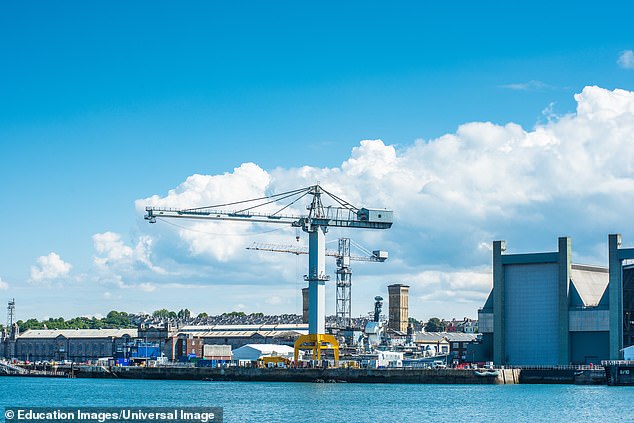
HMNB Devonport is the largest such facility in western Europe and boasts four miles of waterfront including 15 dry docks and 25 tidal berths. The ratio of Chinese restaurants to Indian takeaways near to the facility is a striking 7:1
The recent collapsed prosecution of two British nationals accused of spying for China, after the Government failed to declare Beijing as an enemy, has only served to exacerbate concerns that we are not taking national security seriously enough.
There is a further important factor. In 2017, China’s President Xi passed a controversial new law – with unusual haste and almost zero scrutiny – declaring that every Chinese citizen living anywhere in the world is obliged to answer to the motherland regarding any matter the CCP deems relevant.
Article 14 of the so-called National Security Law declares: ‘State intelligence work organs, when legally carrying forth intelligence work, may demand that concerned organs, organisations, or citizens provide needed support, assistance and cooperation.’
That raises the possibility that the roughly half a million Chinese nationals living in Britain risk appearing to be espionage assets of the so-called Middle Kingdom – whether they like it or not.
Which brings us back to the question of Chinese businesses operating near our military bases.
Could some of them be co-opted by the CCP to pass on information? It sounds fantastical.
But the large number of Chinese takeaways in the vicinity of key MoD sites is certainly curious…
HMNB Clyde
His Majesty’s Naval Base Clyde is perhaps the most secretive site in Britain. For it is here, on the remote Scottish west coast, that the Royal Navy stores and maintains both our nuclear deterrent Vanguard-class submarines and our so-called ‘hunter-killer’ subs responsible for tracking down and destroying enemy vessels at sea.
Britannia once ruled the waves, but today our most lethal aquatic presence lurks hundreds of meters below the surface – and these fearsome machines are deployed and controlled from HMNB Clyde.
The base itself is nestled within Gare Loch, 40-miles from Glasgow, near the remote town of Garelochhead.
So why are there a remarkably high number of Chinese restaurants positioned near the shore at the mouth of Gare Loch through which all vessels leaving HMNB Clyde must necessarily pass?
The ratio of Chinese restaurants to Indian ones is around 2.9:1 around the base.
The Daily Mail has chosen not to list the precise numbers or name the individual establishments.
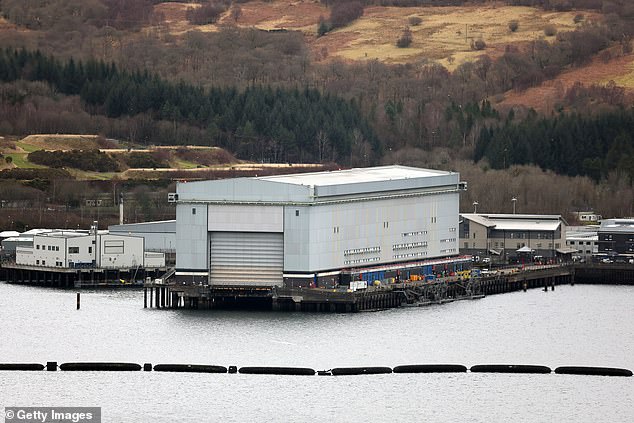
His Majesty’s Naval Base Clyde is perhaps the most secretive site in Britain. For it is here, on the remote Scottish west coast, that the Royal Navy stores and maintains both our nuclear deterrent Vanguard-class submarines and our so-called ‘hunter-killer’ subs responsible for tracking down and destroying enemy vessels at sea
HMNB Devonport
At the other end of the country in Plymouth lies the vast Devonport naval base.
At 650 acres, this is the largest such facility in western Europe and boasts four miles of waterfront including 15 dry docks and 25 tidal berths.
As home to the Navy’s largest amphibious vessels as well as undisclosed numbers of warships and research and reconnaissance units, the base is of the utmost military significance.
Intriguingly, Devonport is the central training hub for frontline operations including the Fleet Operational Sea Training organisation, which delivers standards oversight for the Navy. In other words, what goes on in Devonport is highly secretive and of great interest to our enemies.
And so it is interesting to note that there happen to be many Chinese takeaways in close proximity to the base.
The ratio of Chinese restaurants to Indian takeaways is a striking 7:1.
HMNB Portsmouth
The British naval base in Portsmouth has been operating for more than 800 years and today provides safe harbour to two-thirds of the Royal Navy surface fleet, including HMS Queen Elizabeth and HMS Prince Of Wales, the nation’s two premier aircraft carriers, as well as Type 45 destroyers used to combat enemy aircraft, described by the Navy as the ‘pride of the fleet’.
These 150 metre-long beasts deploy for nine-month periods during which the 260-strong crew munch their way through 75,600 eggs, 19,000kg of potatoes and 54,720 sausages.
What isn’t on the menu in the mess, however, is egg fried rice or sweet and sour chicken.
Ironic, perhaps, considering there are no fewer than 2.3 Chinese takeaways near the base for every Indian establishment in the same area.
Aldershot Garrison
There’s a reason Aldershot is known as the ‘Home of the British Army’.
For 150 years this Hampshire hideout has been at the centre of military command and control – so much so that the Aldershot Garrison was targeted by a 1972 IRA bomb which killed six civilian staff and a military chaplain.
A car laden with explosives was left beside the officer’s mess of the 16th Parachute Brigade, though thankfully no soldiers were eating at the time.
Today the garrison is a fully-fledged military township with more than 10,000 residents including almost 4,000 soldiers.
There are also some 1.7 Chinese restaurants within reach of the garrison, for every one Indian eaterie.
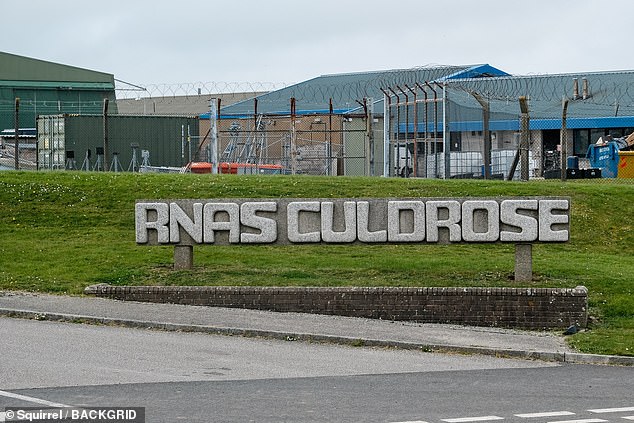
RNAS Culdrose, the home of Britain’s fleet of Merlin anti-submarine warfare helicopters
RNAS Culdrose
Few may have heard of it, but Britain would be as good as defenceless without RNAS Culdrose down in Cornwall, a maritime base home to 3,000 service people.
For it is here that Captain James Hall RN looks after the country’s fleet of Merlin anti-submarine warfare helicopters.
In the neighbouring area – with a population of 11,000 – the ratio of Chinese to Indian restaurants is around 2:1.
Combermere Barracks
Windsor Castle is not only a spectacular royal residence, but the town is home to Combermere Barracks, which houses certain troops from the Household Cavalry Regiment, one of the most storied and prestigious in Britain, and the 1st Battalion of the Welsh Guards, founded by George V during the First World War.
The Welsh Guards – with their iconic red tunics and black bearskin caps – play a pivotal ceremonial role in in military
life and are therefore privy to sensitive information about the whereabouts of high-ranking figures, including members of the Royal Family.
There are far more Chinese restaurants compared to Indian establishments within about a mile and a half of Comber- mere Barracks – at a ratio of around 2.7:1.
Surprisingly, all the Chinese spots are near Windsor Castle itself – though it’s difficult to imagine His Majesty will be issuing the establishments with a Royal Warrant any time soon.