RESIDENT doctors’ support for strikes appears to be dwindling as more turned up to work today than in previous walkouts, health leaders say.
A small snapshot poll of trust chief executives by NHS Providers suggests the vast majority of planned care was able to go ahead as so few medics joined the industrial action.
More than three in four arrived for their shift in some places, with the size of picket lines across the country notably reduced, according to other sources.
One boss said it appeared that most had chosen to work or stay at home rather than stand outside hospitals in the rain.
Wes Streeting accused the British Medical Association of ‘inflicting pain and misery on patients’ and holding them to ransom with their demand for a further 26 per cent pay rise on top of the 28.9 per cent resident doctors have already received over the past three years.
The heath secretary told LBC radio the five-day walkout, which started today, is ‘going to set us back’ and warned union ‘activists’ are ‘damaging’ NHS recovery.
The BMA’s strike mandate expires on January 6 but leaders are planning to ramp up the action by holding a walkout every month next year if members back further industrial action, according to the Guardian.
Conservative leader Kemi Badenoch today said she would ban doctors’ strikes if she was in power.
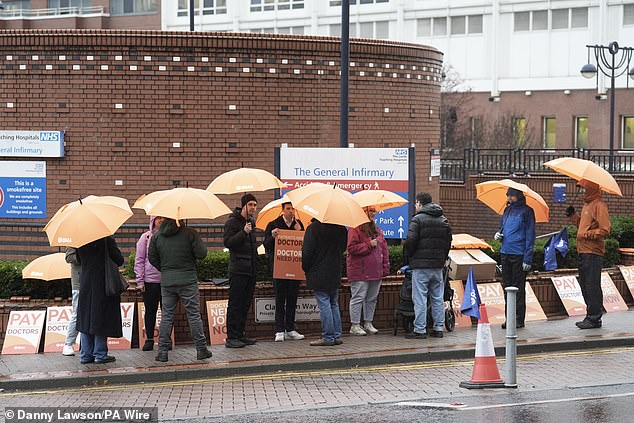
NHS resident doctors outside Leeds General Infirmary
Speaking on a visit in Essex, she said: ‘Just a year ago the Health Secretary said that he had solved the strikes and there wouldn’t be any more.
‘He gave doctors a 28 per cent pay rise – that’s more than anyone else in the public sector got, let alone the private sector. This is now their second strike.
‘It’s putting patients’ health and safety at risk. Conservatives would simply ban doctors’ strikes.’
Mr Streeting had a heated conversation with a doctor, Niraj, from Harrow, North London, during an LBC phone-in, where he said doctors should ‘own’ the damage being done to patients by the strike.
Niraj told Mr Streeting that ‘we all care about patient safety, none of us wants to be on strike, I would rather be at work today’ as he made points regarding a lack of training places and other workforce issues.
Mr Streeting hit back, accusing the BMA of ‘reprehensible behaviour’, adding: ‘To hold patients to ransom and to be out on strike, setting back the NHS, because you don’t think we’re going fast enough, and because the leadership of your union are not honest enough that some of this change takes time, is extremely irresponsible.
‘Don’t tell me you don’t want to be out on strike, because that’s exactly where you are. You made that choice, own it and own the damage it will do to your patients.’
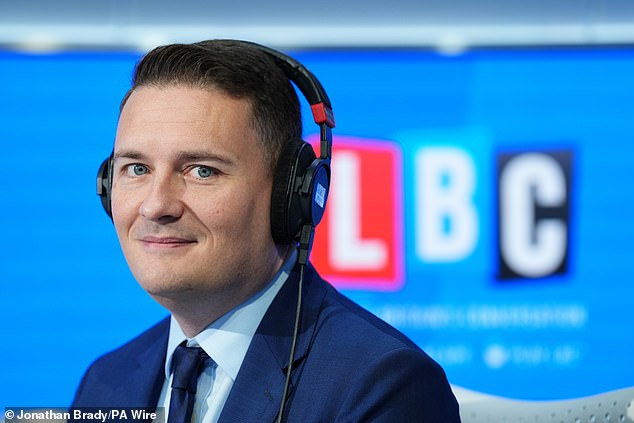
Wes Streeting, secretary of state for health and social care
Mr Streeting said the BMA ‘should have had the courage to put the offer I made them to their members’, which includes extra training places and cash for out-of-pocket expenses such as exam fees.
He added: ‘I don’t believe the BMA are speaking for their members. I think they’re speaking for their activists.
‘Those activists are damaging the NHS recovery, disrupting patients’ lives and they need to own the consequences of their actions.’
The five-day action is the 13th walkout by doctors since March 2023, with the last strike in July estimated to have cost the health service £300 million.
Resident doctors make up around half the medical workforce in the NHS and have up to eight years’ experience working as a hospital doctor or three years as a GP.
The NHS is aiming to continue with at least 95 per cent of the planned activity over the five days.
The last time resident doctors went on strike more than 54,000 procedures and appointments needed to be cancelled or rescheduled, despite the NHS maintaining 93 per cent of planned activity.
Nick Hulme, chief executive officer of the East Suffolk and North Essex NHS Foundation Trust, said it was running 99 per cent of elective operations and 97 per cent of outpatients, and was seeing signs of staff choosing not to strike.
He told BBC Radio 4’s Today programme: ‘We are just checking this morning with both hospitals to see what the numbers are, but we are seeing a higher level of (resident doctors) coming back, and I think it reflects a kind of changing mood both for other clinical staff, but also for our resident doctors, that I think their sense is that they are obviously frustrated in terms of the ongoing dispute, but I think they are voting with their feet and returning to work.
‘We haven’t got the absolute numbers yet, but I get the sense, and certainly in the last strike, we saw more people coming back than seen in previous industrial action.’
Daniel Elkeles, chief executive of NHS Providers, which represents NHS trusts, said: ‘I think lots are saying, “I don’t agree, I’m coming to work.”‘
Professor Meghana Pandit, national medical director of the NHS, told BBC Breakfast there would be an impact on patients, adding: ‘Every strike is devastating, really, for the NHS.’
But she urged patients to keep coming forward for care and to attend appointments unless told otherwise.