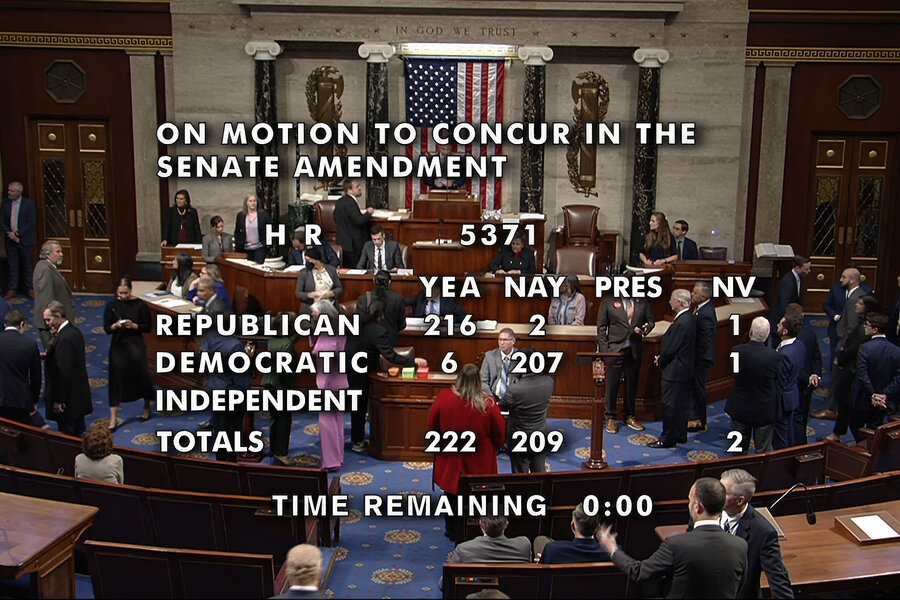
With the House of Representatives voting 222 to 209 on Wednesday evening to pass the Senate’s funding bill, and President Donald Trump signing the legislation in the Oval Office, the longest federal shutdown in U.S. history is officially over.
But turning the federal government back on after six weeks might not be easy. Or instantaneous. The shutdown was felt throughout the country – from sparse dinner tables to missed paychecks from America’s largest employer to upended travel plans. And while the shutdown might have ended legislatively, ripple effects will likely continue as America tries to chart its path forward.
There are logistical hurdles. At least 670,000 furloughed federal employees will be instructed to come back to work. Back pay will need to be sent out for them, and to the 730,000 employees who continued to work without pay. Air travel will need time to get back up to speed (as evidenced by representatives’ 11th-hour efforts to get back to Washington to vote on the legislation on Wednesday – with one congressman riding his motorcycle from Wisconsin while others carpooled). And while Supplemental Nutrition Assistance Program, or SNAP, benefits for nearly 42 million recipients are set to resume, there could be complications as states that gave partial relief calculate outstanding payments for the food program.
Why We Wrote This
With the government shutdown over, the next steps come into view: Turning the federal government back on after six weeks may not be easy, or fast. And new political hurdles lie ahead in a sharply divided Washington.
And, politically, Congress finds itself with an increasingly daunting to-do list at a time of heightened dysfunction. After eight senators on Monday broke with the Democratic Party and Minority Leader Chuck Schumer to vote with Senate Republicans to pass a spending bill that would reopen the government, the party’s weeks of unity have exhibited signs of cracking. Other Democrats have criticized their colleagues for voting to end a shutdown without winning what they were fighting for: an extension of Affordable Care Act subsidies that are set to expire at year’s end.
But the party was successful in elevating the topic as an issue of concern for the American people, and, now, Republicans might find the rising cost of health-care premiums to be a decisive issue for them ahead of the midterm elections next year. Given that this legislation only funds most of the government through Jan. 30, the parties could very well find themselves at another similar impasse in less than three months.

“We just had the longest shutdown in our history, we haven’t resolved what’s going to happen with the health care subsidies, we are borrowing $2 trillion a year, we have no budget,” says Marc Goldwein, the senior policy director for the Committee for a Responsible Federal Budget, a nonprofit group that supports deficit reduction. “So sure, we can pat ourselves on the back for turning the lights on, but the bill does not have any long-term solutions to anything: appropriations, health care, debt.”
Instead, while “essential” activities from defense to Social Security continued as usual, the shutdown, which began on Oct. 1, disrupted a range of federal activities that affect the economy, including scientific research and small-business loans.
“We could have kicked the can to now and now be passing real appropriations. Instead, it took us six weeks to even get to the point of kicking the can,” Mr. Goldwein says. “We had the shutdown kind of for nothing.”
How the bill restores government funding
Though the bill funds most of the government at 2025 levels through Jan. 30, a handful of agencies will be funded through the end of fiscal year 2026: the Department of Agriculture (including SNAP), the Food and Drug Administration, the Department of Veterans Affairs, and military construction.
The bill also requires back pay for all federal employees who were not paid during the shutdown, and nullifies any reductions in force, or RIFs, that were sent out during the shutdown. Any affected employee is to be reinstated within five days of the bill becoming law.
Some other notable elements of the bill include:
- A $603 million increase in funding for the Special Supplemental Nutrition Program for Women, Infants, and Children (known as WIC).
- A provision would allow senators to sue the government for up to $500,000 if his or her data was obtained during an investigation without proper notification. This would allow eight Republican senators, whose phone records were examined during an investigation into the Jan. 6, 2021, attack on the Capitol, to sue. Some House Republicans have come out against this provision, and Speaker Mike Johnson says he’ll hold a vote to repeal the provision next week.
- Heavy restrictions on hemp-derived products, which had previously been legalized in the 2018 Farm Bill.
- Extra funding for officials’ security, including $203.5 million in additional funds for members of Congress and $28 million for Supreme Court justices.

A dent in economy
The shutdown will take a bite out of the economy amid an already slowing growth trend.
“Short-lived shutdowns are usually invisible in the data, but this one will leave a lasting mark,” writes Gregory Daco, chief economist at the accounting firm EY, “both because of its record length and the growing disruptions to welfare programs and travel.”
Forecasters at the Congressional Budget Office have estimated that a six-week shutdown would shave fourth-quarter gross domestic product by around 1.5 percentage points. That would be largely offset by a reopening rebound in the first quarter of 2026, potentially leaving little long-term impact on the economy.
Related problems, however, are delays and gaps in economic data collection caused by the shutdown. The Federal Reserve relies on official surveys on inflation, unemployment, and consumer spending to inform its setting of interest rates. The government has already missed two monthly jobs reports and the collection of inflation data for October.
White House Press Secretary Karoline Leavitt said on Wednesday that October’s jobs and inflation data will most likely not be issued because the window for collection has passed. “Democrats may have permanently damaged the federal statistical system with October CPI and jobs reports likely never being released,” she said.
These gaps will affect how the Fed weighs another possible interest-rate cut in December: Chair Jerome Powell has compared the uncertainty caused by a lack of economic data with driving in fog when it’s prudent to “slow down.” He told an Oct. 29 news conference that “the data may come back. But there’s a possibility that it would make sense to be more cautious about moving.”
Restoring normalcy to the skies
Staffing of air traffic controllers had already begun to improve after the Senate passed the funding legislation, Transportation Secretary Sean Duffy said in a news conference on Tuesday at the O’Hare International Airport in Chicago. The number of staffing triggers – issued by the Federal Aviation Administration when staff levels are deemed too low – decreased to four from 81 on Saturday. Though Mr. Duffy expressed relief then that controllers are starting to “feel more hopeful” about the end of the shutdown and are coming into work, he noted that the United States had a shortage of roughly 2,000 controllers even before the shutdown. Laurie Garrow, an expert on civil aviation at Georgia Tech University, estimates the shortage to be between 3,000 and 3,500 based on rising demand for air travel.
“We need more of them to come into the profession,” said Mr. Duffy. “This shutdown is going to make that more challenging, more difficult for us to accomplish that goal.” The shutdown has depressed both employee recruitment and retention, contends Mr. Duffy, with young employees less willing to enter a profession when they see they might have pay gaps, and older employees less willing to postpone their retirements.
Between 24 and 48 hours of the government reopening, air traffic controllers will receive 70% of their missed pay, said Mr. Duffy, with the rest coming within a week. He didn’t give an exact time for when the mandated flight reductions would be rolled back from the current 6% level. He said flights could be restored incrementally.
“It will take a day or two for the airline industry to get operations back to normal. … All the planes, pilots, and flight attendants need to get back in sync,” says Professor Garrow, noting that a technology outage last year took Delta Air Lines five days to resume normal service. “We’re still in a situation where our air traffic control system is more fragile than in the past.”
“Months to catch up”
The shutdown put a pause on a wide range of activities, from small-business loans to billions of dollars in military and other federal purchases, as well as various grants, such as ones that help Americans address lead hazards in their homes. Another lingering effect is on scientific research.
“Even for shutdowns lasting a few days, it can take science agencies months to catch up on the backlog of paperwork, paychecks and peer review panels before they return to regular operations,” wrote Kenny Evans, a physicist and fellow at Rice University’s Baker Institute for Public Policy. And beyond government agencies, the effects are felt in universities relying on federal funding for research.
Federal aid that expands early childhood education was also affected by the shutdown. Head Start staff members will face at least a month of backlog, says Michelle Haimowitz, executive director of the Massachusetts Head Start Association. That includes October grants that were never disbursed, as well as 135 others scheduled for November that were delayed by the shutdown. Officials will also need to determine how many of the furloughed staff plan to return. “Head Start is not a light switch,” she says. “It can’t be turned off and on automatically.”
And while Wednesday evening might have brought the end of the government shutdown, it also teed up the next controversy in Washington. After Democratic Rep. Adelita Grijalva of Arizona was sworn into office, she gave the final 218th signature needed to force a vote in the House on releasing files related to convicted sex offender Jeffrey Epstein. Speaker Mike Johnson says he plans to hold a vote next week on the full release of related Justice Department materials.
Staff writer Troy Aidan Sambajon contributed reporting for this article.