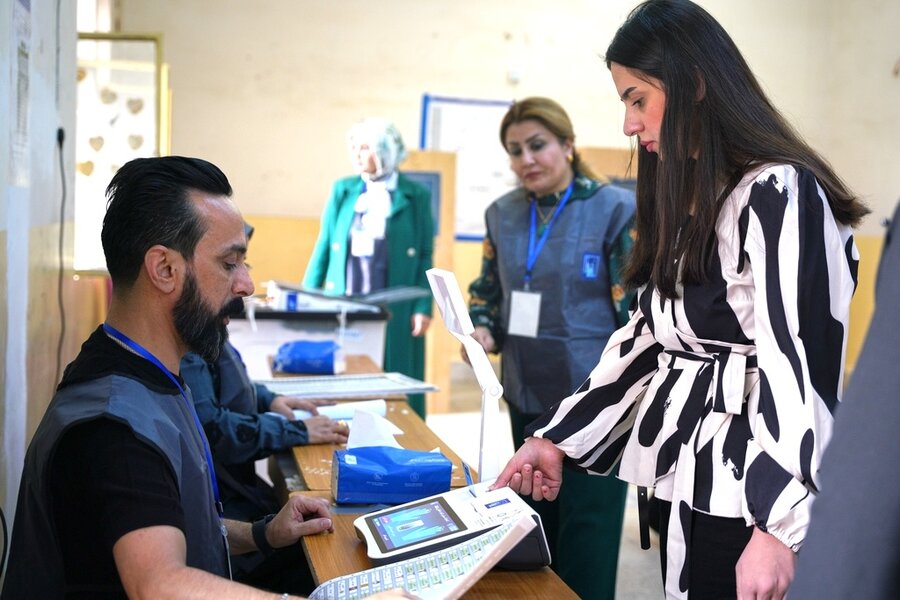
Americans often forget one reason for the 2003 decision by then-President George W. Bush to oust a dictator in Iraq: to plant a model democracy in the Middle East to help fend off terrorist groups like Al Qaeda after the 9/11 attacks of 2001. On Tuesday – about two decades after Iraqis regained a right to free and fair voting – the country held its seventh parliamentary election. Despite public gloom over a largely dysfunctional government, voters achieved a few heartening results.
Nearly a third of candidates were women, more than twice the number in the 2021 election. Despite calls for an election boycott, turnout exceeded 55%, up from 41%. The campaign and the balloting were orderly. And a popular prime minister, Mohammed Shia al-Sudani, saw his bloc win the largest number of seats in parliament.
“The new Iraq, for better or worse, has become a model for democracy in the region,” Michael Rubin, a fellow at the American Enterprise Institute, wrote just before the election.
One reason is that more young people have embraced an Iraqi and civic identity over their religion or ethnicity. Political power may still be divided up among Shiites, Sunnis, Kurds, and other groups under the constitution. Yet most Iraqis today came of age after the Saddam Hussein dictatorship. They seek inclusive, clean governance, reflected in the mass protests of 2019 and 2020. “If [political] incumbency is synonymous with life tenure in most Arab states, it is not in Iraq, where Iraqis punish a person deemed ineffective and corrupt,” stated Mr. Rubin.
Iraq’s strides in just one generation are notable because it still contends with pressure from Iran. Because of its relative stability, however, Baghdad has also become a balancing force among powers in the region.
“The larger picture is one of rising but bounded Iraqi agency, in which the state can sometimes resist and can sometimes broker, but sometimes has to concede to keep the [regional] equilibrium intact,” wrote Yerevan Saeed, an Atlantic Council fellow.
All of this is not to justify the invasion or the postinvasion mismanagement that led to a violent insurgency. Iraqis have seen some of the worst in Middle East violence. If they keep choosing peaceful if flawed democracy, it may because they know certain qualities – freedom, equality, accountability, and pluralism – can help ensure tranquility.
“The legislative elections are a peaceful means of change, and they are the sole guarantee against violence and chaos,” wrote one Iraqi, Ahmed Akho Mazal, to his 57,000 followers on social media. “The greater the popular participation is, the stronger and more stable the political system will be.”the popular participation is, the stronger and more stable the political system will be.”