This article is taken from the November 2025 issue of The Critic. To get the full magazine why not subscribe? Get five issues for just £25.
“Pepys should be enjoyed late at night, with a glass of port in your hand.” That was something said by an old professor of mine in passing. And he was right. When I began to read the Diary, it was hard not to be charmed by Pepys, as many have been before, for his “unrelenting curiosity and his gift for evocative detail” in his accounts of what he saw as “an eyewitness to major historical events and court machinations”, often with unintentionally hilarious honesty. But in her latest book, Kate Loveman asks whether we are right to be amused by the writings of a sexual predator.
As a seasoned scholar of Pepys, Loveman is well placed to ask such a question. She is one of the few in the world capable of reading the system of shorthand Pepys used to prevent his wife and servants from reading the Diary. She edited what is perhaps the best abridged edition of it available today. In this book she sets out to do two things, and does them very well.
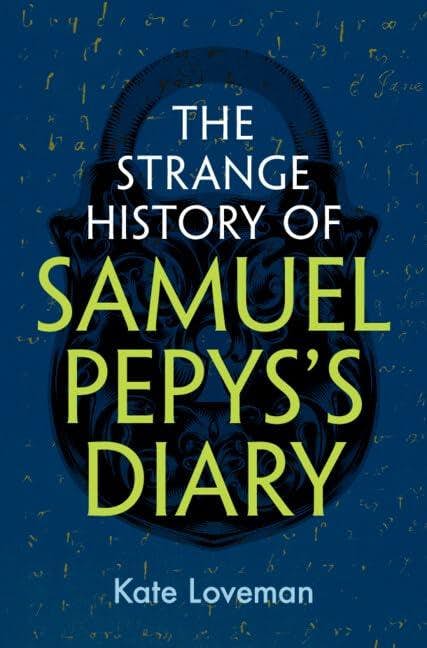
The first is to provide a biography of the Diary itself and its afterlife. This involves when and how it was written, along with the debated question of why a man would write something “whose contents, had they become known, would have destroyed his marriage, ended his career, and quite possibly seen him arrested”.
Why did he choose to record so minutely “court scandals, his sex life, and his bowel movements”. Equally difficult is the question of why he chose to include the Diary amongst the volumes of the neatly-prepared Bibliotheca Pepysiana that he bequeathed to Magdalene, his old Cambridge college.
But the strange history referred to in the title refers largely to the afterlife of the Diary, which began with its discovery a century after it arrived at Magdalene, how it was released in successively less censored editions over the years, until becoming available in full only in 1976, and the unexpected things that readers have done with the Diary since its first publication.
The Diary has “inspired parodies, historical novels, TV drama, interpretive dance, and whisky adverts … Pepys — a naval administrator, gossip, clotheshorse, and routinely unfaithful husband — has come to stand as both the personification of the Restoration and, when needed, as a manifestation of an enduring national character”.
His famous entries during the Great Fire of London have even made him a regular feature of the primary school curriculum. We can only imagine what he would make of the animated GCSE-Bitesize Pepys who narrates what he saw and recorded during the fire, including his notorious decision to bury his parmesan cheese and wine in the garden.
A new generation of readers discovered Pepys during the pandemic. When he bravely remained at his post in the Navy Office during the plague of 1665, he saw scenes of a deserted and desolate London that sounded familiar. As he wrote in one entry: “But Lord, what a sad time it is, to see no boats upon the River — and grass grow all up and down Whitehall-court.”
Loveman notes, “Nineteenth-century discussions of Pepys’s diary had often implied that readers should look generously on the diarist’s parsimony, selfishness, vanity, and other shortcomings … As evidence of his honesty, it was amusing and, in recognising his lapses, readers might rise above them.”
But when his descriptions of the Great Fire of London became vividly real for those living through the firestorms of the Blitz, “responses to the diary shifted from the idea that readers should excuse Pepys, to the idea that Pepys excused readers”. Pepys’s faults and vanity, his “failure to live up to the ideals of virtue, nobility, and heroism … was psychologically comforting” to readers during the War.
In telling the story of how the Diary came to be published and read in varied ways, Loveman has a Pepysian eye for personal anecdotes and small details to enliven a story that could have easily turned into a dull, academic “reception history”.
The disputes she describes between the co-editors who brought the full and unabridged Diary into print in the 1970s — the brash shorthand expert William Matthew from California and the staid Restoration historian from Cambridge, Robert Latham. Both their disputes with each other and with their publishers would provide perfect material for a campus novel along the lines of David Lodge’s Changing Places.
Loveman also rescues from oblivion the role played by Ann Jackson, administer of Pepys’s estate after her husband (Pepys’s nephew) died. The Diary might not have survived without Jackson, “who ensured the library reached Magdalene” and “agreed the covenant that bound the college to Pepys’s terms”.
But “it would have been easy to neglect his wishes, for there were other demands on her. She had seven small children to care for, whose fortunes might have been better served by ‘dissipating’ the library by auction — the prospect that had so alarmed Pepys”.
It is in her final chapter that Loveman really gets to her second task, which is to focus on “what Pepys’s diary does not say: what he leaves out, misrepresents, or covers up”. Her concern is that Pepys’s readers have often downplayed or overlooked the evidence that he was a sexual predator by their own conniving prejudices, by Pepys’s use of euphemisms and by the Diary’s misleading reputation for complete frankness.
If a tirade against “academia gone woke” is expected here, dear reader, I must disappoint. What Pepys’s readers have often downplayed as his naughtiness, as if he were a petticoat-chasing buffoon, a Restoration-era Benny Hill, glosses over deeds that were coercive, abusive and sometimes violent. His “anatomically specific descriptions of who did what to whom” were considered too obscene to be included at first, but even when they were published later on, their full meaning was not immediately understood.
Pepys added another layer of secrecy to his shorthand by using a mixture of French, Spanish and Latin (the languages of lust, naturally) when describing his groping of underage servants and ravishing of the wives of men seeking a promotion from Pepys. Loveman argues convincingly that, reading between the lines, Pepys frequently “sought gratification from women and girls who had to either physically defend themselves or who were not in a position to resist coercion”.
Loveman’s book might not be suited for someone without a prior interest in Pepys. But she guides those who have already dipped into the Diary through the story of how it reached us and how others have read it, and she does so in a compact, clearly written book.
She handles the more unsavoury aspects of his life fairly, but in a way that leaves an uncomfortable thought: that the whitewashing of Pepys’s treatment of women not only concealed his vices but revealed those of his readers.