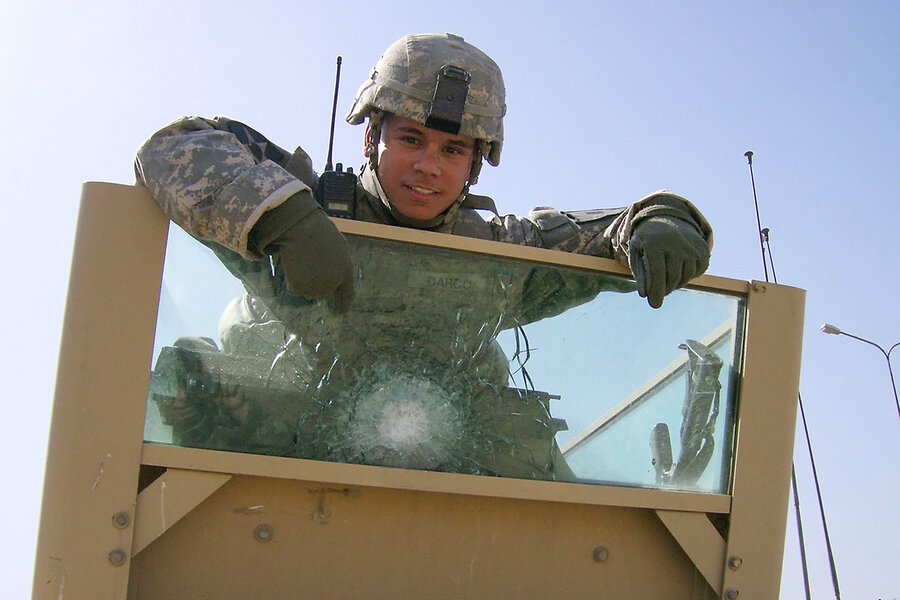
Jose Barco was the youngest soldier in his unit, patrolling one of the most notoriously dangerous stretches of highway in Iraq in 2004, between Fallujah and Ramadi, when a car bomb exploded.
Mr. Barco, who enlisted in the Army when he was 17 years old, lifted the searing wreckage to free two U.S. troops trapped beneath. He saved their lives, witnesses say, sustaining third-degree burns and earning a Purple Heart.
Despite his wounds, Mr. Barco had the presence of mind to radio for help, says David Nash, a soldier who was there. “It’s one of the most impressive things I’ve ever seen.”
Why We Wrote This
Non-citizen U.S. military members have been essential to the United States since the country’s founding. But if they commit a crime and serve time in prison following an honorable discharge, should they then face deportation as well?
Born in Venezuela to Cuban exiles who immigrated to the United States when he was 4 years old, Mr. Barco then deployed for a second tour in Iraq, serving another 15 months in combat. But upon his return to the U.S., Mr. Barco made a decision that would change the course of his life: He fired his gun at a house party in Colorado Springs, hitting a bystander – a pregnant teenager – in the leg.
His defense team says he suffers from post-traumatic stress and an untreated traumatic brain injury sustained during combat. His victim, whose child was born healthy, has said on the record she’s “haunted every day” by the shooting.
Two decades after becoming a decorated American military member, and after 15 years behind bars paying for his crime, Mr. Barco is now in U.S. deportation proceedings.
Mr. Barco’s story, though complicated and layered, is taking place at a moment when the U.S. executive branch is laser-focused on deporting record numbers of immigrants – especially those with criminal records. His case raises questions about whether noncitizen veterans who have pledged their lives to protect the nation deserve mercy for reckless choices they make after their service ends, and whether deportation for their crimes amounts to double punishment.
“Even natural-born citizens who serve in the military are not exempt from the nation’s laws,” says Stephen Biddle, a professor of international and public affairs at Columbia University. “You can earn the Congressional Medal of Honor in combat as a natural-born citizen and still go to jail for a crime.”
Typically, like any other citizen, American veterans convicted of crimes serve their sentences and then are set free. But those veterans without documented and legal U.S. citizenship face the additional threat of deportation.
Who deserves citizenship?
Non-U.S. citizens have been integral to the country’s military efforts since the nation’s founding, and by the 1840s made up 50% of all military recruits. By World War II, Congress had fast-tracked the naturalization process for noncitizens who served honorably in the U.S. military.
About 3% of active-duty troops are noncitizens. But some veterans never become citizens – often because of paperwork errors, misunderstandings of the process, or, in some cases, false promises made by recruiters.
“Soldiers raise their right hand” in their oath of enlistment, which includes swearing to defend the U.S. Constitution against all enemies, says Diane Vega, who runs the nongovernmental organization Repatriate Our Patriots in El Paso, Texas, which supports deported vets and those at risk of deportation. “It’s very similar to the oath of naturalization. I understand when veterans say, ‘But I thought I was a U.S. citizen. I thought because I said I would die for this country, that that was enough,’” she says.

After hearing that Mr. Barco, a permanent resident when he enlisted, had been picked up by Immigration and Customs Enforcement (ICE) officials, retired Sgt. Ryan Krebbs, a combat medic who treated Mr. Barco in Iraq, says his first reaction was, “How are you not a citizen yet?”
Through a WhatsApp group, he mobilized some two dozen fellow soldiers who had served with Mr. Barco to support him.
Ms. Vega, who served in the U.S. Air Force, first heard about the U.S. deportation of veterans when she began working on her master’s thesis in 2015. “I went through all the assumptions the general public does: They must have done something really bad to get deported. This falls on them. They should have known better.”
But through meeting a community of deported veterans across the border in Ciudad Juárez, she realized her assumptions were wrong. Few of the vets she met had committed violent crimes; many were caught in possession of drugs. Studies show that veterans have a slightly higher incidence of substance use disorders, often related to battle trauma or injuries.
Some crimes that aren’t considered felonies under state law are considered “aggravated felonies” under federal immigration law, and can lead to deportation proceedings.
This case is an outlier. “Most of our clients have nonviolent crimes, and there isn’t a specific victim,” says Tran Dang, founder and executive director of The Rhizome Center for Migrants in Guadalajara, Mexico, which supports deportees from the U.S. and has consulted on Mr. Barco’s case.
His case has received a lot of media attention, dividing public opinion. His critics say that a man who fired a shot into a crowd deserves no absolution, regardless of his prior service to the country.
One in 3 veterans report having been arrested, compared with 1 in 5 people among the nonveteran population, according to data cited in a 2023 report by the Council on Criminal Justice, an independent think tank. Serving in the armed forces on its own doesn’t lead to criminal activity, the report emphasizes, but there are risk factors, like combat exposure, that can make veterans more susceptible. A traumatic brain injury increases the odds of getting involved with the justice system by 59% among veterans, according to the report.
According to his American wife, Tia Barco, Mr. Barco says he has no memory of shooting the gun at the party, where he’d been a guest but was kicked out with his friends after reportedly firing a gun into a ceiling. Under medication that clouded his decision-making, he says, he fired his gun again as they were driving past the front porch of the house, where a group of people was gathered. That’s how his victim was shot.
A model prisoner
In prison, Mr. Barco taught GED classes to those also behind bars, and, after serving 15 of his 50-year sentence at the Colorado State Penitentiary, he was paroled for good behavior.
As he stepped out of the prison gates Jan. 21, 2025, the day after President Donald Trump started his second term in office, Mr. Barco was picked up by ICE and put in detention, where he remains today. He never got his U.S. citizenship because the paperwork for his application, which he submitted after his second tour, was lost, says his legal team.
“Most people are deported after completing their sentences,” says Ms. Dang.
“It’s sort of like triple jeopardy. You just keep getting punished for the same thing,” she says of U.S. policy toward noncitizen vets. If the first punishment is prison, the second is deportation, and the third is being forced to adapt to a country that, in most cases, the veteran has never known.
Retired Lt. Col. Michael Hutchinson was a leader in Mr. Barco’s battalion and says he is sensitive to the concerns of the victim and her family, who may want to see him deported. She did not return several attempted phone calls requesting an interview.
“If I was in their shoes, I can’t say that I would think differently” from the argument that he deserves to be deported, he says. “There are enough bad people who have served in uniform – you can’t give everyone a free pass just for serving.”
At the same time, Mr. Barco’s case feels different, he says, because his combat wounds may have contributed to his crime. “Basically, everyone thought of him as a hero. And he was just the nicest person – the opposite of the usual blustery infantry guy.”

Stateless
Mr. Barco’s pro bono legal team is arguing that he will face harm amounting to torture should he be deported to Venezuela. It is one of three countries, along with Cuba and Mexico, that ICE has named as likely destinations for him.
Mr. Barco was born and lived in Caracas for four years until his Cuban parents – his father, a dissident, was imprisoned for opposing Fidel Castro’s communist regime – were granted political asylum in the U.S.
All of his family is now in the U.S., Mr. Barco says. He has no ties to Venezuela or Cuba.
With his military background and training, officials in Havana or Caracas “could think I’m a plant, or trying to infiltrate the government or assassinate the president,” Mr. Barco told immigration Judge Tyler Wood.
These risks are compounded at a moment when Mr. Trump said he authorized CIA action in Venezuela, and that President Nicolás Maduro’s days in power could be numbered.
After ICE detained Mr. Barco, he waived his right to fight deportation at his initial hearing Feb. 12 in immigration court, without counsel, says Ms. Barco. He was sent to Honduras, where immigration agents from Venezuela processed deportees from the U.S. But they rejected him. They questioned his accent, which they said was Cuban, and his birth certificate, which they said looked fake.
That could be enough to have him taken into custody in Caracas, or for him to be rendered stateless and unable to leave, his legal team says. He also wouldn’t have access to the Veterans Affairs care he has earned, like other deported vets.
Mr. Barco was asked in immigration court why he originally waived his right to fight deportation.
“I guess you could say I was desperate,” he said. “I just wanted to be free – as I still do.”
His lawyer and fellow veteran Kevin O’Connor Jr. sees the best-case scenario as deportation to Mexico, where there is more of a network for deported veterans.
But life in Mexico can be difficult for deportees, who receive little government support. The former soldiers’ familiarity with weapons and military training makes them easy targets for criminal recruitment, too.
Bringing veteran deportees “home”
Along a ditch near the Aurora, Colorado, detention center where Mr. Barco is being held, a candle of the Virgin of Guadalupe, an important figure among Latin American Catholics, burns as Mr. Barco’s legal team convenes a press briefing.

Anna Grobe/The Christian Science Monitor
Anna Strout, a former mayor of Grand Junction, Colorado, who now serves on the City Council and is volunteering her time on Mr. Barco’s case, says that emphasizing his military service is not to elicit sympathy or compassion. Still, his service should matter, she says. If he had followed the protocols for expedited citizenship after an honorable discharge, Mr. Barco would have repaid his debt to society and been paroled by now.
“If you’re an immigrant, you’re never forgiven. You can never do enough time,” says Ms. Dang. “We have this whole belief [in the U.S.] that you can rehabilitate. But it doesn’t apply to immigrants,” she says. The message the U.S. is sending is, “Immigrants can’t make mistakes, and they can’t be forgiven.”
Veterans outside the U.S. cannot access their VA benefits, and some morbidly joke that the easiest way to gain citizenship is to die. Despite deportation, those who served honorably are entitled to a military burial in the U.S., and families can sometimes apply for posthumous citizenship on their behalf.
There have been efforts in recent years to bring deported veterans back to the U.S., too – from a proposed congressional bill in 2023 to protect honorably discharged vets from deportation and to expedite their naturalization process, to a Biden-era program called the Immigrant Military Members and Veterans Initiative (IMMVI).
That program, launched in 2021, succeeded in bringing more than 100 deported veterans or veteran spouses back to the U.S., mostly through humanitarian parole. However, many of those who benefited from the IMMVI program are still living in limbo, required to renew their parole typically every year. Given the current administration’s focus on deportations, advocates for deported veterans believe this program is no longer a priority.
In late September, the immigration court verdict arrived for Mr. Barco: He lost his case and has once again been ordered deported.
In his ruling, the judge did not specify where Mr. Barco is to go. But the removal process, his lawyer says, could start any day.
“He says it was the worst thing he’s ever done. He’s very ashamed,” says his wife, Ms. Barco.
Yet she also says she worries that his fight for justice has been challenged by the politics around immigration in the U.S. “We don’t want him to end up somewhere as an example.”