It’s over for Keir Starmer. Don’t take my word for it. Don’t even be guided by the polls, which couldn’t be more dire for him or his party. Just speak to his own MPs.
The honest ones will tell you (off the record for now, though not for much longer) that within the Parliamentary Labour Party the only matter still to be determined is not if Starmer should go but when.
Some think they should wait until after next May’s elections, which will be catastrophic for Labour in England, Scotland and Wales, before giving him the heave. That’s currently the majority view on the backbenches. Others argue that it’s pointless to prolong the pain.
They want to oust him in the New Year, when it will be obvious beyond any doubt that the upcoming Budget, which will have Starmer’s fingerprints on it as much as those of Chancellor Rachel Reeves, has gone down like a lead balloon. That’s now the mood gathering momentum.
Whatever the differences on timing, a clear consensus has emerged among Labour MPs: Starmer isn’t just useless at politics (they rumbled that a while back), he is useless at government, which becomes all the more apparent with every passing week.
That’s why the Prime Minister is now living on borrowed time.
The past week provided fresh evidence of his government’s systemic incompetence and his own growing irrelevance. Inexplicably, Starmer decided at the last minute to make a flying visit to yet another climate change conference, this one in sunny Brazil.
Exactly why, remains something of a mystery, other than the fact that he regularly grabs any excuse to leave these shores, even for just an away-day in another hemisphere.
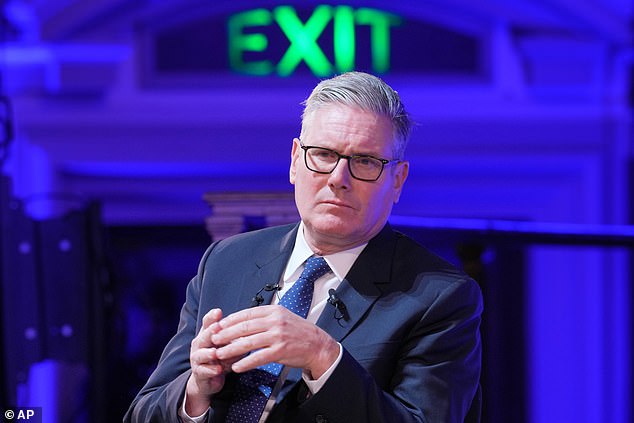
A clear consensus has emerged among Labour MPs: Starmer isn’t just useless at politics (they rumbled that a while back), he is useless at government, writes Andrew Neil
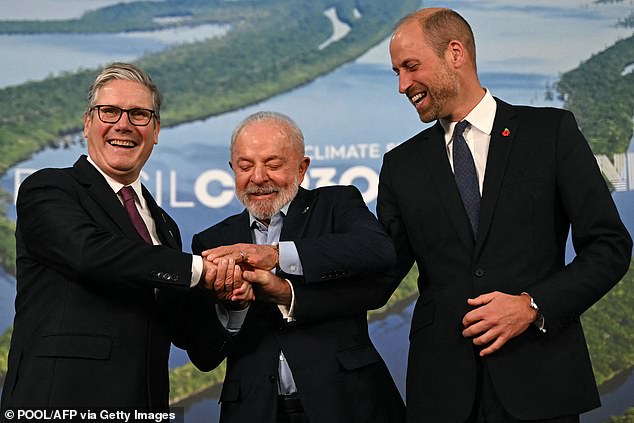
Starmer decided at the last minute to make a flying visit to yet another climate change conference, this one in sunny Brazil – where his interesting three-way handshake with Prince William and Brazil’s President Luiz Inacio Lula da Silva took place
It certainly served no purpose. He was on the ground for barely 24 hours. The leaders of the world’s biggest emitters of carbon dioxide – China, America, India and Russia – couldn’t be bothered to make the trip.
So a bit player like him was hardly likely to make a difference. These global gatherings are past their sell-by date anyway, mere jamborees now for green grifters and Net Zero zealots Starmer couldn’t even contribute to Brazil’s latest wheeze for extorting tens of billions out of richer countries – a tropical rainforest fund – because the Treasury had told him there was no money left for such things after he’d paid Mauritius billions to take the Chagos Islands off our hands (a costly, unnecessary, self-inflicted mistake if ever there was one).
He even had to endure the ignominy of being told that, a year after he’d launched it with a flourish, no other country wanted to join his British-led ‘Clean Power Alliance’ of Net Zero enthusiasts – a project marred by ‘typical inertia and confusion’, says a senior Whitehall official involved in it.
Back in gloomy old Blighty, David Lammy, who doubles as Deputy Prime Minister and Justice Secretary, was disappearing down the plughole of his own serial stupidity in the midst of yet another prisoner-release scandal. Starmer, of course, being 4,600 miles away, was in no position to rescue him.
But more than just the future prospects of Ludicrous Lammy are at stake.
The whole Starmer project is unravelling at warp speed.
For most of this year Labour has struggled to stay above 20 per cent in the polls, itself a remarkable falling off from the 34 per cent it won in last year’s General Election. Suddenly, even 20 per cent is beyond its reach.
In recent weeks Labour’s poll ratings started to slip into the teens, joining the Tories in extinction territory. The latest poll puts Labour in an unprecedented fourth place on a paltry 15 per cent, not just way behind Reform on 33 per cent but behind even the Greens (18 per cent) and the Tories (16 per cent).
Labour is now haemorrhaging support on its Right to Reform and on its Left to the newly revitalised Greens.
And remember this is all before Labour whacks up our taxes – breaking a solemn manifesto promise in the process – in the upcoming Budget.
Who knows what fresh polling horrors await it after that?
At Labour’s annual conference in Liverpool just over a month ago, the party largely ignored the Tories and trained its big guns on Nigel Farage and his Reform UK Party. It has kept up the bombardment ever since. Its reward for all its invective has been to watch Reform climb even higher in the polls.
I asked one Labour grandee this week what Plan B was. ‘There isn’t one,’ he snapped. To those Labour MPs who told me at the end of the summer things couldn’t get worse, I say to them – they just have.
It is an uncomfortable truth – I don’t blame the party for not wanting to acknowledge it – but the harsh reality is that Labour is now too far gone to recover.
There will be no comeback, no resurgence, no clawing back of support bit by bit. They have plumbed the depths too deeply for any kind of renaissance to be realistic. It’s over for Labour as well as Starmer, however far away the next election is.
The wiser heads in the party accept that ditching Starmer is unlikely to revive Labour’s fortunes. But they have developed a visceral dislike of the PM bordering on hatred and they want to see the back of him. They know there is no transformative alternative leader waiting in the wings – but have concluded they have nothing to lose by trying someone else. Labour’s ‘soft Left’, now the dominant force in the parliamentary party, thinks a less technocratic, more socialist leader would help shore up its Left flank and see off the danger of defection to the Greens or even Jeremy Corbyn’s new party (should it ever see the light of day).
It might. But I suspect Labour’s woes are too fundamental, too systemic for a fresh face or a new approach to make much difference.
And not just Labour. It is a remarkable feature of our current politics – making them all the more unprecedented – that for all Labour’s litany of woes, it has not led to the rebound of the Conservatives.
What we used to regard as our two major parties are locked together in a historic dance of death. To resort to a good Scottish word, the British people are thoroughly scunnered with both Labour and the Tories.
That won’t change any time soon. The more conservative-minded are fleeing to Reform, the more radical to the Greens and other Leftish forces. The centre ground is becoming a lonely place in British politics, as it already is in America and France.
There will be much satisfaction in seeing Labour and the Tories getting their just deserts. But also some danger: we’re keen to throw out the ‘old’, but not yet sure what sort of ‘new’ we’re ushering in.
Yesterday, an editorial in this newspaper highlighted a study revealing how we’ve become a much more polarised nation. Mass immigration, culture wars, identity obsessions, economic inequality made worse by the decline of social mobility – they’ve all divided us more than before.
It is perhaps inevitable that our politics will change to reflect these more acute, stark divisions.
British post-war politics, as in most advanced democracies, gravitated to the centre and discourse was dominated by the centre-Left and centre-Right.
That is all changing as the forces of the populist Right and the populist Left call the political shots. Our traditional two-party system served us reasonably well for decades, presiding over prosperity, peace and harmony.
But in this century, both Labour and the Conservatives have proved unequal to the task of dealing with the new challenges that now confront us.
Both developed the knack of making things worse.
So I shed no tears for their demise. But I remain apprehensive about what might come next. Out with the old order is a fine sentiment. It’s not knowing what comes next that worries me.