Are your beauty favourites quietly shrinking – while prices stay the same?
From shampoo bottles downsizing to lipsticks getting slimmer, beauty pros say brands are cutting quantities and bulking out products with water. Fabulous investigates…
FROM chocolate bars to sausages, our favourite foods have been shrinking for years, as prices either rise or remain the same.
But now shrinkflation is hitting our make-up bags and bathroom cabinets, as brands target the beauty aisle.
A bottle of Herbal Essences shampoo which used to contain 400ml now has just 275ml — but still costs £2.
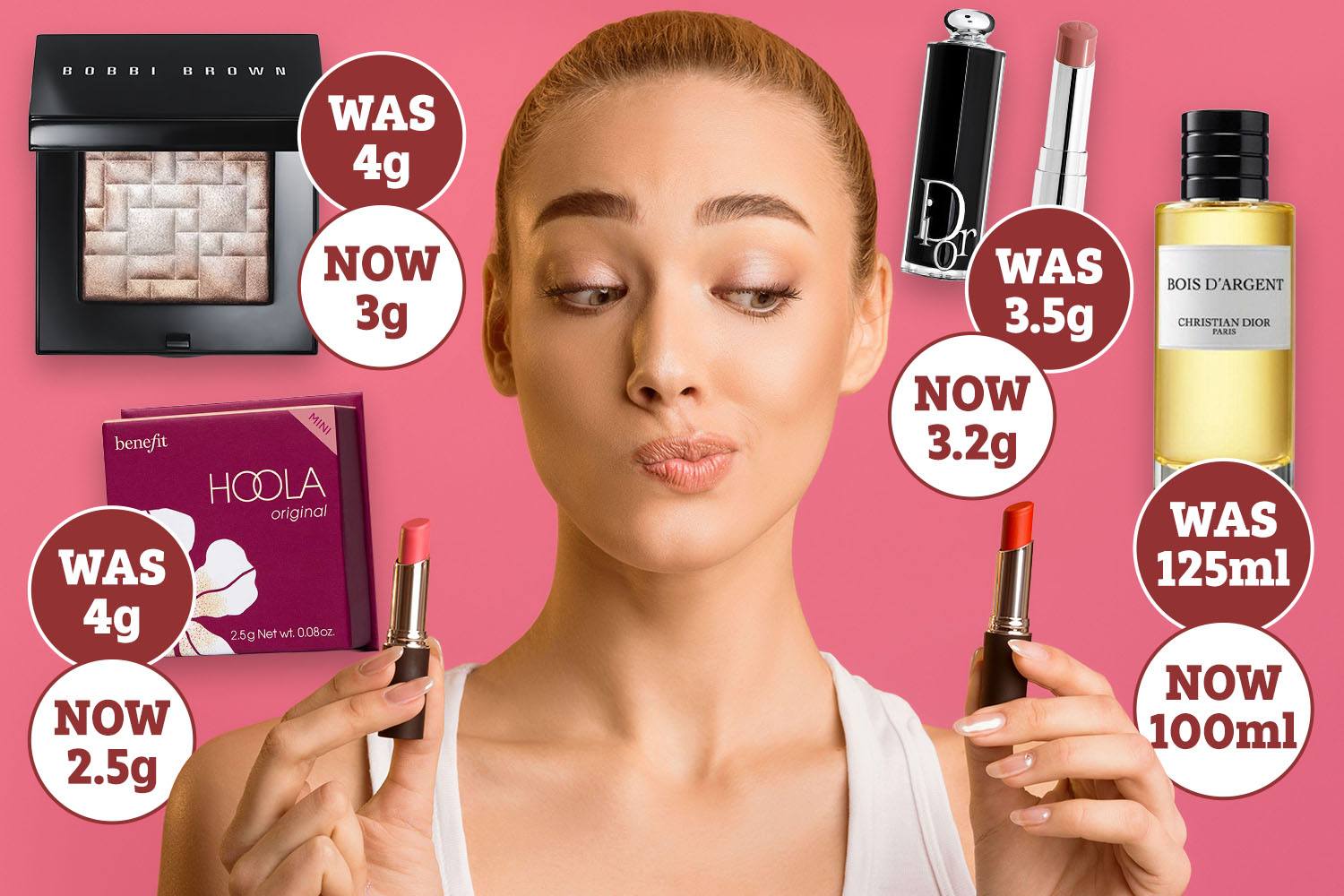
A Bobbi Brown mini-highlighter has shrunk from 4g to 3g, but will still set you back around £21.
READ MORE ON SHRINKFLATION
Alberto Balsam’s Juicy Green Apple shampoo went from 350ml to 300ml, and still costs 95p, while the popular Benefit Mini Hoola bronzer has shrunk from 4g to 2.5g, but there was no reduction in price, as it still retails at around £17.
Thousands of customers are moaning about beauty shrinkflation, in TikTok videos and on Reddit forums, with big brands including Nivea, The Body Shop and Dove all accused of cashing in.
As make-up artist and beauty blogger Joyce Connor points out, products are now running out faster than ever before.
She says: “I often get a huge box, open it up and think, ‘Is that all?’.
“Manufacturers alter the packaging all the time so what you buy looks big, but you get less product inside.
“Lip glosses, for example, are now appearing in square tubes. They look big, but when you dip the wand in, there isn’t much product and it doesn’t last long.
“I refuse to buy square-shaped lip glosses for this reason.”
Joyce adds that products are often discontinued and reformulated, meaning it is difficult to make a direct comparison between the older, larger version, and the new, shrunken one.
But the contents of a new YSL blush, she says, were barely bigger than a 50p piece.
Some Lancome lipsticks have quietly reduced in size from 4g to 3.5g, while Dior Addict lipsticks have shrunk from 3.5g to 3.2g.
“We are being deceived as the packaging looks huge,” she says.
Many brands are also selling mini-versions, but while you may not get even half as much as in the full-sized product, these items are rarely half the price.
Joyce says: “Many high-end brands are also selling slimline lipsticks which cost the same, but contain less product.”
And that’s not the only way beauty firms are trying to save cash.
‘Lot of smoke and mirrors’
Julie Macken, a chemist and founder of skincare company Neve’s Bees, says other companies are also bulking out products with water.
“There is an awful lot of smoke and mirrors that happens in the beauty industry,” she warns.
“One thing I’ve seen happening more and more is ‘skimpflation’. This is where manufacturers bulk out products with cheaper ingredients.”
Julie says when water was first added to creams, around 100 years ago, they could be less than 50 per cent water.
Shockingly, products can now contain up to 90 per cent water.
“Water costs less than 0.5p a litre in the UK, whereas expensive moisturising oils and waxes might cost upwards of £50 a litre,” she says.
“While the water itself is not causing any harm, it’s not at all necessary.
“And in order to mix it with the moisturiser you have to add processing additives such as preservatives, stabilisers and emulsifiers, the same as you find in processed food.
“These can damage the skin’s barrier, making it drier.”
Julie says if a product is 70 per cent water, then around ten per cent will be made up of these processing chemicals and additives.
Typically, only around 15 per cent of a moisturiser is the active ingredient that might actually benefit the skin.
Manufacturers must list ingredients by quantity, so if water makes up the biggest percentage, it will be top of the list — and it will be written as “aqua”.
The most beneficial ingredients — the ones they shout about — are often right at the bottom, meaning they are only included in tiny amounts.
Even in cult product The Rich Cream, from luxury brand Augustinus Bader, which costs £240 for 50ml and is favoured by Victoria Beckham, the main ingredient is water.
The second ingredient is Coco-Caprylate, which is chemically manufactured from coconut oil or palm oil and has some moisturising properties.
As sunflower oil is listed as the third ingredient, Julie advises to just purchase this instead.
She says: “Using an organic sunflower oil on damp skin would likely leave your skin better hydrated — and be kinder for your purse and our planet.”
To avoid being duped, always check the ingredients list before buying.
Shampoos boasting argan oil, or eczema creams with oat oil, are also likely to scrimp on the most helpful ingredients.
“When you look, argan oil, commonly referred to as Argania Spinosa Kernel Oil, is often way down the list,” says Julie.
“You think you are paying for a fancy ingredient and maybe in the past you were, but now it is so diluted down.
“And if it gets diluted with water, there has to be a lot of processing chemicals added too. None of these are beneficial for your skin and none of these are good for the environment.”
Last night, some of the brands mentioned here, such as Dior, told us adjustments to formula and volume are a response to a combination of the rising costs of materials, enhancements to formulas and a dynamic global market.
A spokesperson from Dior said: “At Parfums Christian Dior, we are committed to delivering the highest quality and most innovative products to our clients.
“Our pricing and product formulations reflect a complex array of factors, including the continuous advancements in cosmetic science, the sourcing of premium ingredients, the unique artistry of our creations, and the meticulous craftsmanship involved in every stage of development and production.
“Regarding the Dior Addict Lipstick, product evolutions, including adjustments to net weight, are sometimes implemented as part of our continuous effort to enhance formula performance, introduce new ingredients, or update packaging to align with our brand’s luxury standards and sustainability objectives.
“Any changes are carefully considered to ensure that the product continues to deliver the exceptional experience our clients expect.
“Similarly, for our esteemed Maison Christian Dior fragrances, such as Bois d’Argent Eau de Parfum, adjustments to volumes and pricing are influenced by a dynamic global market.
“This includes the rising costs of rare and high-quality raw materials, intricate fragrance development, and the detailed presentation of our iconic bottles.
“These decisions are made to ensure we maintain the unparalleled quality and exclusivity that define our Haute Parfumerie collections.
“We consistently strive to offer unparalleled luxury, innovation, and a superior client experience across our entire range.


“We value our clients’ loyalty and always aim to provide products that embody the excellence and heritage of Dior.
“Thank you for allowing us to clarify our position.”