
IT’S that time of year again when everyone seems to be a bit snotty.
And if you’ve ever glanced at your tissue after blowing your nose, you may have noticed it can be an array of colours, from green and red to even black.

While many of us are quick to toss our used tissue in the bin, keeping an eye on the colour of your snot can offer some clues about your overall health.
Snot is the common term for nasal mucus – a slippery, protective substance produced by the mucous membranes that line your nose and sinuses.
Its primary functions are to moisturise the respiratory tract, filter out dust, allergens, and germs, and trap them for removal from the body.
According to the NHS, your body will produce about 1.7 litres of the stuff daily, but you usually swallow most of it.
During an illness like a cold, it overproduces more to help flush out the infection.
It’s your body’s first line of defence against infection because it contains antibodies, which trigger a reaction to ward off viruses and bacteria.
Taking note of what trickles out your nose can be useful – it can show you’re not as ill as you might feel or that you should get checked out.
So what are the colours, and what do they mean?
1. CLEAR
Clear snot is normal and usually healthy, the NHS says.
But if your nose is particularly runny, it could be a sign of an allergy, according to Houston Advanced Nose and Sinus doctors.
Occasional or mild clear nasal drip will often resolve within a few days or weeks.
However, there are more serious causes of clear nasal drip, such as nasal polyps, which are non-cancerous growths inside the nose.
The NHS says they’re not usually serious but can keep growing and block your nose if not treated.
2. YELLOW
Phlegm which edges towards a yellow shade could be a sign your body is fighting an infection.
“The yellow colour is a result of your infection-fighting white blood cells being expelled with your mucus,” Pharmacist Rita Ghelani said.
“You’re probably feeling rough and very blocked up,” she added.
It’s considered a normal sign your body is fighting a mild infection, such such as a cold or flu, and is usually no cause for immediate worry on its own.
3. GREEN
Pharmacist Rita Ghelani, who worked with nasal spray brand Xlear, said green snot is a sign the infection has taken hold and your immune system is in overdrive.
Again, the green colour comes from dead white blood cells (called neutrophils) that are released to destroy germs.
“You might have a temperature and be feeling feverish – if that’s the case, it might be wise to consult your doctor or pharmacist,” she said.
While green snot means your immune system is working hard, it’s often a sign the infection is resolving, not worsening.
4. WHITE
Dr Raj Sindwani from the Cleveland Clinic in the US, said white snot is a sign you have a nasal infection or a cold.
If this is the case, you’ll likely also have some congestion.
Speaking to the New York Post, the expert explained tissue inflammation results in a slowed flow of mucus, which is a much thicker and cloudier texture.
Rita added this colour is “nothing to worry about”.
However, if you have asthma and you’re producing lots of white phlegm, it could be a sign your airways are inflamed and your asthma is getting worse.
According to Asthma and Lung, your preventer inhaler is the number one way to deal with this, as long as you’re taking it as prescribed by your doctor or nurse.
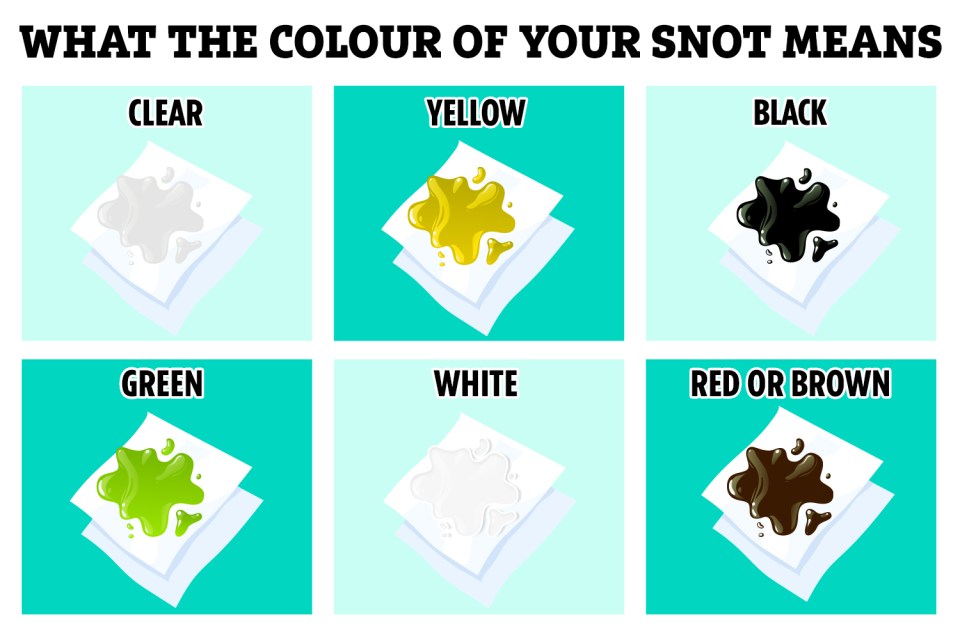
5. RED OR BROWN
When your boogers turn red or brown, this is usually a sign you have some dried blood up your nose.
Dr Raj said: “Full-on red could be a nosebleed related most likely to trauma or infection.
“A few specks of blood or a pinkish hue mucus may not be a big deal. That could be just damage or irritation of the lining.”
If bleeding is continuous, heavy, persistent, or accompanied by other severe symptoms you should look to seek medical attention.
6. BLACK
Having black boogers is usually a sign that you’re a smoker or live in a highly congested – and so, polluted – area.
But a doctor should evaluate black snot to rule out more serious conditions.
In some rarer cases, it could be a symptom of a serious fungal infection, such as mycetoma fungal sinusitis, allergic fungal sinusitis, chronic indolent sinusitis and fulminant sinusitis.
But these usually only affect people with compromised immune systems who can be more susceptible, according to the World Health Organisation (WHO).
HOW LONG TO EXPECT TO BE SNOTTY FOR – AND WHEN TO SEE A GP
According to pharmacist Abbas Kanani at Chemist Click, the length of time you’re snotty for depends on the cause.
He advised: “Generally if its due to a respiratory infection or cold / flu, seven to 10 days.
“It can last for several weeks for viral or bacterial bronchitis and sinus Infection.
“Sometimes a few months for chronic sinusitis. Long-term conditions like COPD or chronic bronchitis can cause the presence of phlegm to last for months or even years.”
If you’re coughing up large amounts of blood or consistently seeing red phlegm, you should see a doctor urgently.
If your phlegm is coloured, persistent and not going away for more than a few days, it’s also worth seeing your GP, said Kanani.
He added: “Especially if it is accompanied by fever, chest pain, difficulty breathing, chills at night and unintentional weight loss.
“You should also seek advice if you notice changes in the colour, volume or frequency if you have a long-term condition such as COPD.”
THINGS YOU CAN DO TO HELP EASE MUCUS
THERE are things you can do to help ease common snot and mucus issues like catarrh (build-up of mucus):
- drink plenty of water
- sip ice cold water when you need to clear your throat, rather than coughing or swallowing
- try using a humidifier to help loosen the mucus in your nose and throat
- try using an extra pillow in bed so you sleep in a more upright position, rather than lying flat
- try gargling with salt water
- try rinsing your nose with salt water
You could also ask a pharmacist about:
- decongestants and other medicines to help relieve catarrh
- salt water nose rinses – you can get several types, including specially designed bottles, nasal sprays and sachets
Source: NHS