Shortly after the First World War, King George V is said to have quashed a proposal that holders of the Victoria Cross could be stripped of their award if convicted of a serious criminal offence, insisting that recipients of the VC who were convicted of murder should be permitted, if they wished, to wear their decoration on the gallows.
There would be an obvious injustice in stripping Andrew of medals that he earned fair and square
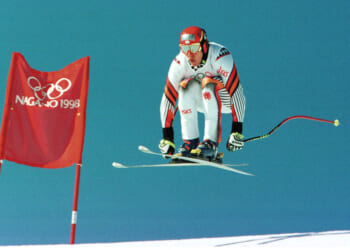
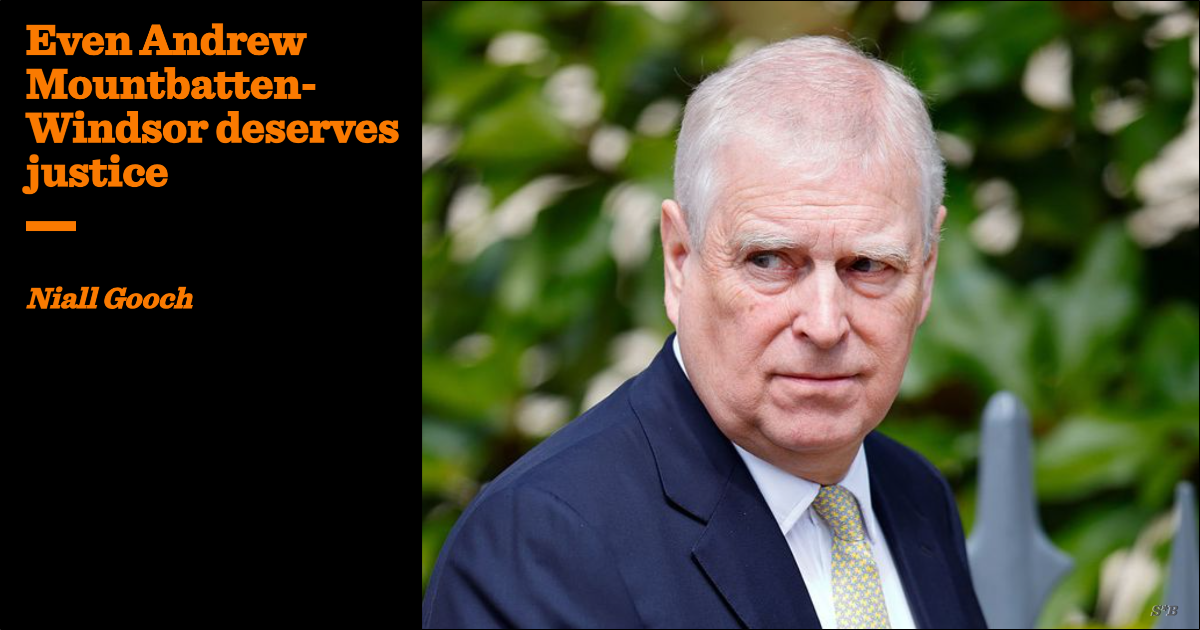
Hanging has not, yet, been proposed as a punishment for George’s great-grandson, the man whom we must now call Andrew Mountbatten-Windsor, though who knows what might happen, given the increasingly histrionic atmosphere around the aristo formerly known as Prince. But according to The Times, the Palace has refused to rule out stripping him of the South Atlantic Medal — a campaign medal held by over 30,000 military personnel and civilians who saw active service during the Falklands War. Andrew flew multiple sorties during the conflict, including anti-submarine missions, and search and rescue operations after the deadly attack on the Atlantic Conveyor supply ship. This was dangerous work; several helicopters were destroyed by enemy action, and others were lost in accidents. Altogether, 255 British personnel were killed. As with Prince Harry in Afghanistan 25 years later, the late Queen apparently insisted on Andrew being allowed to embark with the task force, against the wishes of timid Cabinet members who preferred that he be moved to a desk job for the duration.
There would be an obvious injustice in stripping Andrew of medals that he earned fair and square through courageous service in a war zone. Whatever his conduct since that time — and there are numerous well-attested reports of his being an arrogant, obnoxious and greedy playboy, even before we come to his involvement with Jeffrey Epstein — the purpose of a campaign medal is not to assert that someone is a moral paragon, or to guarantee that they will henceforth live a life of chaste and ascetic humility. It is a statement about particular actions at a particular time — a recognition that someone did their duty when it was necessary. The idea that campaign medals, or gallantry awards like the VC or the DSO, are bestowed on an eternally provisional basis, dependent on subsequent morally upright behaviour, defeats the entire object of the exercise. It is one thing to take away unearned honours — Andrew was a Commander when he retired from the Navy in 2001, but subsequently became an honorary Vice-Admiral, a rank now being removed at the insistence of the King. It is quite another to obliterate an official acknowledgement of honourable service, after the fashion of the old Roman punishment known as “damnatio memoriae”, the systematic posthumous erasure of an individual from all public records. Andrew has already undergone this to a considerable degree, with his name removed from schools, horse races, and charity patronage.
The royals and their advisors obviously feel that some ruthlessness is in order, to ensure that the monarchy’s image doesn’t suffer by association. It may be a little early for alarm bells but YouGov found that support for the institution fell by 13 percentage points between the Diamond Jubilee in 2012 and the Platinum in 2022, from 75 per cent to 62 per cent. Charles has continued his mother’s initiatives for a slimmed-down, less grandiose Firm, with a smaller group of working royals and an end to supposed extravagances like the Royal Train (the decommissioning of which is a curious decision in light of Charles’ environmentalist sympathies). Throwing Andrew over the side to lighten the ship can probably be seen as part of this project. All the same, briefing the press that even Andrew’s Falklands medals are up for grabs does seem like a needlessly vindictive step.
None of this should be taken as planting my flag on Team Andrew
This is especially true given that the various allegations about Andrew have never been properly tested in open court (admittedly this is in part due to the work of his own lawyers in arranging an out of court settlement of the civil suit brought by Virginia Giuffre). He may well be guilty of something — he was, by his own admission, friends with both Epstein and Ghislaine Maxwell — but many of the accusations have been made by people whose testimony is of dubious reliability, and natural justice demands that we not assume the worst without clear evidence. He has never been charged with, or convicted of, a criminal offence. US prosecutors have sought to have him taken to the USA for questioning, but it is worth noting that this was a mutual legal assistance request rather than an extradition request.
None of this should be taken as planting my flag on Team Andrew. He seems to be an unpleasant man in many ways. The numerous testimonies of him being verbally abusive and disdainful towards staff are particularly damning. It remains true that you can tell a lot about someone by how they treat those who cannot answer back.
There is value, however, in having an accurate understanding of the total moral arc of a single human existence. We all fall short and we all have our faults. Most of us will have periods or incidents in our personal lives which would not stand up to much scrutiny. Solzhenitsyn was right that the line between good and evil doesn’t run between human hearts, but within them. The most cursory reflection on human experience, or the canon of great art, will confirm this to be the case.
This doesn’t mean we abandon all moral judgments, and all gradations in moral standards. It’s not true that under the right circumstances we could all be Heinrich Himmler, and some wrong acts are clearly much worse than others. If Andrew is guilty of having sex with trafficked women, that is contemptible — more so than amost people will have done. Certain kinds of wickedness are so awful that they rightly dominate our assessment of a person.
What it does mean is that we maintain the ability and the willingness to make important distinctions, admitting that a life which is generally unsatisfactory, or overshadowed by evil acts, may yet contain points of light and moments of virtue. Justice is detail.