For decades, Mississippi students struggled to read, and the state ranked low on education quality. Not anymore. Strong student test scores – dubbed the “Mississippi Miracle” – have catapulted the Southern state into the national spotlight.
But the state superintendent at the helm during those literacy reforms has repeatedly pushed back against that buzzy term. Instead, Carey Wright has described the state’s success as the “Mississippi Marathon.”
“This is not something that happens overnight,” Dr. Wright, now Maryland’s state superintendent, said this year at a Greater Albuquerque Chamber of Commerce event. “It’s something that happens over time.”
Why We Wrote This
Dozens of states have passed laws directing a “science of reading” approach to helping struggling students. But who is teaching the teachers how to make that happen?
Literacy experts say it happened with the steady drumbeat of a “science of reading” instructional approach – and a trained workforce to back it up. Slowly but surely, they say, the nation’s higher education and K-12 systems are trying to bridge knowledge gaps between science of reading laws and the workforce tasked with teaching children to read.
Today, some 40 states and the District of Columbia have laws or policies related to the science of reading, according to an Education Week analysis. California took another step in that direction when Democratic Gov. Gavin Newsom signed legislation in October that provides funding for teacher training and instructional materials. The mission underpinning the laws is urgent: Nationwide, 40% of fourth-graders were reading on a level deemed “below basic” on the 2024 National Assessment of Educational Progress.
But legislation can only go so far without adequate teacher preparation. If the need or appetite is any question, consider the 243,000-member Facebook group called “Science of Reading – What I Should have Learned in College.” Daily posts, many from teachers, seek advice or offer suggestions.
“Are there schools doing literacy well under the [science of reading] approach and what do your intervention services look like?” one group member recently asked.
What do teachers need to know?
Inside classrooms using a science of reading approach, educators put a greater emphasis on phonemic awareness, phonics, fluency, vocabulary, and comprehension.
If you’re scratching your head, think of it this way: Children learn that sounds correspond to letters or letter combinations, which then form words. And words have meaning, which, when put together, tell a story.
Two years ago, only 28% of teacher preparation programs adequately addressed those components of evidence-based reading instruction, according to a review by the National Council on Teacher Quality. And 22% of programs didn’t sufficiently prepare aspiring teachers for any of those components.
When the council releases its next review of teacher preparation programs in the spring, Heather Peske, the group’s president, expects to see improvement.

“The reason I’m optimistic is because there have been so many states that have adopted new reading laws that include requirements for teacher preparation programs to align their program to the science of reading,” she says, pointing to Colorado and Mississippi as examples.
Those two states also require a strong licensure test for teachers entering the classroom.
“A gap between research and practice”
On the higher education front, Gordon College in Wenham, Massachusetts, is one of the institutions leading the charge. The private Christian college is accepting applicants for its new doctorate of education in the science of learning program, which will begin next summer and include a concentration in language and literacy education.
The program builds on the college’s existing efforts to train aspiring teachers in the evidence-based approach but is aimed at a new audience: education leaders, teacher educators, and advocates. Gordon officials hope it creates a multiplier effect.
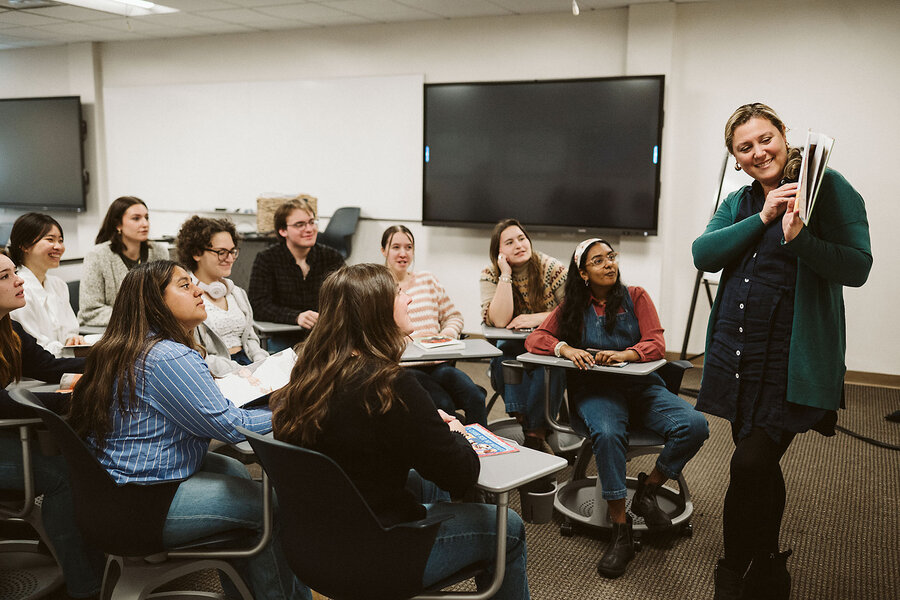
“There’s a gap between research and practice. The research has been there for a long time, but to get it into the field is what is taking a long time,” says Julia D’Onofrio, an instructor of education at Gordon. The program goal would be to arm doctoral students with the knowledge necessary to “read research and translate it into instructional practice for educators.”
But a wholesale shift within teacher preparation programs across the country will take time. For starters, literacy experts say expertise remains a barrier. College faculty might not be well-versed in the science of reading.
And a pedagogical hurdle may be the very definition of the science of reading. Cognitive neuroscientists, such as Maryanne Wolf, director of the Center for Dyslexia, Diverse Learners, and Social Justice at the University of California, Los Angeles, have been advocating for a broader understanding of the evidence-based approach. She says it should include both foundational literacy skills and deep reading skills.
“It’s slower,” Dr. Wolf says, referring to teacher preparation, “because I think people don’t understand it’s not just phonics.”
Prepping on a Friday night
Laura Patranella, a fifth-grade teacher in Seguin, Texas, acknowledges she has an unconventional hobby on Friday and Saturday nights. She reads books about how to improve her instruction through the science of reading.
“I’m always kind of obsessively on the hunt for that next way of doing things,” she says. “It’s just a little tweak that really has a big impact.”
Her devotion to her craft has paid off. Last school year, 83% of her students showed reading growth on a Texas standardized test known as STAAR (State of Texas Assessments of Academic Readiness), Ms. Patranella says. Her students’ progress fuels her desire to learn more on her own, but she knows that’s a tall ask for her peers in the field.
“There’s never enough time in teaching,” she says. “If you’re overwhelmed, there’s only so much you can do.”
So, what’s the best way to train teachers who didn’t learn about the science of reading in college?
Tennessee took an approach that heavily favored practical application in the classroom. Using pandemic-era funding and federal grants, the state launched Reading 360, which included resources for schools and summer training for teachers, several years ago.
The teacher training unfolded over an online course and then, more crucially, within cohorts that included colleagues – teachers, literacy coaches, and principals – from the same schools, says Lisa Coons, the former chief academic officer for Tennessee’s Department of Education who led the Reading 360 initiative.
“That gives you a leg up when you’re going back to the classroom,” she says. “You can walk down the hallway to that second grade teacher and say, ‘What did we do? How does this work with my materials?’”
The Education Recovery Scorecard, a collaboration between researchers from Harvard and Stanford Universities, found that Tennessee ranked No. 9 in reading recovery between 2019 and 2024. Neighboring Southern states such as Alabama, Louisiana, and Mississippi also showed strong reading gains during that period.
Those four states have been in it for the long haul, says Dr. Coons, who most recently served as Virginia’s state superintendent.
“It has been a deep five-, seven-, 10-year commitment to the work,” she says. “And it’s going to take that kind of deep, sustainable commitment to making sure that we embed the right kind of practices for our students over time.”
But not all of the work is happening at the state or school-district level. Some of it is stemming from grassroots efforts to meet teacher demand for literacy training.
The Goyen Foundation, which supports and amplifies the work of expert literacy teachers, receives hundreds of applications per year from teachers who want to participate in its fellowship, says Kata Solow, the foundation’s executive director.
The purpose of the fellowship is straightforward. Ms. Solow says the foundation finds “really great reading teachers” who have figured out how to translate the theory surrounding the science of reading into effective classroom teaching strategies. It then pays those teachers to share what they are doing on social media or through webinars.
It’s a “teachers teach teachers” model.
“We believe that teachers are generally the best teachers of other teachers,” Ms. Solow says. “And they’re going to be the best persuaders, too.”