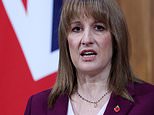
Rachel Reeves today put Britons on notice that tax rises are coming in her Budget later this month – and she attempted to shift the blame onto a myriad of factors.
The Chancellor refused to recommit to Labour‘s manifesto promise not to increase income tax, National Insurance or VAT.
It paves the way for her to conduct another huge tax raid on 26 November, after she announced levy hikes worth £40billion at her first Budget last year.
Ms Reeves issued the fresh tax warning during an extraordinary speech in Downing Street this morning.
She also used the address to try and pin responsibility for her actions on a slew of global issues, as well as previous Tory governments and Brexit.
This is despite her speech coming just under a year since she claimed she was ‘not going to be coming back with more tax increases’.
In November 2024, Ms Reeves also told Government departments to ‘live within the means’ of her spending plans after her previous huge tax raid.
Responding to the Chancellor’s speech on Tuesday, Tory leader Kemi Badenoch branded it ‘one long waffle bomb’ and a ‘laundry list of excuses’.
‘She blamed everybody else for her own choices, her own decisions, her own failures,’ Mrs Badenoch added.
So – apart from herself – who does Ms Reeves blame for rowing back on her past words and for breaking Labour’s manifesto pledge on taxes?
The Tories
In her speech this morning, Ms Reeves piled blame onto previous Tory governments.
She claimed that, in their 14 years in power, the Conservatives had ‘not adequately faced up’ to the challenges facing the UK economy.
‘Too often, political convenience has been prioritised over economic imperative,’ the Chancellor said.
‘The decision to pursue a policy of austerity after the financial crisis dealt a hammer blow to our economy, gutting our public services and severing the flows of investment that would have put our country on a path to recovery.
‘The years that followed were characterised by instability and indecision, with crucial capital investment continually sacrificed, and hard decisions put off again and again.’
Liz Truss’s mini-Budget
Ms Reeves took specific aim at former prime minister Liz Truss and her infamous ‘mini-Budget’, which took place more than three years ago in September 2022.
The Chancellor claimed she was still ‘dealing with the aftermath of Liz Truss’s disastrous mini-Budget’ as she complained about the impact of high borrowing costs.
She said: ‘The whole point of the decisions that I plan to make in the Budget on November 26 is to make decisions in the future easier than the decisions that confront us today.
‘By getting a grip of the national debt, for example, will open up opportunities either to put money into public services or to get taxes down in the future.
‘The reason those opportunities don’t present themselves now is that borrowing costs are too high and the national debt is too high.
‘Those are issues that we inherited from the previous government and they’re ones that I plan to address in the Budget later this month.’
Brexit
More than nine years on from Britons voting to quit the EU, Ms Reeves tried to pin some of the blame for the country’s economic woes on Brexit.
She hit out at a ‘rushed and ill-conceived Brexit’, which she claimed had ‘brought further disruption’.
‘Businesses trying to trade were faced with extra costs and extra paperwork,’ she added.
Donald Trump
Although she didn’t mention the US President by name, Ms Reeves suggested Donald Trump’s global trade war had added to the economic turmoil facing Britain.
She said ‘the world has thrown even more challenges our way’ in the last 12 months.
‘The continual threat of tariffs has dragged on global confidence, deterring business investment and dampening growth,’ Ms Reeves added.
‘Inflation has been too slow to come down, as supply chains continue to be volatile, meaning the costs of everyday essentials remain too high.
‘And the cost of government borrowing has increased around the world, a shift that Britain – with our high levels of debt left by the previous government – has been particularly exposed to.’
Covid
In a further swipe at the Tories, Ms Reeves claimed previous governments had left Britain ‘under-prepared’ for the Covid crisis.
She said: ‘When the pandemic arrived our country was under-prepared our public services weakened and our economy fragile.
‘And we finished the pandemic with higher death rates and higher debt than our peers.
‘This isn’t about relitigating old choices. It’s about being honest with people about the consequences those choices have had.
‘It is my job to deal with the world as we find it not the world as I would wish it to be. Not to commentate or speculate, but to act.’
The Office for Budget Responsibility
The Chancellor took a swipe at the Office for Budget Responsibility watchdog amid claims it has downgraded productivity forecasts.
This is said to have added an estimated £21billion to the black hole in the public finances that Ms Reeves is grappling with ahead of the Budget.
Ms Reeves said: ‘Everyone can see this year has thrown further challenges our way, Britain is not unique in that respect.
‘The impact of tariffs, of global uncertainty weighs on countries around the world.
‘At the same time the OBR are choosing this moment to update their forecasts on productivity.
‘I am determined to beat those forecasts, but you have to respond to the independent forecasts that are presented, not just your view of what the future will look like.’
Vladimir Putin
Ms Reeves admitted that energy prices were still ‘very high’ for Britons, as she pinned the blame on Vladimir Putin’s continuing invasion of Ukraine.
‘We haven’t been building enough energy infrastructure in Britain and when Russia’s invasion of Ukraine came along, we were too exposed to global markets,’ she said.
‘We did not have gas storage facilities or produce enough homegrown energy, which is why we’re putting efforts into that.
‘I do recognise that energy prices are still very high for people and we want to ease that pressure on the cost of living.
‘That’s why I’ve set it as one of the three priorities for the Budget; the cost of living, NHS waiting lists, and getting the national debt down.’