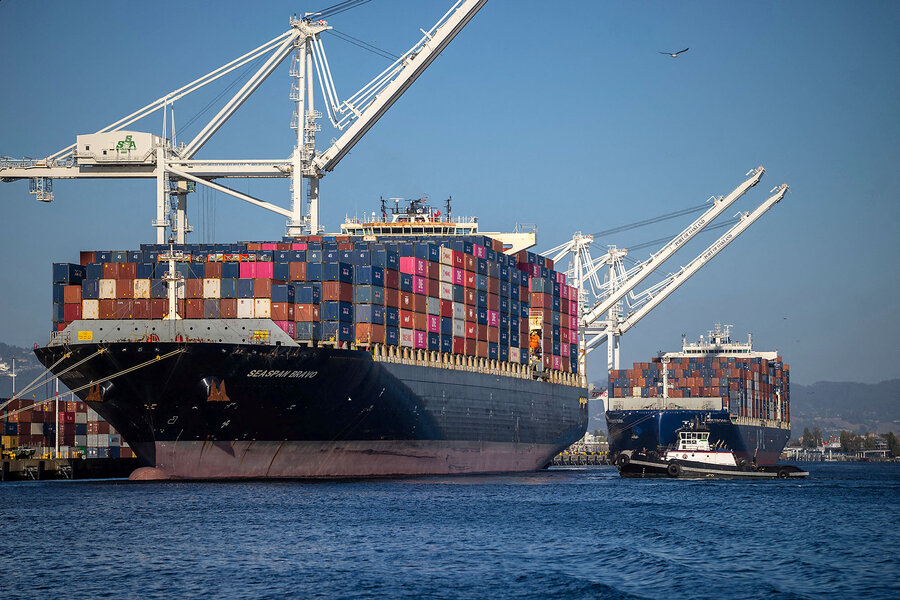
Seven months ago, President Donald Trump proclaimed April 2 “Liberation Day.” Standing in the White House Rose Garden, he announced a round of “reciprocal” tariffs levied against nearly every country in the world.
He had already levied tariffs against China, Canada, and Mexico shortly after taking office in January. But are all these tariffs lawful? The Supreme Court will consider the question Wednesday.
The case concerns what the Trump administration regards as its greatest economic policy achievement to date, and what a bipartisan array of critics describes as a new effort by Mr. Trump to expand presidential power beyond the Constitution’s limits.
Why We Wrote This
After lower courts struck down the legal argument for the Trump administration’s most sweeping tariffs, the Supreme Court now takes up the matter. The case is important not only for the economic policy of the United States, but for the Constitution’s separation of powers.
Mr. Trump brought his case to the justices after three lower federal courts struck down the tariffs. The administration, the courts ruled, authorized the tariffs by misreading an emergency economic powers law. Decades of precedent support their interpretation of the law, the administration counters.
If the high court rules in President Trump’s favor, “it potentially offers unprecedented amounts of authority to the president,” says Wendy Cutler, senior vice president at the Asia Society Policy Institute and a former acting deputy U.S. trade representative.
According to Mr. Trump, this power is critical to America’s economic competitiveness on the world stage.
The case is “one of the most important … in the history of our Country,” he wrote on social media last month. “If we don’t win,” he said at the White House in October, “we will be a weakened, troubled, financial mess for many, many years to come.”

Treasury Secretary Scott Bessent has said a ruling against the administration would raise difficult practical questions about what to do with the billions in tariff revenue already collected. Even critics of the tariffs agree with the Trump administration’s assessment – to an extent.
“I’m not sure it’s [one of] the most important cases in American history, but it is one for the ages,” said Michael McConnell, a Stanford Law School professor who is representing small businesses challenging the tariffs, during a call with reporters last week.
“This is a major confrontation between the executive branch and Congress,” he added.
Origins of tariff authority
The Constitution delegates the tariff power to Congress, with Article I stating that the legislative branch has the power “to lay and collect Taxes, Duties, Imposts and Excises.”
But Congress has also passed several laws giving the president some authority to set tariffs. The law at issue in this case is the International Emergency Economic Powers Act (IEEPA). This law – which doesn’t mention the word “tariff” – says that in the face of an “unusual and extraordinary threat,” the president can declare a national emergency and invoke the IEEPA, which provides them new powers to “regulate … importation.”
The Trump administration is arguing that trade deficits, as well as fentanyl trafficking from China through Mexico and Canada, are national emergencies justifying its tariff declarations. Mr. Trump is the first president to attempt to use the IEEPA to levy tariffs.
The closest another president has come to unilaterally imposing tariffs came in 1971, when Richard Nixon cited a predecessor statute to the IEEPA in ordering a small and “temporary” 10% tariff on imports to the U.S. He ended the tariffs four months later after successful trade negotiations with the affected nations.
The Trump administration says it is following a similar playbook, citing trade deals with the European Union, Japan, and Britain agreed upon after imposing tariffs. Unlike under President Nixon, however, many of those framework deals include a Trump tariff remaining in place.
Mr. Nixon “applied these tariffs for a short period of time,” says Ms. Cutler. “Under the Trump administration’s view, once you declare an emergency you can keep them for as long as you want.”

The Constitution and Congress’s role
The confrontation boils down to America’s earliest democratic principles. Taxation without representation sparked the Revolutionary War, and the Constitution sought to address it by giving Congress the exclusive power to levy taxes. By unilaterally imposing tariffs –effectively a tax on American businesses that import goods, according to the nonpartisan Tax Foundation) – critics say Mr. Trump is ignoring these foundational principles.
More specifically, the Trump administration has been doing an end-run around the Constitution by misinterpreting the IEEPA, critics from legal groups across the ideological spectrum claim.
The IEEPA, they argue, is effectively a wartime law. When the country faces an “unusual and extraordinary threat,” the act gives the president a range of new powers to address the emergency, including the power to “regulate … importation.”
That is not a power to set tariffs, critics argue. Furthermore, they claim, an emergency the Trump administration is citing is no emergency at all. The executive order imposing the “Liberation Day” tariffs, for example, includes the phrase “large and persistent…trade deficits.”
“Use of the IEEPA is limited to extraordinary emergencies, [and] a trade deficit is not unusual or even an emergency,” said Jeffrey Schwab, director of litigation at the Liberty Justice Center, a legal group that represents a group of small businesses challenging the tariffs.
The center is one of a number of strange bedfellows fighting Mr. Trump’s tariffs. When it last appeared before the justices, the organization won a landmark case restricting union organizing rights around the country – a decision celebrated by conservative America. In the tariffs case, the organization now finds itself allied with left-leaning organizations including the Brennan Center for Justice and the Democracy Forward Foundation.
Also on their side is the Pacific Legal Foundation, a public interest law firm that typically represents conservative causes. One of the group’s recent Supreme Court victories struck down a Biden administration loan-forgiveness program.
In the tariffs case “the issues are effectively the same,” says Oliver Dunford, a senior attorney at the firm.
“Here, the president is effectively making new policy,” he adds. “And if we want to address [a policy issue], Congress has to be involved.”
As for the bipartisan opposition, Mr. Dunford hopes it’s a “good omen that … in the future, there will be more bipartisan opposition to presidents when they exceed their authority.”
How the White House defends tariffs
The Trump administration, meanwhile, claims that the trade deficits have created “an ongoing economic emergency of historic proportions.” Using tariffs to pressure China, Mexico, and Canada to limit fentanyl trafficking into the U.S., meanwhile, is a valid use of the IEEPA, the administration argues.
One of the administration’s prominent claims is that the tariffs fall squarely within the presidents’ authority over foreign policy and national security matters.
The IEEPA “is a particularly broad delegation in the domains of foreign policy and national security,” the administration wrote in its petition to the court.
If the Supreme Court strikes down the tariffs, the administration added, it “would reflect an intolerable judicial intrusion into the President’s responsibility to manage foreign relations and trade.”
Trump administration officials have also raised what could be a persuasive “remedies” argument – one focused on what the administration would have to do should it lose.
In a declaration submitted to the court, Mr. Bessent wrote that billions of dollars in tariffs have already been collected. If the tariffs are suddenly eliminated, he added, “unwinding them could cause significant disruption.”
Given the time-sensitive nature of the case, most courtwatchers believe the justices will deliver an opinion months before the term ends in June.
Some experts also believe that a loss for the Trump administration wouldn’t mean the end of its tariff regime. The justices could uphold some tariffs but not others, and, if some tariffs are struck down, the administration could use other statutes to reimpose them. The administration has also set tariffs under different statutes, such as tariffs on steel and aluminum, that have not been legally challenged.
“If [the tariffs are] struck down, it would be a blow to the president’s trade agenda, but there may be a Plan B,” says Ms. Cutler. “We’ll still be in a world where tariffs are a core part of the administration’s trade agenda.”