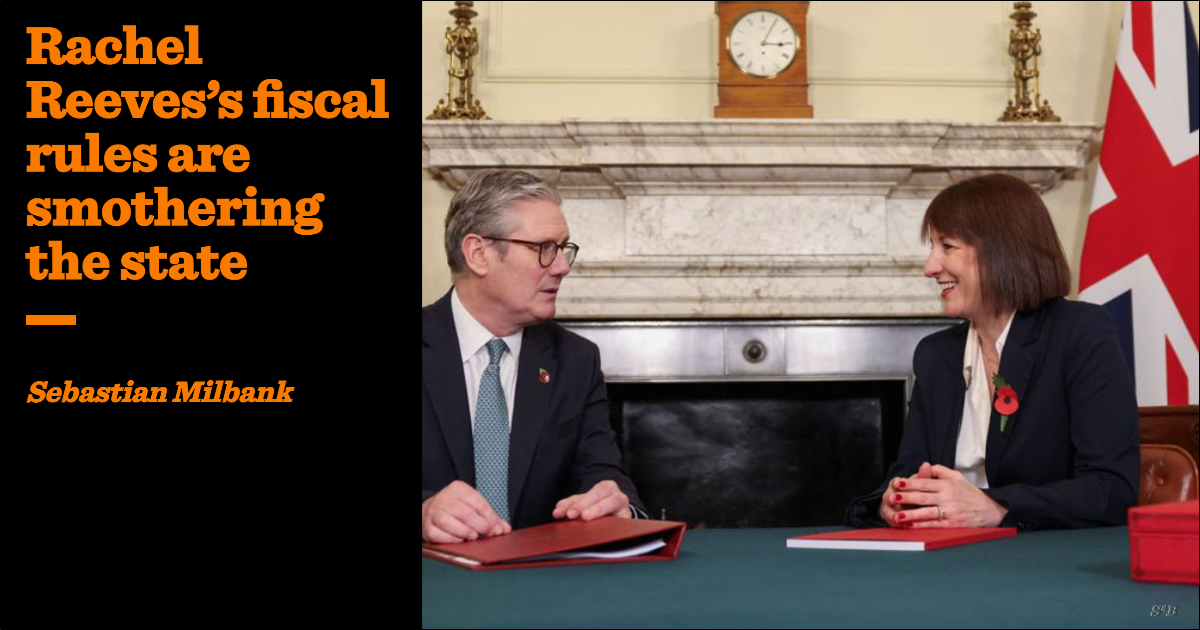
It has not been a very good week for Rachel Reeves. Of course, it’s very hard to remember when the hapless Labour chancellor last had a good week. Recent events saw Reeves come close to resignation for the second time, echoing the turbulence of July which saw her weeping in the Commons as the Prime Minister refused to rule out her departure. The latest brush with political death involved yet another housing law “scandal”, similar to that which claimed the scalp of deputy leader Angela Rayner. News that the error was blamable on the lettings agency has spared Labour another decapitation, but it was hardly the most restful stop on the road to the budget in November.
Reeves is expected to announce further spending cuts and tax rises as she struggles to fend off a debt crisis amidst a lagging British economy and sluggish productivity growth. The likelihood of a punishing budget has seen large-scale and ugly lobbying, with every industry and special interest group sliming its way round Westminster and screaming its case on Fleet Street. The gambling “industry” has been especially shrill, with Betfred implausibly threatening to close the entirety of its high street gambling outlets (if only), and lobbyists shamelessly telling baffled MPs that there are “no social harms” results from gambling.
The gambling industry is a rather fitting metaphor for British finances. There is a surface plausibility: shiny reports, big tax revenues, thousands employed, sponsorship of premier league football. But beneath the surface it produces nothing, adds no value, and only extracts money from the poor to be redistributed to its shareholders. If you could join the invisible journey of currency circulating around the British economy, you could probably witness a flock of sterling fluttering out of the pockets of a problem gambler, into the bank accounts of the gambling industry, back out again in taxes, before ending their journey where they began, as the gambler collects his disability check.
The illusion that gambling is an “industry” is no more absurd than an even more widely believed fiction: that the British state is a household that must carefully jot up its pennies and pounds lest it get into trouble. The framing of a Policy Exchange report about public spending was a neat summation of this worldview. The title itself — “Beyond Our Means” — accompanied by a smashed union jack piggy bank, conjures images of Britannia as a frugal housewife, pursing her lips as she looks at John Bull’s profligate spending.
It’s understandable, when seeking to communicate the complexity of debt and government policy in the modern world that we default to intuitive images. But this compelling metaphor quickly becomes a constricting reality as politicians try to run the country as if they were a family with credit card debt. Government spending can’t just be turned down for a bit, the policy equivalent of cancelling the family holiday in France or shopping at Lidl, until all the debt has been paid off.
British fiscal policy [has] narrowed to an unsustainable and dangerous fixed path over a cliff
This mindset, much bolstered by the media, has seen British fiscal policy narrowed to an unsustainable and dangerous fixed path over a cliff. Labour is left perpetually finding the least politically painful ways to stick up tax and reign in spending, all whilst trying to find a few areas where it can distract voters from worsening public services and rising tax bills. Reeve’s fiscal rules act like the shark cage in Jaws, as the hapless Chancellor is menaced by the circling sharks of the bond market, she hopes its steel bars will protect her from disaster. Yet like the cage in the movie, when the shark is out to get you, it’s just a shark snack box. On screen, Matt Hooper is smart enough to swim clear of the mangled cage and evade the circling predators — back in parliament, it’s impossible to imagine Reeves abandoning the rules she’s staked her reputation on.
Reeves is not so much an individual as she is the crystallisation of the instincts, limitations and errors of the British establishment. Even the way she has put up taxes and limited spending is typically counterproductive. Instead of a single bold tax rise on one of the big three taxes, which would spread the pain out in return for a significant boost to revenue, we see manipulation of rules and categories to extract amounts that make little difference on a large scale, whilst inflicting a great deal of trouble, cost and disruption on small groups, as we saw with the inheritance tax changes for farmers. At the same time, instead of serious structural reform to spending, categories are fiddled, resulting often catastrophic backlash, as with the failed attempt to force through disability benefit reform. One lesson of austerity is that though it failed in policy terms, it was for a while a politically successful message because it offered a trade off — short term pain for long term gain. But Reeves can at best promise stability and the temporary survival of a system that isn’t working for most people.
The reason the sphere of fiscal action has grown so stiflingly and dangerously small is that a series of assumptions and dogmas have been baked into the budget process by successive generations of British politicians. A triple-locked state pension, and gold-plated public sector pensions, are both drawn from general taxation, and no politician has taken steps to limit or offset these and other liabilities. Chopping back crucial, future-oriented areas of public service like education, R&D, defence, infrastructure and energy in favour of a growing health, social care, benefits and pension bill is nothing less than a betrayal of the young, and in any case will crater GDP, and thus any hope of growing our way out of the crisis.
What makes this more than just a “household budget” problem is that government debt and spending is not like what you or I engage in. It is closer, though far from identical to, how commercial entities function. There are highly indebted companies which produce nothing and have no revenue which may nevertheless be massively worthwhile — startups with major intellectual property that could one day scale up to commercial giants, or realise huge value for the company that purchases them. At the same time, there have been solvent, profitable corporations whose business model was doomed, as with Kodak or Blockbusters. Of course profitability — having more coming in than is going out — is the ultimate point, but profit is the result of having a purpose, and creating real value for the consumer. If a company has something to offer, it can be made profitable, if it doesn’t, then balancing the books in the short term isn’t going to do any good.
If Britain is like a struggling firm, it is in need of more than the management consultant solution of cutting some staff, closing a few unprofitable branches, and handing bigger dividends to the shareholders. That approach has come and gone, and it hasn’t worked. It hasn’t worked because of the ways in which states are even less like households than corporations are.
Whilst companies are ultimately fiscal entities, states are equally born of military and police power. A profit-making entity only has to worry about the bottom line, but a nation state has to secure the supply of food, the transport of goods, the maintenance of rail and roads, communication, national defence, law courts, policing, energy, water and heating, long before we even get to welfare. When a company cuts a job, that cost disappears from its balance sheets forever. When the government cuts spending in one area, the cost is often magnified and passed on to another. Cuts to welfare and policing show up in hospitals and prisons, cuts to infrastructure show up in lower GDP and tax revenue. More basically, in times of crisis it is generally not politically possible for the state to divest itself of responsibility, as with the pandemic.
Turning the state into something that serves a social purpose … means a radical rethink
The running down of smaller scale institutions, and the mutual networks of welfare, self-help and charity that once cohered society, have seen the responsibilities of the state multiply, but as Thatcher and Cameron both discovered, cutting the state doesn’t magically expand civil society. Hopes that markets would deliver in their stead have resulted in something worse than either the central state or the free market — the privatisation of profit and the socialisation of debt.
Turning the state into something that serves a social purpose, rather than perpetuating unsustainable fiscal transfers means a radical rethink. Moving resources from areas of spending that keep social problems at bay, to areas of spending that could solve those problems long term is not necessarily going to save money in the short term.
If the state exists for a purpose, then taxes, currency and debt are instruments that arose to facilitate those purposes. But elements of our fiscal system which once acted as handmaids to an effective government have become cruel and controlling governesses. Shockingly, a British Prime Minister (albeit an extremely incapable one), was unseated and her agenda crushed, by the bond markets — the investors who help determine the cost of British borrowing. British governments peer warily at financial markets lest they wreck public finances or ruin our economic fortunes. Rather than working for us, it is we who are increasingly working for our financial sector.
A strong and effective state would both find ways to restructure public spending towards ends that serve the public good and produce long-term growth, and reign in the power of financial markets to dictate policy and disrupt the real economy. The first step surely has to be getting the fox out of the hend house by getting rid of the OBR (Office for Budgetary Responsibility) and cleaning house at the Treasury.
The mistakes of Truss need not be repeated. A radical agenda could build a great deal of credibility by creating cross-party agreements on reforming public liabilities to a public insurance system, so that there is a more direct correlation between tax contributions and services, and areas like pensions and health are no longer eating up day to day spending. Debt-funded spending in the short term is no bad thing if it builds long term capacities in areas like nuclear power, road and rail, digital infrastructure and shipping. Likewise, the welfare bill could be dramatically constrained over the long term by investing heavily in the most deprived regions, whilst gradually tapering off and means testing benefits, so that work crowds out dependency.
Much of the “soft” areas of government could be gradually devolved to local councils, who would in return be given greater tax and borrowing powers. Fiscal transfers would still take place, but struggling councils would now be incentivised to attract investment rather than wave their shrouds. This would in turn free up the national government to focus on “hard” areas like defence, research, infrastructure and energy where large-scale and long-term investment is needed, without being beholden to the shorter term demands of meeting immediate health, education and care needs. In turn, greater tax breaks and investment could be made available to social enterprises, mutuals and charities working to provide services at a more human and voluntary scale, gradually building up the civil society that we’ve lost.
The reimagining of the British state will happen, because it will have to. The straitjacket of the fiscal rules, the culmination of decades of dogma and follow, is already almost too tight to be borne, and will stifle the patient soon enough. A financial or political crisis seems now inevitable, and renewal will be postponed, as so often, until we’ve reached collective rock bottom. Until that hopeful but painful hour, we may have a few more Reeves budgets to suffer through — but perhaps not very many.