This article is taken from the November 2025 issue of The Critic. To get the full magazine why not subscribe? Get five issues for just £25.
Survival funds
In his brief, and as usual well written, article, [TIME TO ABOLISH CASH? OCTOBER] “Ned” argues that abolishing physical currency would end neither tax evasion nor drug dealing but would reduce them. However the costs of doing so are much greater than “Ned” suggests.
At a conference at Munich University in 2014, the German economist Otmar Issing quoted a phrase of Dostoevsky’s that physical money is “coined liberty”. It must, he urged, never in any way be compromised or surrendered.
I briefly worked with a man (the father of a friend of mine) who was a banker in Germany in the 1930s. He escaped to Britain, carrying all his customers’ assets as cash or bearer securities. These he converted back to the names of his customers, with cash placed in accounts in their names, when he reached London.
Those of his customers who reached England thus had access to their assets; for those less fortunate, the assets were available for their surviving heirs. Coined freedom seems an eminently good way of describing currency.
Only the shortest of time perspectives could lead one to think otherwise. Abolishing it would be a grave error.
Geoffrey Wood
Professor emeritus, City St George’s, University of London
Money is Free Speech
Whilst I’m sure Ned is correct that cash is being used to evade taxes in some instances, removing cash entirely from a society would, I believe, be a huge mistake. Consider these examples:
- In 2022, the Canadian government asked banks to freeze the accounts of the organizers of the truckers’ protests over Covid-19 vaccine mandates.
- In 2023, Coutts Bank closed the accounts of Nigel Farage. His subject access request revealed that had been because continuing to do business with him was “not compatible with Coutts given his publicly-stated views” and the decision “was not a political decision but one centred around inclusivity and purpose”.
- In 2025, my own bank refused to make a payment to a perfectly legitimate business in the United States as part of my investment portfolio, stating that it didn’t do business with the adult industry.
The point is that if cash were to cease to exist tomorrow, at some point shortly thereafter we would be in a situation where the things that we purchase and the business we choose to do, even if perfectly legitimate, can be deemed by a bank to be incompatible with their business model.
The first example I recall is Huntingdon Life Sciences, back in the late 1990s — PETA started threatening the directors of the company and of its bankers, leading the Bank of England to step in as its bankers (the company later moved to the United States).
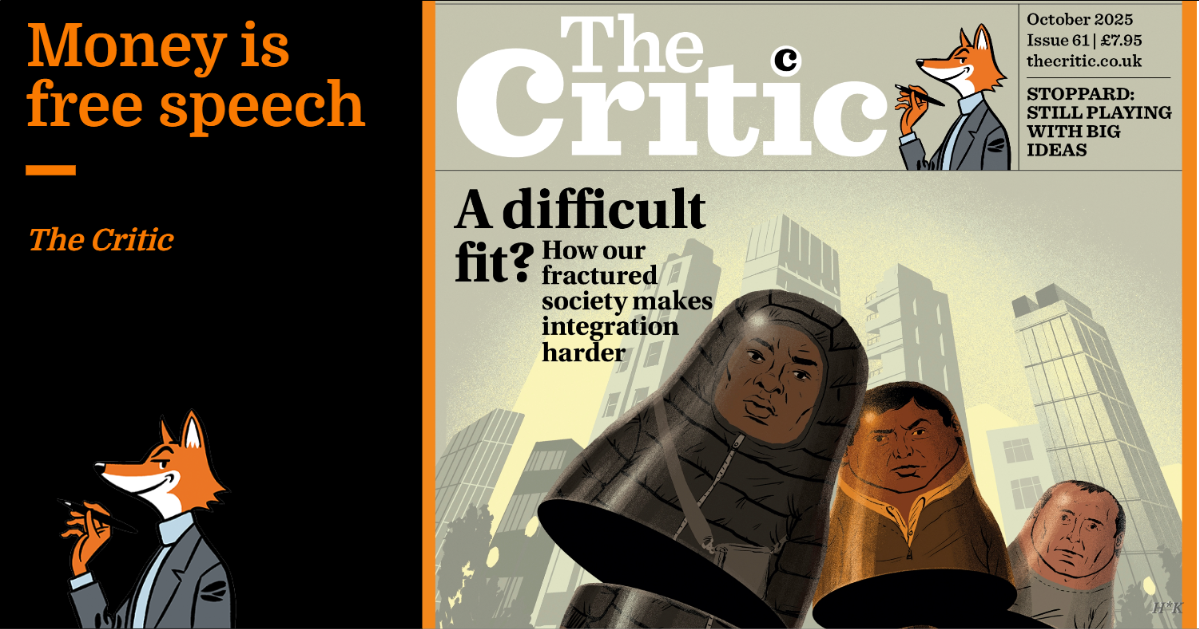
Money is free speech, and it is amoral — it is not up to our bankers how we who earned it choose to spend it. The availability of cash protects us from a situation where we cannot decide what we spend our own money on.
Rus Newton
St Martin, Jersey
The show goes on …
Brexit removed automatic right of free movement for work between the UK and the rest of the EU, but it did not stop people coming here to work. The procedure just changed. Alexandra Wilson [WITH FRIENDS LIKE THESE, OCTOBER] reports Brexit affected opera singers “operating in a global industry” — which seems unlikely.
Andrew Smith
Epping, Essex
Brilliant Brazil
I was fascinated to learn in Alexander Larman’s profile of Tom Stoppard [OCTOBER] that the playwright was a co-scriptwriter for the Terry Gilliam film Brazil. This deserves to be recognised as Stoppard’s masterpiece.
A key part of its satire is that there is no censorship — instead we oppress ourselves with our “computer says no” obsession with the grinding, crushing gears of process.
In an early scene, a simple misprint on a form causes an innocent man to be branded a terrorist. Even as he’s being dragged off in chains, a grey-suited official hands his bewildered wife a stack of paperwork to sign for the arrest: “Here is my receipt, for your receipt,” he declares as they exchange tickets multiple times.
The action hero of Brazil is a heating engineer who ziplines around the city fixing broken radiators instead of sitting waiting for the work orders to be authorised — this is what passes for heroism in a sclerotic world dominated by lawyerly procedure.
Brazil is not a far-off fantasy. With the UK’s unproductiveness signalled by organisational disasters such as HS2 and the Lower Thames Crossing — a planning application over 300,000 pages long — we are living in its world right now. It is my belief that every civil servant should be required to watch Brazil before taking up his role.
Robert Frazer
Salford, Lancashire