One of the remarkable aspects of the current government shutdown is how little it has affected ordinary Americans. Unless you’re a federal employee, are furloughed, or, more likely, are working without pay, the partial closure of the government probably has had minimal effect.
But that appears to be changing. Today, money was due to run out for federal subsidies that help 42 million low-income people buy groceries. But rulings from two federal judges Friday call on the Trump administration to use national-emergency money to continue funding the program this month. That would only delay the spreading effect of the shutdown.
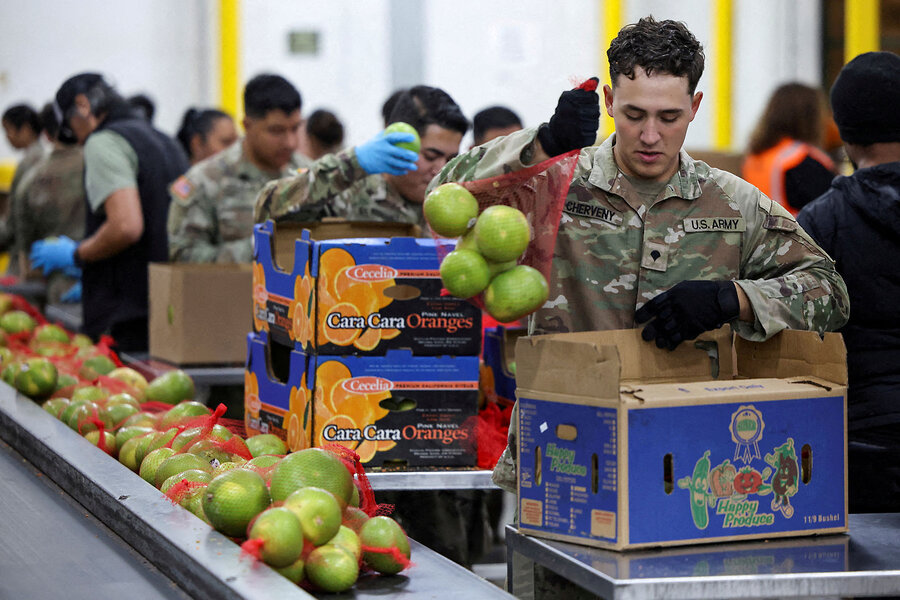
In a couple of weeks, some 1.3 million active-duty service men and women in the military might not get a paycheck. And staffing issues, already causing delays and temporary closures at airports, could lead to a “disaster” during the busiest travel days around Thanksgiving, Vice President JD Vance warned Thursday. Those events alone could change the dynamics of the shutdown and increase political pressure to end it.
Why We Wrote This
Workarounds have shielded most Americans from the government shutdown’s effects, but program interruptions might soon test public patience and political will.
The inability to fund military salaries could have especially sharp political consequences, says Wendy Edelberg, a senior fellow at the Brookings Institution and former chief economist at the Congressional Budget Office. “There’s just a particular egregiousness of people putting their lives on the line to defend the United States and not getting paid.”
The first political test for Congress, which was supposed to start today, involves the Supplemental Nutrition Assistance Program, formerly known as food stamps.
With Republicans and Democrats at odds over funding the government, the Trump administration said before Friday’s judicial rulings that there’s no more money for SNAP. Run by the states but funded by the federal government, it helps low-income people – roughly 1 in 8 Americans – feed their families.

Today’s cutoff, if it takes place, won’t hit all states immediately, since some have found temporary workarounds. States from New Mexico to Virginia have pledged to replace federal funding with state money that will last recipients anywhere from a few days to a month. Other states are sending funds to food banks, hoping they can fill in the grocery gap. It’s a tall order, since food banks are already strained by the extra demand from federal employees no longer receiving a paycheck.
A push for military pay
The Trump administration has done some reshuffling of its own to pay military personnel. On Oct. 15, it tapped unused military research and development funds to ensure full paychecks. On Friday, the administration said it is using a mix of legislative and defense funds and a $130 million donation from one of President Donald Trump’s friends to meet payroll. Critics point out that the anonymous donation, which invites legal, political, and national security challenges, covers only $100 per service member.
Historically, both Democrats and Republicans have used shutdowns because they can make a point with little political cost. That’s possible because shutdowns aren’t universal in scope. High-profile and “essential” government operations, like the Postal Service and air traffic control, must continue without pay for workers. Under the Trump administration, about half of the approximately 2 million federal workers have been deemed essential.
“The Social Security checks go out; the Medicare bills get paid,” says Douglas Holtz-Eakin, president of the American Action Forum, a center-right economic and fiscal policy nonprofit in Washington. “The things that affect the most Americans and have the most money on the line continue to happen.”
Even the National Park Service, which has many nonessential workers, is keeping open some 350 of its 433 sites, which cover more than 85 million acres. It is dramatically reducing services and, in some cases, using admission revenues to keep paying personnel.
But the longer the shutdown continues, the harder workarounds become and the more government programs run out of money.

In some states, the shutdown in Washington has threatened and delayed a federally funded program that helps low-income families pay for heat. A Minnesota group administering the Low Income Home Energy Assistance Program delayed its opening just as lower temperatures are beginning to set in. One local Massachusetts agency had to stop administering its LIHEAP program altogether, while states like Connecticut are using leftover funds from last year to keep operations going for a while.
Another blow to some households begins today, when people start choosing health insurance plans for 2026. Enhanced subsidies end for some 22 million Americans who buy their insurance through the government’s exchanges. On average, Affordable Care Act premiums are expected to more than double, according to KFF, a health policy research group.
Those subsidies lie at the heart of the impasse that led to the shutdown. Democrats refuse to vote for appropriation bills until Republicans agree to extend those subsidies. Republicans want to negotiate them after Democrats agree to end the shutdown.
Who will cry “uncle” first?
The shutdown will end when one or the other party decides that polls show the shutdown is hurting it disproportionately, says Mr. Holtz-Eakin. That’s unlikely to happen before Nov. 4, when voters in New Jersey and Virginia elect a governor and state representatives, he adds.
While shutdowns rarely have a lasting national economic impact, as spending delays in one quarter are often offset in the next, the local impact can be more severe in certain areas.
“The end of the season wasn’t what we were hoping for,” says Ian Blair, co-owner of Kayak Lake Mead, a tour company in White Hills, Arizona, that launches at the foot of the Hoover Dam, a National Historic Landmark. The adjacent Lake Mead National Recreation Area remains open, but with significantly reduced services to accommodate its continued influx of visitors. “It wasn’t the worst, but it definitely wasn’t meeting expectations from the rest of the year,” Mr. Blair says.
The National Parks Conservation Association estimates that communities serving as gateways to the parks risk losing $80 million a day in visitor spending on everything from restaurant meals to gear rentals. In 2024, park visitors in the U.S. spent approximately $29 billion in “gateway regions,” resulting in about $56 billion in economic output, according to a National Park Service report.

In Spruce Pine, North Carolina, clawing back from last year’s floods from Hurricane Helene has been tough enough, says Robert Thomason, owner of Rocks and Things, a gem store. But concerns about the shutdown appear to have led to a slowdown in business along the Blue Ridge Parkway, one of the nation’s most popular park attractions, he says. The parkway, a unit of the park service, connects Shenandoah National Park with Great Smoky Mountains National Park and serves many gateway communities.
“Right now, the leaves are showing beautifully and we’re seeing some leaf-lookers, but that’s our last hope for customers for the rest of the year,” he adds. “We’re gasping for air, you might say.”
As the shutdown drags on, even minor delays begin to wear on those affected by them, says Ms. Edelberg at Brookings. Because of the shutdown, the Small Business Administration is not approving any new loans. A two-week delay is annoying; a six-week delay might feel quite different, she adds. Ditto for those applying for mortgages insured by the Federal Housing Administration, which is also not accepting new applications.
Then there are the federal employees themselves, some of whom face the loss of a third paycheck. “Two paychecks feels kind of shocking,” says Ms. Edelberg at Brookings. “Three paychecks, and I think it starts being a financial catastrophe.”
And it causes many of the best government workers to look for private sector jobs, and foreign investors to reconsider investing in the U.S., she adds. Such costs are hard to determine, but they can have a long-term impact.