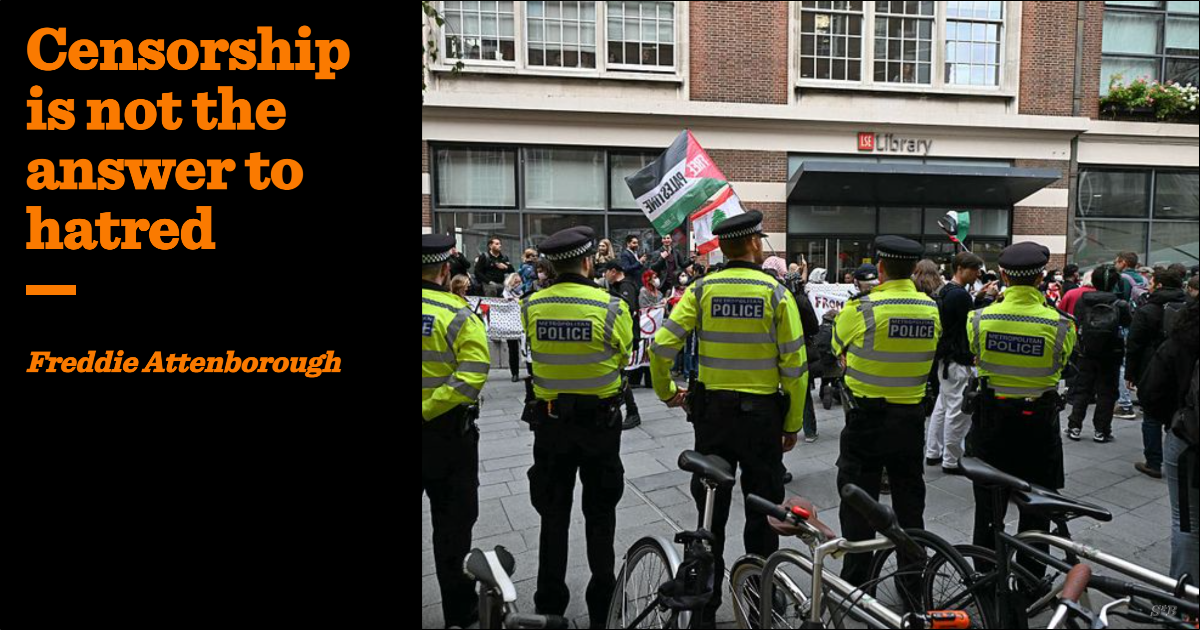
Following a surge of antisemitic incidents on British campuses, the Union of Jewish Students will shortly begin delivering 600 government-funded training sessions for university staff. The Department for Education says these sessions will help academics “identify harassment and hate”. Yet the two terms are not synonymous, and conflating them risks extending the reach of ‘hate speech’ beyond unlawful antisemitic abuse to encompass lawful but controversial debate, including criticism of Israel itself.
Morally speaking, of course, the drawing of that line isn’t particularly easy. Since 7 October 2023, incidents of antisemitic abuse on campus have been simply too numerous to list in full: students spat at, pelted with eggs, threatened with rape, their Star of David necklaces torn from their necks. And in recent weeks, as some activists have literally celebrated the second anniversary of Hamas’s slaughter of more than a thousand Jews in Israel’s southern communities, Britain’s campuses have, if anything, become still more hostile places for Jewish students.
At City St George’s, part of the University of London, Israeli-born economics professor Michael Ben-Gad was targeted over his service in the Israel Defence Forces — a conscript army — during the early 1980s. City Action for Palestine branded him a terrorist and vowed it “will not allow evil to roam free on our campus”. Protesters later stormed his lecture theatre, one allegedly threatening to behead him.
Days later, masked demonstrators besieged a Jewish-history event at University College London organised by the UCL Friends of Israel Society after discovering the relocated venue. Wearing keffiyehs and waving Palestinian flags, they forced their way into the building, chanting “Zionism off campus” and “Crush the Zionist settler state”. Others blocked the entrance shouting “There is only one solution, intifada revolution”, preventing students from hearing an Israeli guest speaker. Police were eventually called to restore order.
At a pro-Palestinian march in London, Oxford undergraduate Samuel Williams was arrested on suspicion of inciting racial hatred after chanting “Gaza Gaza, make us proud, put the Zios in the ground”, a slogan later echoed by activists at Leeds, Cardiff and Queen Mary universities. In Glasgow, the Justice for Palestine Society launched The Gaza Guardian, urging readers to “join the student intifada” and praising “armed resistance”. The group said an event on 7 October was held to “honour our beloved resistance and martyrs”, adding: “We celebrate the glorious Al-Aqsa Flood” — Hamas’s name for its attack on Israel.
Few would dispute the need to protect Jewish students from unlawful acts
Against this grim backdrop, few would dispute the need to protect Jewish students from unlawful acts. Yet the Government’s initiative warrants scrutiny. While harassment is a defined legal concept under the Equality Act 2010 and other statutes, hatred has no independent definition in UK law. What, then, will be taught under this heading of “harassment and hate”? And will those sessions remain anchored in the legal framework that separates unlawful conduct from the expression of lawful, if uncomfortable, opinion?
The sector regulator, the Office for Students, addresses this balance with particular care. Its guidance makes clear that universities have a dual duty: to secure freedom of speech within the law while taking proportionate steps to prevent harassment and intimidation. That framework presumes a high tolerance for lawful expression and cautions against treating mere offence as evidence of harm. It was therefore notable that, in a recent House of Lords debate on antisemitism in universities, the Minister for Skills, Baroness Smith, speaking about the case of Professor Ben-Gad, referred only to “harassment” and “intimidation”, not to “hate” or “hate speech”.
As to the UJS’s likely approach to its training sessions, recent history offers some clues. Alongside the Board of Deputies, the union was among the groups that successfully pressed Education Secretary Bridget Phillipson to pause commencement of the Higher Education (Freedom of Speech) Act in July 2024, claiming that the legislation could unleash a torrent of antisemitic “hate speech”, including Holocaust denial.
That concern was misplaced. The Act defines “freedom of speech” by reference to Article 10 of the European Convention on Human Rights, and the European Court of Human Rights has long held that Article 17 excludes Holocaust denial from protection altogether. Nor would the Act authorise any broader category of unlawful expression or discriminatory conduct. It protects only speech “within the law”, and existing legislation already provides ample safeguards against harassment and against criminal offences aggravated by hostility towards protected characteristics, including the Crime and Disorder Act 1998, the Public Order Act 1986, the Protection from Harassment Act 1997, and the Equality Act 2010.
In some ways it’s that last piece of legislation — the Equality Act — that most clearly shows how blurred the boundary between offensive and unlawful speech has become. In February 2024, an employment tribunal ruled for the first time that anti-Zionist beliefs constitute protected philosophical beliefs under the Act. The claimant, Professor David Miller, had been dismissed by the University of Bristol for describing Zionism as “inherently racist, imperialistic and colonial” and for suggesting that Jewish students were being used as “political pawns” by the Israeli government. His statements were offensive to many and arguably “hateful” in ordinary language. Yet the tribunal found that Miller’s beliefs qualified as a philosophical belief — and therefore as a protected characteristic — under section 10 of the legislation, and that his dismissal amounted to direct discrimination.
These ambiguities are precisely why the language of “hate speech” needs to be handled with care. If the forthcoming UJS training helps staff distinguish between unlawful harassment and lawful, even repugnant, expression, it could provide a valuable service. But if “identifying hate” becomes shorthand for discouraging legitimate criticism of Israel, Zionism or related political movements, it risks entrenching a culture of self-censorship and professional detriment.
Because amidst the genuine surge in antisemitic abuse, it’s worth remembering that this, too, is a problem. Since October 7, several universities and public bodies have appeared to overinterpret the adjective “hateful” — and the conduct associated with it — in ways that penalise lawful expression.
In Abu Qamar v Secretary of State (2024), a tribunal allowed a Palestinian student’s human-rights appeal against the Home Office’s decision to cancel her visa on the grounds that her presence was “not conducive to the public good”. The decision, based on remarks she had made on 7–8 October 2023 about the situation in Gaza, was found to be a disproportionate interference with her Article 10 right to freedom of expression and therefore unlawful under the Human Rights Act. In its reasoning, the tribunal observed that her description of Israel as an “apartheid state” was “consistent with views expressed publicly by human-rights organisations”.
Only by holding that line can they address harassment without sacrificing freedom of speech
At Cardiff University, staff liaised with police ahead of pro-Palestine encampment events, forwarding flyers for a public Friday-prayer gathering and a lecture by a Muslim scholar, and later sharing details of an Egyptian podcaster whom officers described as having “views that are pro-Palestine and not supportive of Israel”. Later that month, a lecturer at another UK university was told he would be investigated by his employer for misconduct after students complained about one of his social media posts, which shared a statement by education workers in Palestine calling for support in the face of Israeli air strikes. And Liverpool Hope University postponed a lecture by Avi Shlaim, emeritus fellow of St Antony’s College, Oxford, after concerns were raised that his views on Israel might pose “wellbeing and safety” risks for students and staff.
The impulse to protect Jewish students is right and necessary. But the best protection lies in resisting the temptation to apply definitions that pertain to people’s inner mental states, and instead enforcing existing statute, which is more than capable of targeting incitement, intimidation, and harassment. So while universities should welcome the government’s support in tackling antisemitism, they must also ensure that every element of its new UJS-delivered programme remains transparently tied to the statutory framework. Only by holding that line can they address harassment without sacrificing freedom of speech to an ever more elastic notion of “hate speech”.