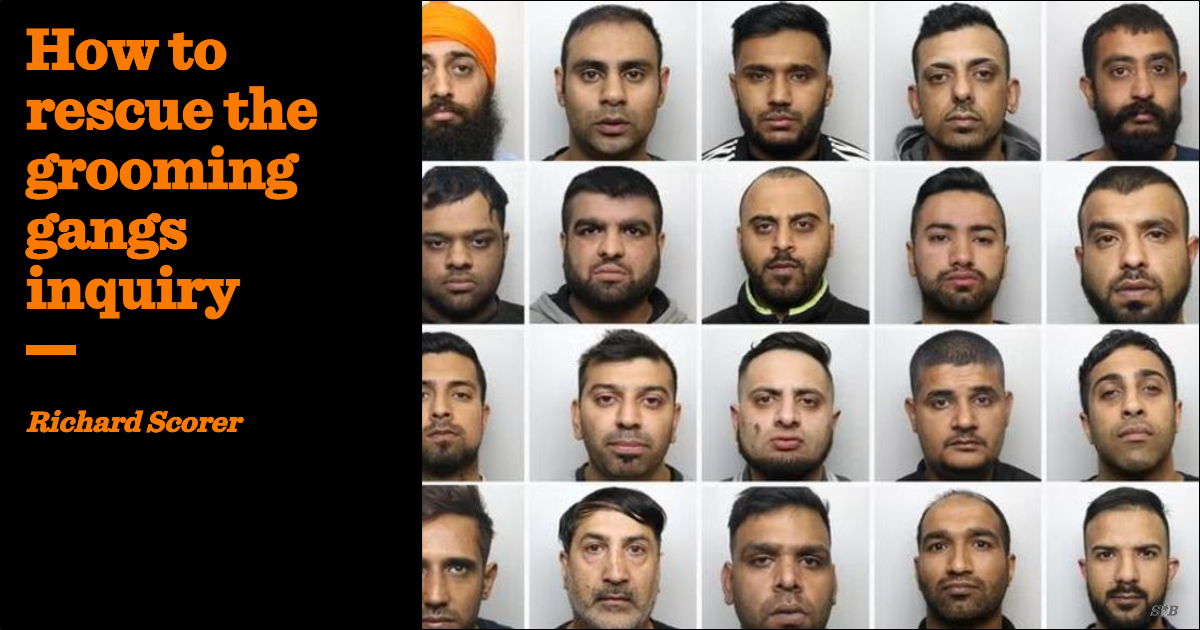
Can the grooming gangs inquiry be salvaged? With the withdrawal of two candidates for chair, and the resignation of several members of the government’s survivor panel bringing it close to collapse, Nigel Farage says the inquiry is “dead in the water”. In its place, he proposes a cross-party parliamentary commission with the power to summon witnesses under oath: in effect, that MPs should step in and do their own inquiry.
This mess and the solution to it can only be understood if the following factors are kept in mind: the deep reluctance of officialdom, and the Home Office in particular, to investigate and expose this scandal; the failure of IICSA, the previous abuse inquiry, to do so; and the nature of the investigation now required.
The survivors who resigned cited two concerns: Home Office stage management of the process, and an attempt to dilute the inquiry’s focus on group-based child sexual exploitation by including other types of child sexual abuse. Neither of these attempts to subvert the inquiry’s independence and remit are at all surprising and they could have been predicted as soon as the Home Office became involved.
In her audit, Louise Casey was clear on the need for a focused inquiry which, amongst other things, would look at why men from certain cultural backgrounds are over-represented in this type of abuse. This over-representation has long been obvious, and the available data, albeit inadequate, confirms it. A 2020 study examined prosecutions for group based child sexual exploitation between 1997 and 2017. It found that “Muslims, particularly Pakistanis, dominate prosecutions” for this type of crime (83 per cent in this large sample). Other studies, possibly less rigorous, have reached the same conclusion. Although the data needs to be improved, the overrepresentation of men of Muslim and Pakistani backgrounds in prosecutions for this subset of sex crime cannot realistically be doubted. The inquiry should be in part about why, how this has affected state responses, and what we can do about it. But the Home Office, as Fiyaz Mughal observed in the Daily Telegraph, instinctively resists scrutiny of anything involving religion or ethnicity, fearing its impact on social cohesion. This results in a “desire to bury difficult truths”. The government has denied that there was any attempt to widen the inquiry away from the focus recommended by Casey, but the suggestion clearly came from somewhere, and the Home Office is the prime suspect. Survivors were right to call it out.
The need for a fresh inquiry arises because of the failure of the previous national abuse inquiry, the Independent Inquiry into Child Sexual Abuse (IICSA), to investigate grooming gangs properly. IICSA sat from 2015 to 2022. I was heavily involved, representing the largest group of victims and survivors. Parts of IICSA were done well: some of the churches were exposed to unprecedented and much needed scrutiny. But the IICSA investigation into child abuse by organised networks was inadequate and ill-conceived. IICSA selected six geographical areas to investigate but bizarrely left out the areas, like Oldham and Bradford, which have experienced the worst scandals. In assessing police and local authority responses, IICSA drew heavily on evidence from corporate witnesses, with very little counterbalancing evidence from individual victims (my firm represented literally the only victim granted core participant status in this part of IICSA, via her mother). That type of evidence is crucial because when victims and survivors give their accounts these tend to be at odds with the much rosier picture of service delivery painted by corporate bodies. IICSA heard very little from those able to describe the reality on the ground, which is why survivors need to be at the centre of any inquiry now. The hearing was only 2 weeks long, in effect about a day per area which was almost no time to interrogate police and social services properly. The issue of perpetrators’ cultural backgrounds was quietly ignored. Despite lots of complaints at the time, IICSA’s approach was never really explained. Survivors have every right to feel that one of the worst scandals in Britain since the Second World War deserved better.
How to rescue this new inquiry? Farage’s idea of a parliamentary commission that investigates and reports “within a couple of months” betrays a lack of understanding of the sheer scale of this scandal and the forensic work involved in investigating it. These crimes occurred in hundreds of British towns and cities over many decades, and are still happening now. A single evidence session involving the questioning of a local authority CEO or a police Child Sexual Exploitation lead would require many hours of preparation. In order for any inquiry to be meaningful, it has to involve examination of individual case files. This is not a small task, but it cannot be avoided. Safeguarding is now a thicket of documentation and Quality Assurance Frameworks. Some victims’ files run to 50 lever arches, although some of the paperwork can be pro forma box ticking which actually disguises inaction. Case files still have to be properly examined to even start to make sense of it all, so this is not an exercise, sadly, that can be done quickly or cheaply, and certainly not in a couple of months. It can be done more quickly if local inquiries in areas like Oldham (where one was promised to survivors, but has now inexplicably stalled) operate in tandem with and feed into the national inquiry.
Some perpetrators have been convicted, but many are now out of jail. Nobody in public office has really been held to account
A parliamentary commission carries other risks. Whatever they say publicly, some MPs want this inquiry to fail. Labour certainly has little to gain and much to lose from a proper inquiry. In fairness to Keir Starmer, he emerges reasonably well from his period as Director of Public Prosecutions — whilst he was in charge cases started to be prosecuted more proactively and in greater numbers, and the CPS tried to base its decision making on evidence and eschew victim stereotypes. But many local authorities have a woeful record in responding to child sexual exploitation, and many of them have been Labour controlled. Labour would rather avoid interrogation of its clientelist relationships with unelected and invariably male “community leaders”. The difficulty in deporting some of the perpetrators begs the question of whether human rights provisions and/or international treaties may sometimes be protecting perpetrators from justice. So this is a difficult inquiry for Labour. But it is difficult for the Conservatives too — in 14 years in office they did little to address grooming gangs and presided over a near collapse of the criminal justice and prison system. So entrusting this to MPs with a vested interest in maintaining the cover up is not the answer.
The reality is that only a properly resourced statutory inquiry, equipped with powers to compel witnesses and force disclosure of documents, and preferably freed from the dead hand of the Home Office, will be equal to the task of unpicking this scandal. In my view this needs to be judge– or at least lawyer–led as some of the organisations under scrutiny will use every possible legal excuse to avoid the truth coming to light, so a chair needs to have the confidence to deploy statutory powers. Survivors undoubtedly deserve a proper investigation and proper accountability. The violence, cruelty and depravity involved in the grooming gang cases puts them in the most serious category, but officialdom repeatedly turned a blind eye. Some perpetrators have been convicted, but many are now out of jail. Nobody in public office has really been held to account. The scale and gravity of this scandal more than justify a public inquiry but if this is to happen it must be done properly: it cannot be a repeat of the IICSA failure. Given the vested interests opposing this, whilst pretending not to, I am not optimistic that this will happen but nobody should be in any doubt about what is required.