This article is taken from the November 2025 issue of The Critic. To get the full magazine why not subscribe? Get five issues for just £25.
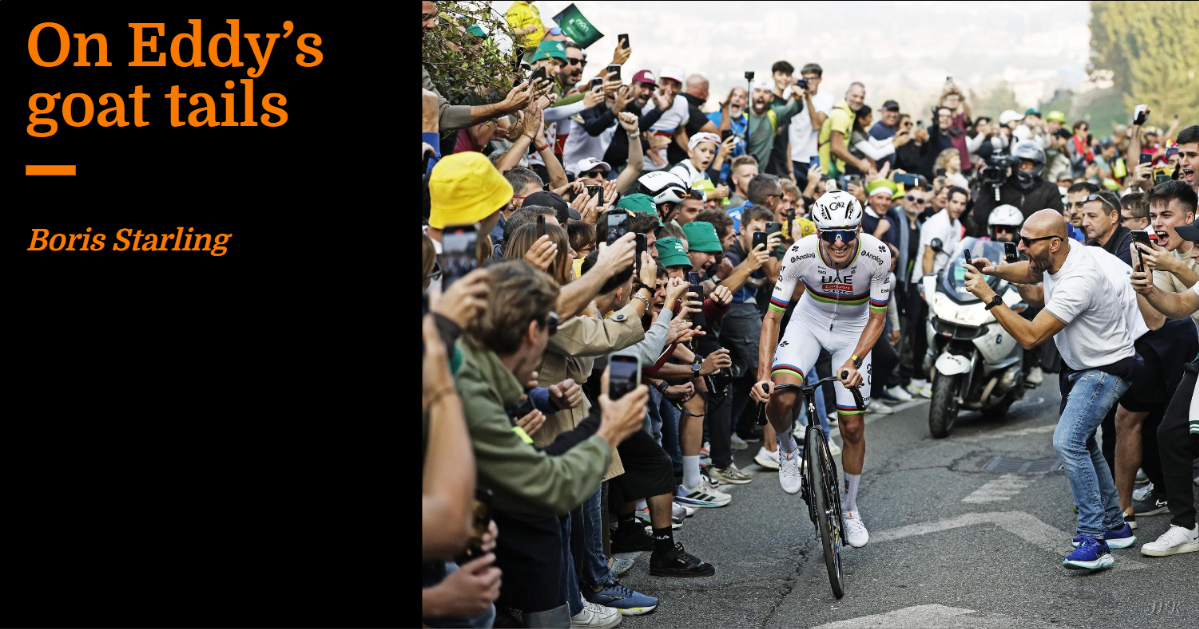
Who’s the greatest cyclist of all time? For the past 50 years, the answer’s been simple: Eddy Merckx first, daylight second. But finally there’s another name in the caprine conversation: Slovenia’s Tadej Pogačar.
A rider’s place in history depends primarily on the nine most prestigious annual races: the three-week Grand Tours (Tour de France, Giro d’Italia, Vuelta a España), the five one-day Monuments (Milan-San Remo, Paris-Roubaix, Ronde van Vlaanderen, Liège-Bastogne-Liège, Il Lombardia) and the World Road Race Championship.
At first glance, bracketing Merckx and Pogačar together looks absurd. Merckx has 11 Grand Tours to Pogačar’s five, 19 Monuments to 10 and three Worlds to two. Merckx won every Grand Tour at least once and every Monument at least twice: Pogačar has yet to conquer the Vuelta, Milan-San Remo or Paris-Roubaix.
But the figures obscure as much as they reveal. Cycling’s a much more globally competitive sport now than it was in Merckx’s day. When Merckx won his first Tour de France in 1969, only nine nations, all Western European, were represented. This year, Pogačar faced opponents from 27 countries spanning all five continents. The breadth and depth of talent, training techniques, technology and nutrition is unprecedented.
Pogačar has already outdone Merckx by some metrics. This season, he became the first to win the Tour/Worlds double twice in a row, win a Monument (Il Lombardia) five consecutive times and podium in all five of the year’s Monuments. And he’s still improving: each of his seven seasons as a professional has been better than the last. He’s only just turned 27 and Merckx was a serial winner until his early thirties (the age Pogačar will be when his current contract expires in 2030).
If all this makes Pogačar sound like a soulless two-wheeled Terminator, nothing could be further from the truth. His domination is such that victory, even in the hardest races, can seem a formality, but there is so much to like about him.
He attacks with panache and daring, often from what seems like a suicidally long way out: both his world titles involved 100km solo breaks. He rides with a smile, and he is generous in praising teammates and rivals alike. “I think we have a really nice generation of cyclists,” he’s said. “The top competitors, I like to race against them. They’re big champions, good guys.”
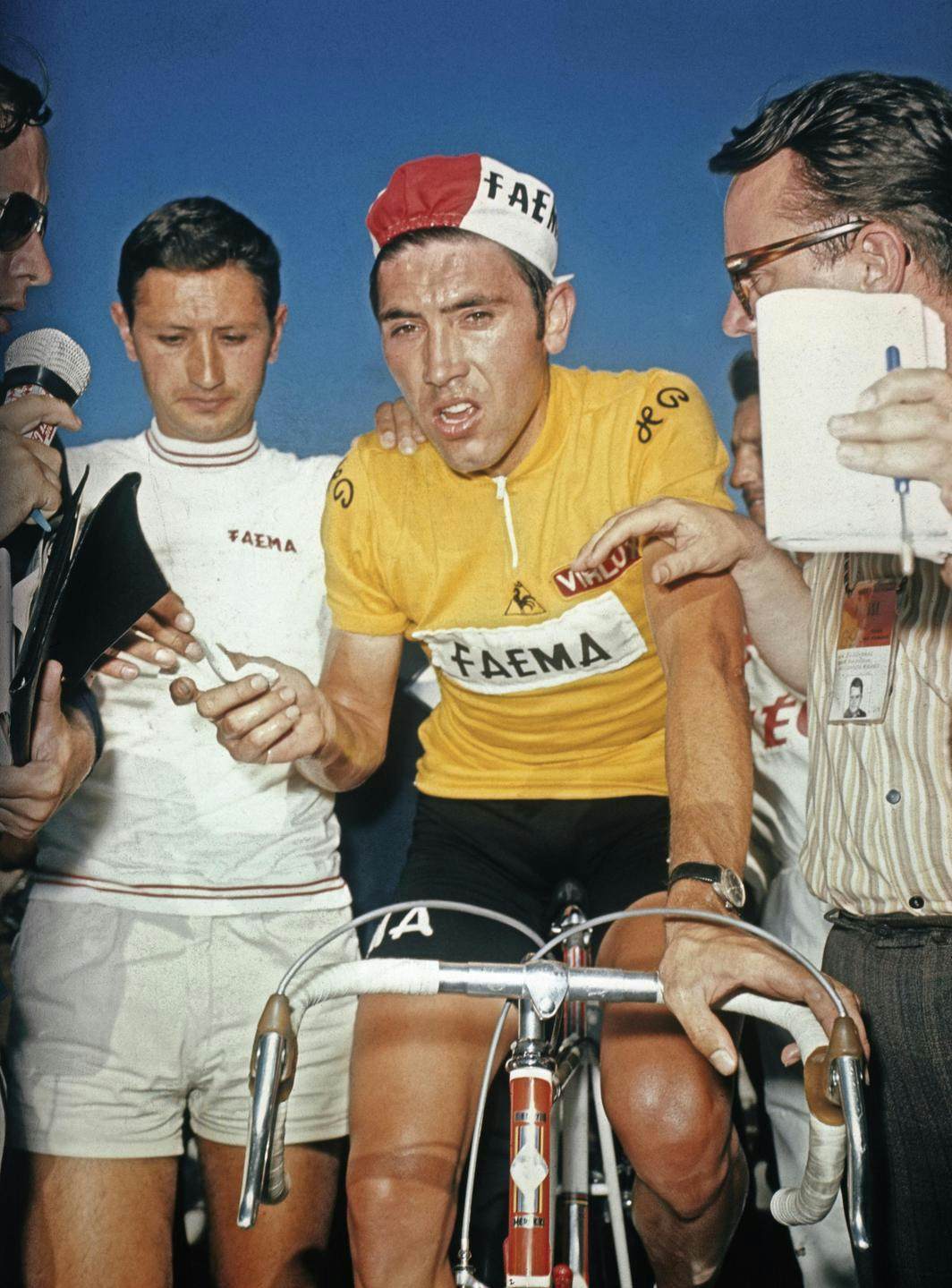
Where Merckx’s response to being told he won too much was to learn “I am completely indifferent” in six languages, Pogačar invites us to share the pleasure of seeing such a supreme talent sublimely expressed. Where Merckx was awe, Pogačar is joy. Nor is he afraid to show his frailties: few watching the merciless close-ups of him struggling on the Col de la Loze in the 2023 Tour will forget the rawness in his desperate statement: “I’m gone, I’m dead.”
If greatness is part numbers, part magic, Pogačar has both: and his story’s still being written. So, assuming he still has the hunger to keep achieving, what does he have to do to put the GOAT debate to bed?
First: complete the set with the three wins he doesn’t yet have. Second: overtake Merckx in at least one significant measure. This doesn’t necessarily mean getting to 12 Grand Tours, 20 Monuments or four worlds: it could be winning six Tours de France, putting him clear not just of Merckx but also Jacques Anquetil, Bernard Hinault and Miguel Indurain, or even going after Mark Cavendish’s Tour stage record of 35.
But there are two unprecedented feats which would really set Pogačar apart. The first is winning all five Monuments in one season. It would need luck, teamwork and daring, especially in Milan-San Remo (which is long but relatively flat, making him easier to mark: he’s called it “the race that’s going to send me to the grave”) and Paris-Roubaix, on whose cobbles even the best riders can come to grief. But it is feasible, involving five stellar days of riding with plenty of recovery time between.
Much harder, perhaps borderline impossible, would be winning all three Grand Tours in the same year. Three Grand Tours equals 63 days of racing, often in extreme weather, where a rider’s effort can be derailed in an instant: a crash, illness, what the French call un jour sans — a day without, when for whatever reason the legs just aren’t there. Given that even Pogačar can only maintain peak form for around six weeks at a time, he would have to ride at least some of those days below optimal condition.
Few cyclists even attempt all three Grand Tours in one year, and the ones who do are usually domestiques who ride for their team leaders and whose own finishing positions are largely irrelevant. The American Sepp Kuss won the 2023 Vuelta having finished 14th in the Giro and 12th in the Tour, but the time gaps to the respective winners in those races are more telling than the finishing positions: he was 13 minutes back in the Giro and 37 minutes in the Tour, huge margins at that level.
The treble would be one of the greatest achievements in all sport, let alone cycling. It may be that Pogačar never even attempts it, let alone completes it. But if anyone can, Tadej can.