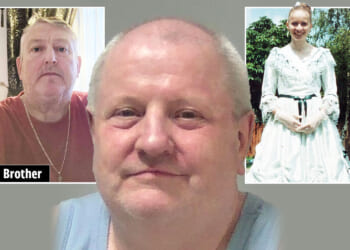
A British soldier who died of a gunshot wound after being injured by a bomb in Ukraine was ‘concerned about how war casualties were being dealt with’, and inquest has heard.
Former Royal Marine commando Oliver Bovey was fighting against Russian forces in the Donetsk region when an explosion caused by either an anti-personnel mine or an IED left him with leg injuries.
It is believed that the 27-year-old could have survived his initial injuries as a tourniquet was applied.
But a post mortem carried out back in the UK found he had suffered a single gunshot wound ‘to the roof of the mouth’, which was consistent with being inflicted by a ‘high velocity’ assault rifle.
Coroner Darren Salter told a hearing at Oxford Coroners Court there was ‘insufficient’ evidence to record a verdict of suicide – as there were no witnesses or evidence of intent.
‘The issue and nature of the gunshot wound to the head raises consideration maybe it was a self-inflicted gunshot’, he said.
‘But to reach a conclusion of suicide, we need to determine did they intend to end their life.
‘Oli sustained blast injuries to his lower legs. This is not a typical case of suicide. There isn’t evidence to sufficiently indicate Oli was responsible for the gunshot wound to his head.’
The inquest heard Oli, of Torquay, Devon, had raised concerns with his loved ones back at home about the ‘evacuation of injured troops’ shortly before his death.
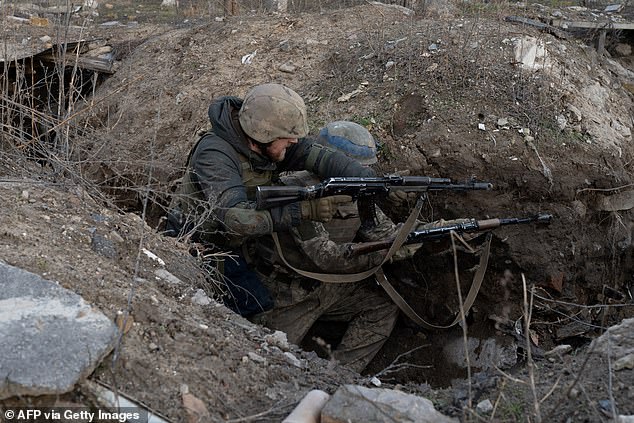
Soldiers amid the Russian invasion of Ukraine in January of this year (stock image)
Mr Salter said there was a concern Oli had raised in advance about the ‘evacuation of the injured’, and acknowledged there was ‘uncertainty’ about what had happened during the incident in November last year.
‘Unfortunately, there is an air of uncertainty around the specific circumstances’, he said.
‘There was a fatal gunshot wound to the head that could have been self-inflicted – but we don’t know what happened and it could been inflicted by someone else as well.’
The inquest was told Oli had been involved in active combat in a ‘populated area’, where a number of casualties had been recovered around that time, and taken to the local bureau for medical examination.
A post-mortem was conducted at the Royal Devon and Exeter Hospital in December 2024 by Dr Russell Delaney.
He concluded the ‘blast injuries’ to his lower legs were ‘in keeping with shrapnel – most likely an anti-personnel mine or IED that exploded under his legs.’
He wrote in his report that this would have caused ‘immediate blood loss, but not immediate death’, adding he ‘would have been amenable’ to treatment.
Ukrainian authorities confirmed a tourniquet was put in place, and an initial post-mortem carried out overseas did not record a gunshot wound, and instead listed death as being caused by a ‘shrapnel wound’.
But Dr Delaney concluded a separate ‘penetrating wound to the head, with entry to the roof of the mouth’ was the cause of death.
He added the wound was consistent with being caused by a ‘high velocity assault rifle’ and would have been the ‘immediate and principle cause of his death’.
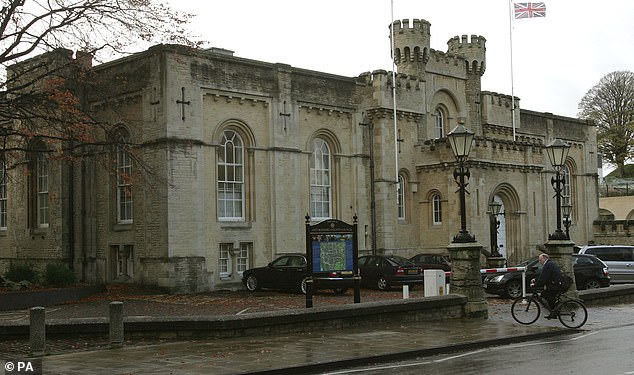
The inquest at Oxford Coroner’s Court (pictured) heard Oli, of Torquay, Devon, had raised concerns with his loved ones back at home about the ‘evacuation of injured troops’
‘Had he survived longer, the injuries to the lower leg could ultimately have proved fatal,’ the report added.
Dr Delaney said it was ‘feasible’ for the gunshot wound to be self-inflicted, or inflicted by another person, and that it was ‘not possible’ for the post-mortem to determine reason or intent.
Recording a narrative verdict, Mr Salter said: ‘We don’t have any eyewitness accounts if there were any to know exactly what happened initially.
‘It does seem to be the case the lower limb injury from the explosion happened first and a tourniquet was applied.
‘We have the messages to Oli’s friend with the issue of him raising a question mark about recovering him from the battlefield. We don’t know how concerning that was to Oli but it was shortly before his death.
‘There is uncertainty about what happened. It concerns the unreliability of the Ukrainian evidence and an inability to call further evidence.
‘We have little detail about how the gunshot wound was inflicted – we can not say anymore than that.
‘I can not rule out it may have been Oli who inflicted that wound when he was extremely injured – but equally it could have been inflicted by other person.
‘There isn’t evidence to record his death as suicide
‘It is a little open as we don’t know details about that.’
In his formal conclusion, Mr Salter added: ‘Oliver Bovey was serving in the international legion of the Ukrainian army on the 27 November, 2024.
‘While on a combat mission near the village of Hryhorivka, Bakhmut District, Donetsk Region, he sustained blast injuries to his legs, mostly likely from an anti-personnel mine or improvised explosive device
‘These injuries would not have resulted in immediate death, and it appears a tourniquet was applied. There was also a single gunshot wound into the roof of the mouth resulting in rapid death.
‘This could have been self-inflicted or inflicted by another person.’
– For confidential support call the Samaritans on 116123 or visit a local Samaritans branch, see www.samaritans.org for details