SHOCKING images taken after the fall of El Fasher in Sudan show vast patches of red-stained sand and clusters of bodies, marking a massacre so large it is visible from space.
Analysis by Yale University indicates that more than 2,000 civilians were killed as Rapid Support Forces (RSF) fighters seized the city in one of the deadliest episodes in Sudan’s two-year civil war.
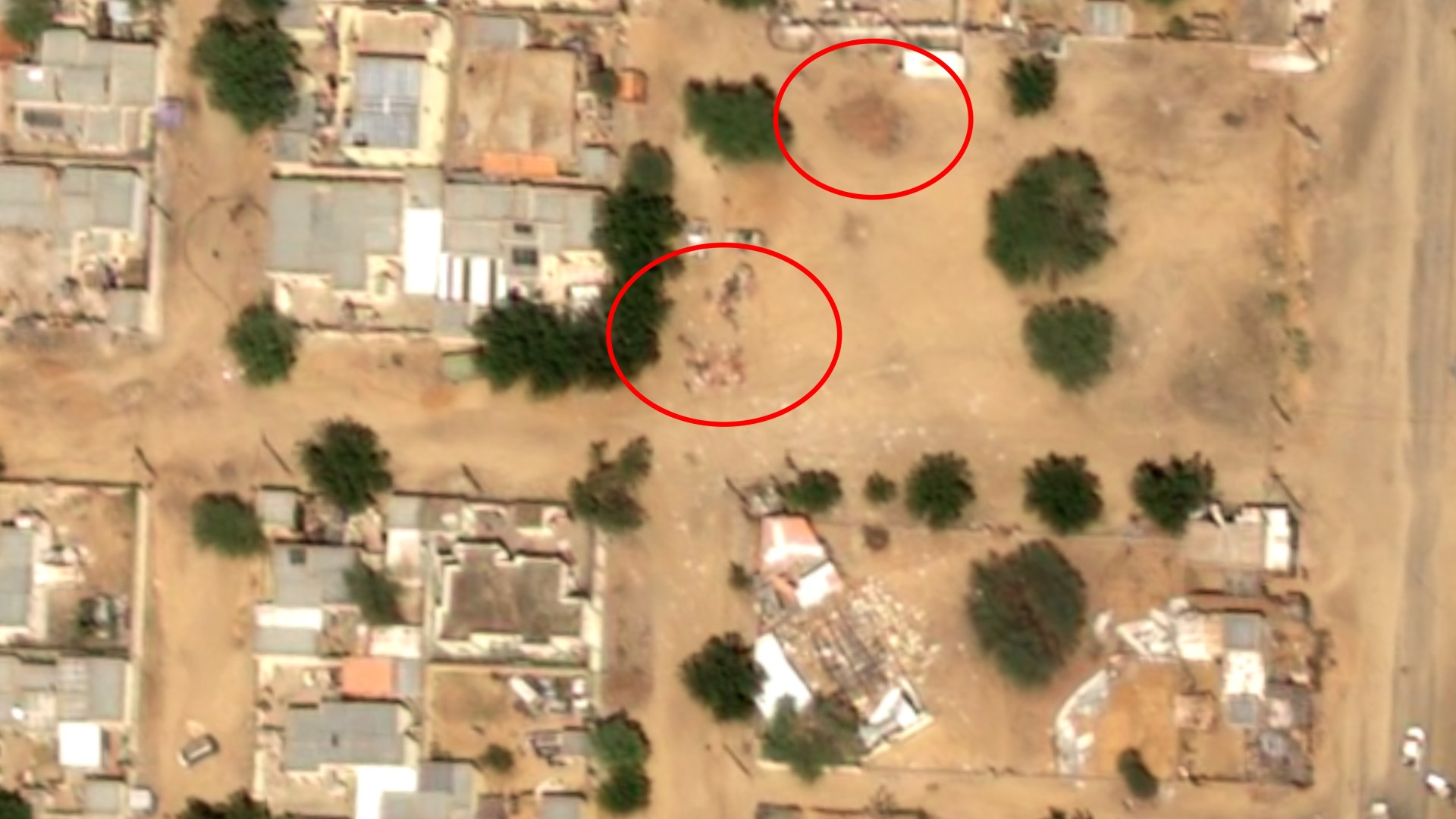
In the city’s Daraja Oula neighbourhood, analysts from the Yale School of Public Health’s Humanitarian Research Lab (HRL) found “clusters of objects consistent with the size of human bodies” and “reddish ground discolouration”.
In one image, light and dark shapes, each around two metres long, lie strewn beside pickup trucks and sand berms.
The reddish stains weren’t there in earlier photos.
Nearby, vehicles block side streets in what investigators describe as “door-to-door clearance operations.”
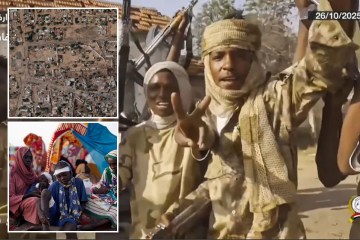
At least five separate clusters of bodies appear around the city’s perimeter, where witnesses say civilians were shot trying to flee.
The Yale team concluded: “El Fasher appears to be in a systematic and intentional process of ethnic cleansing of indigenous non-Arab communities through forced displacement and summary execution.”
Local militia fighting alongside the army said the RSF “committed heinous crimes against innocent civilians,” claiming most victims were women, children, and the elderly.
In just 48 hours, more than 2,000 civilians were “executed and killed”, according to the Sudanese army’s Joint Forces.
Videos shared online show RSF fighters gunning down captives at point-blank range.
In one, a child soldier shoots a man in cold blood, and another shows rebels pretend to release prisoners before executing them.
The UN Human Rights Office said it had received “multiple, alarming reports that the RSF are carrying out atrocities, including summary executions.”
British Foreign Secretary Yvette Cooper said: “We are witnessing a deeply disturbing pattern of abuses in El Fasher, including systematic killings, torture, and sexual violence.”
At the 157th Artillery Brigade base, satellite coordinates show fresh clusters of bodies along the berm, which were “not present in prior imagery.”
Elsewhere, two tanks, believed to be Soviet-made T-55s, appear in the RSF’s control zone.
The once-bustling 6th Division Headquarters is now blackened by “thermal scarring” from at least 15 munitions impacts.
South of the city, hundreds of people can be seen on the B26 road, fleeing on foot toward RSF-controlled camps.
HRL analysts described “large groups of objects consistent with people,” matching eyewitness videos of families running for their lives as fighters shout racial slurs and open fire.
“Kill the Nuba,” one gunman screams in a clip verified by researchers in a chilling echo of Darfur’s genocidal past.
Cameron Hudson, a former U.S. National Security Council director for Africa, said: “We have seen what is unfolding in El Fasher before.
“It was two years ago in El Geneina … It’s happening again and still we do nothing. Shame on them. Shame on us.”
The RSF, largely drawn from Arab militias once known as the Janjaweed, stands accused of repeating the genocidal tactics it unleashed in Darfur 20 years ago.
The group has been fighting Sudan’s army since April 2023, when a power struggle between Gen Abdel Fattah al-Burhan and Gen Mohamed Hamdan Dagalo (Hemedti) exploded into full-scale civil war.
Since then, 14 million people have been displaced and up to 150,000 killed, according to humanitarian agencies.
The UN calls it the world’s worst humanitarian crisis.
Before El Fasher fell, the city had been under siege for 18 months. Over 260,000 civilians, half of them children, were trapped without food or medicine. Many were eating animal fodder to survive.
Now, the RSF controls every Darfur state capital, effectively partitioning Sudan.
Analysts say the army’s withdrawal marks a turning point — and perhaps the death of a united Sudan.
General al-Burhan said his forces had pulled back “to a safer location” but vowed to fight “until this land is purified.”
The European Union said it was “deeply concerned” and urged all sides to de-escalate. “There can be no impunity,” said EU foreign affairs spokesman Anouar El Anouni.
UN rights chief Volker Türk warned that the risk of “ethnically motivated violations and atrocities” was “mounting by the day.”


The RSF’s past record is grim. When it seized El Geneina in 2023, an estimated 15,000 civilians were massacred.
The same playbook appears to be unfolding now: house-to-house killings, racial targeting, and executions near city limits.