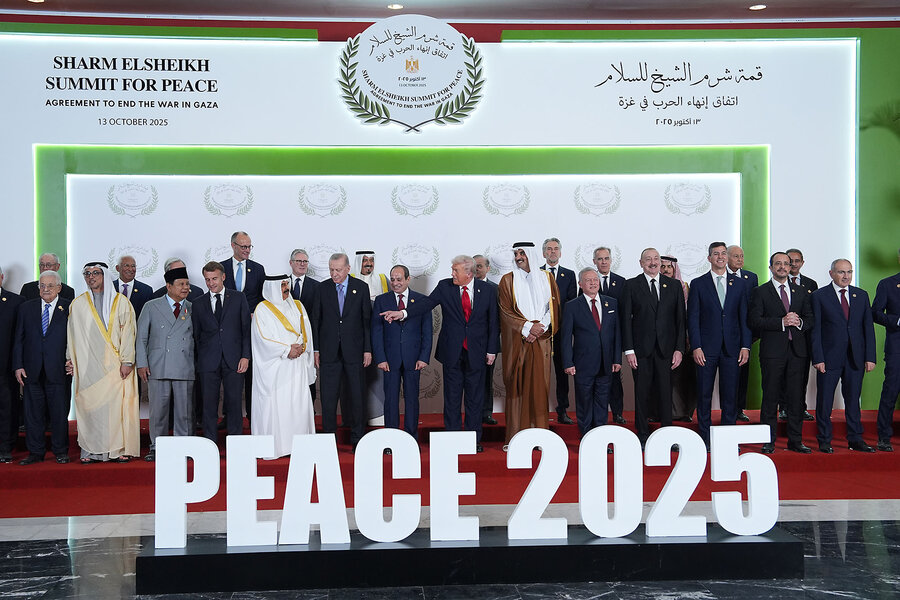
When President Donald Trump announced agreement to his Gaza peace plan at a summit this month in Egypt with Middle Eastern and world leaders, Iran was not in the lineup.
Tehran had been invited to hear Mr. Trump’s proclamation of peace, but refused to attend.
That was unsurprising, given that Iran is a key supporter of Hamas, a member of its regional “Axis of Resistance” – an alliance that Israel and the United States have militarily weakened in a corollary to the two-year war in Gaza.
Why We Wrote This
Iran quietly voiced support for the Trump ceasefire plan for Gaza, based on its ally Hamas’ acceptance of the deal. More broadly, analysts say, Tehran is trying to change the narrative about its regional posture, painting Israel as the real threat.
Explaining his country’s absence, Iranian Foreign Minister Abbas Araghchi said top officials favored diplomacy, but could not “engage with counterparts who have attacked the Iranian people and continue to threaten and sanction us.”
But Iran did not oppose Mr. Trump’s deal, and instead quietly issued a statement in support of Hamas’ decision to accept Washington’s Gaza plan. In its first phase that has yielded a ceasefire, the release of Israeli hostages and Palestinian prisoners, an influx of humanitarian aid, and a partial Israeli withdrawal.
Tehran’s quiet support is consistent with what analysts see as an Iranian bid to change the narrative about its role in the region, at Israel’s expense.
“They didn’t speak about it loudly, but they didn’t oppose it, either,” says Hassan Ahmadian, an assistant professor of Middle East and North Africa studies at Tehran University.

“I don’t buy it as Iran acquiescing to what the Trump administration is trying to achieve in the Middle East,” says Dr. Ahmadian. “Iran wanted to stop the war. President Trump stopped it, and Hamas accepted it … and the Iranians said, ‘OK, if you [Hamas] are OK with it, we are OK with it.’”
The Islamic Republic does not recognize Israel, and its leaders repeatedly predict its inevitable demise. And while Iran backs Hamas’ decision on Phase 1 of the Gaza deal, it will be much harder to digest subsequent steps – especially favorable to Israel – which will require Hamas to disarm and play no role in government.
Potential paradigm shift
The Axis of Resistance, and Iran itself, have been heavily damaged in the violent aftermath of the Oct. 7, 2023, attack on Israel, in which Hamas killed some 1,200 people, took 251 hostage, and traumatized the Jewish nation.
Yet the scale of the devastation that Israel has wrought in retaliation, and the chain of regional events that have unfolded, have also created such shock waves that Iran sees a beneficial paradigm shift in the region.
“What the Israelis have been doing gave Iran a lot of space to act diplomatically,” says Dr. Ahmadian. “Absent Israeli provocations left and right, Iran would have had a harder time to get closer and build stronger ties with the Arab region.”
Before the Hamas attack, Iran was widely seen as “the prime threat to many in the region,” he says. “Or at least the perception was that Iran was not a friendly country,” and that Arab governments could balance the region by normalizing relations with Israel.
“After Oct. 7 to today, the Israelis have put themselves in that position” of posing a regional threat, “and the Iranians got out of it to a large extent, thanks to what the Israelis are doing,” Dr. Ahmadian says.
Just hours before the peace ceremony in Sharm El-Sheikh, Mr. Trump addressed the Knesset, Israel’s parliament. “It would be great if we made a peace deal with [Iran]. Wouldn’t it be nice?” he told Israeli lawmakers. “I think they want to.
But any sense that Iran might dance to the American tune in the Middle East – by accepting a Gaza ceasefire that Mr. Trump said would bring peace for the “first time in 3,000 years” – was undercut last week when Iran’s supreme leader, Ayatollah Ali Khamenei, delivered a scathing address.
Mr. Trump had tried to “boost the morale of the disappointed Zionists in occupied Palestine with a handful of empty words and his buffoonery,” said Mr. Khamenei, whose 3 1/2-decade rule has ensured that anti-U.S. and anti-Israeli sentiment remain enshrined in Iranian revolutionary ideals.
Did Iran’s Axis alliance win?
Nonetheless, discussion has emerged in Iran about the multitude of costly blows Iran and its allies, such as Hezbollah, suffered at the hands of Israel and the United States, and whether Axis of Resistance forces “won.”
In Gaza, the death toll reached 67,000, and Israeli airstrikes forced most Palestinian families from their homes, which had been largely reduced to rubble.

That prompted some U.N. investigative bodies and scholars to describe Israel’s actions as amounting to genocide, a characterization Israel rejects.
In Lebanon, Hezbollah, Iran’s most powerful ally, has seen its top leadership wiped out by Israeli strikes. The militia’s vast missile arsenal has been diminished, its political power reduced, and its Shiite strongholds devastated. Thousands of Hezbollah fighters and thousands of Lebanese civilians were killed.
And Iran itself, which had exchanged limited blows with Israel in 2024, weathered 12 days of sweeping Israeli airstrikes in June that killed top commanders of Iran’s Revolutionary Guard and a dozen key nuclear scientists, damaged missile and nuclear sites, and left a death toll of more than 1,000.
Iran responded by firing some 550 ballistic missiles and more than 1,000 drones at Israel, striking military targets and residential buildings in Israel and leaving 33 Israelis dead. Mr. Trump ordered U.S. forces to join the battle, deploying bunker-buster bombs for the first time against Iran’s deepest underground nuclear facility.
Israeli operations across the region included hundreds of strikes to destroy Syria’s military capabilities, after the ouster last December of President Bashar al-Assad, a key Iranian ally. Israel and the U.S. have also repeatedly struck pro-Iran Houthis in Yemen, which frequently fired missiles at Israel.
Campaign to “gain friends”
For much of the Israel-Hamas conflict, Iran signaled its desire to avoid all-out war with Israel and the U.S., even while supporting limited “solidarity” attacks by its allies against Israel. But that reticence, some analysts say, encouraged much more opportunistic and destructive Israeli moves – especially in Lebanon against Hezbollah, and then against Iran itself.
Tehran might, however, have achieved a higher purpose by changing the narrative about Iran, says Narges Bajoghli, an associate professor of Middle East Studies at the Johns Hopkins School of Advanced International Studies in Washington.
“Because it has been so isolated in the region for so long … Iran had to play the game in a special way” to counter 45 years of being portrayed as a “blood-thirsty, irrational actor,” she says.
“Now, because its arch-enemy in the region, Israel, was acting in a way that was starting to produce more enemies, Iran had to respond to gain friends, rather than solidify foes,” says Dr. Bajoghli.
“That was part of their decision-making, because now Iran is coming across as the state that is not trying to drag the world into a deeper war,” she says. “That’s a big narrative win, after so many years of being really painted across the globe as this crazy place.”