
Does being a feminist make you a conspiracy theorist? It’s something I’ve worried about for years. “Don’t worry,” I will tell people. “I don’t think ‘the patriarchy’ is literally a group of super-powerful men meeting to decide how best to screw women over. I don’t think they’re all in league with one another.” Only these days, sometimes I do.
Certainly, I no longer consider the representation of women as inferior and exploitable merely a misconception in need of correction, the kind of thing one might fix with a few UN Women-style tweets. Whether one is considering the co-defendants in the Pelicot trial, the escalating abuses of the Taliban or the global network of men — named and unnamed — in Virginia Roberts Guiffre’s memoir, there is something not just systematic, but deliberate, shared and unashamed about patriarchy’s worst excesses. Dehumanisation is not an accident, but an ongoing project, following multiple scripts.
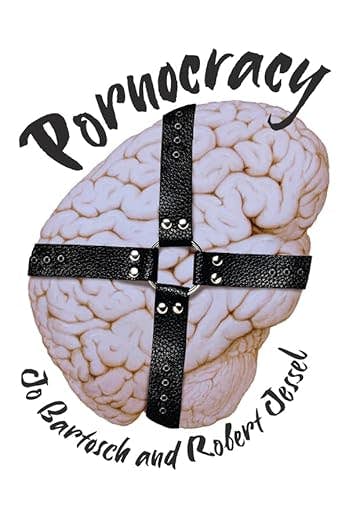
Multiple people sat down, for instance, and scripted the following scenario, outlined in Jo Bartosch and Robert Jessel’s excellent new book, Pornocracy:
A woman stands in a room with several men. She is fully clothed. […] If she manages to leave the room, she’ll receive money. For each article of clothing she has at the end of the scene, she’ll also get cash. For each sex act the men compel her to perform, they’ll get paid and she’ll lose the same amount from her fee.
It’s a situation designed to accurately depict sexual assault — “the men are genuinely attacking the woman, who is genuinely attempting to resist them” — without being legally classified as such. Yet, as the authors go on to note (and their book goes on to show), “under the Pornocracy, this counts as a relatively ‘vanilla’ scene”.
Bartosch and Jessel are not ones to fear potential accusations of conspiracy theorising (alongside the fellow sins of “promoting stigma” and “stoking moral panic”). From the outset they make their thesis clear. “We might not realise it,” they write, “but we are all subjects of the Pornocracy — a system where our minds, relationships and laws are shaped by global-scale sexual exploitation.” You do not have to make or watch porn yourself to be affected by its representation of men, women, children and the power relations between them. As they argue in the chapter “Pulled Apart By Porn”, men and women’s attitudes towards one another — from what a member of the opposite sex is to who exists to serve whom — are deeply influenced by modern-day porn narratives. As I suggest in my own book Unkind, the global porn industry has picked up where conduct manuals, conservative gender essentialism and religious fundamentalism left off.
The double standard that protects porn is staggering
In many ways, this should not be a complex argument for liberal feminism to grasp. It already gets the basics. Not everyone has to read the same books or listen to the same sermons or believe in the same gods for everyone to be affected by a dominant belief system which positions women as passive, masochistic, hollowed out, in need of punishment. What happens to perceptions of women and girls when, as Bartosch and Jessel write, “in our pockets, just a click away, is a realm where men are subjects and women objects”? Why should one such realm be considered less harmful than any other?
Yet the double standard that protects porn is staggering. On the face of it, it is baffling that the rise of #MeToo and the left’s obsession with hate speech have done nothing to mitigate its influence. As Helen Lewis wrote in 2020’s Difficult Women, “we subject other forms of culture to intense scrutiny – ‘Is Girls racist?’, ‘Is The League of Gentlemen transphobic?’ – and leave porn untouched”. Bartosch and Jessel point out that “as zombie feminists have continued to censoriously carp about micro-aggressions and trivialities, the moral revulsion once aimed at men who paid for sex has abated”. More than that — there are “feminists” who actively lead the charge to defend the indefensible.
In her recent book Enemy Feminisms, Sophie Lewis takes feminists past and present to task for racism and siding with the oppressor. Nonetheless, she also finds time to defend “porno magazines and movies involving KKK and plantation scenarios” on the basis that “even here, unexpected pleasures may arise for both porn workers and viewers”:
To playact rape is not the same as rape, even if and even when the reasons people enjoy playacting it, and watching others playact it, stem from the influence of the real thing on our desires as they are presently constituted—real desire to harm, and real traumatized repetition compulsion.
For Lewis, porn occupies a magic sphere, in which it is not part of, but merely a response to and reflection of cultures which enable and facilitate rape. Somehow, she — someone who views “pornophobic” feminists as more complicit in harm than pornographers themselves — is not considered the one to be indulging in wild imaginings.
Lewis’s position is reminiscent of that of Judith Butler. In her 1999 takedown of Butler, Martha Nussbaum notes that Butler’s (unoriginal) observation that power structures are eroticized leads her to conclude that “we all eroticize the power structures that oppress us, and can thus find sexual pleasure only within their confines”:
For Butler, the act of subversion is so riveting, so sexy, that it is a bad dream to think that the world will actually get better. What a bore equality is! No bondage, no delight.
Real, drudgy equality is a boner killer — or at least it is to the terminally unimaginative. What research actually shows — as explored in the second chapter of Pornocracy — is that exposure to more extreme material creates sexual dysfunction and misdirects desire.
The sacred status of porn — no matter how abusive or hateful it is — can make combatting its influence feel an insurmountable challenge. It can also make other attempts to challenge misogyny feel toothless. Seriously, what is the point in raging about the portrayal of women by the tradwife movement — submissive, passive, blank-eyed, servile — if you’re all in with it the moment it’s repackaged as an edgy femme identity? Why bother complaining about stochastic terrorism if you won’t ever draw the well-established link between systemic violence against women and children and the “normalising” narratives of porn? Yet this dissonance makes books such as Pornocracy matter all the more.
Pretending the large-scale dehumanisation and abuse of women and girls is some terrible mix-up — while the male orgasm is sacred — is less likely to see you treated as an extremist. You are less likely to receive, as Bartosch no doubt correctly perceives she will, “unhinged emails peppered with the same slurs thrown at women in pornography”. But you are also less likely to ever understand why misogyny is so persistent and deep-rooted or to have the tools — some of them suggested at the end of the book — with which to combat it.
“Under pornocracy,” write Bartosch and Jessel, with characteristic bluntness, “collective progress and the concept of human rights risk being overtaken by a single, overwhelming demand: the right to be fucked”. This is not a conspiracy theory. It is a choice.