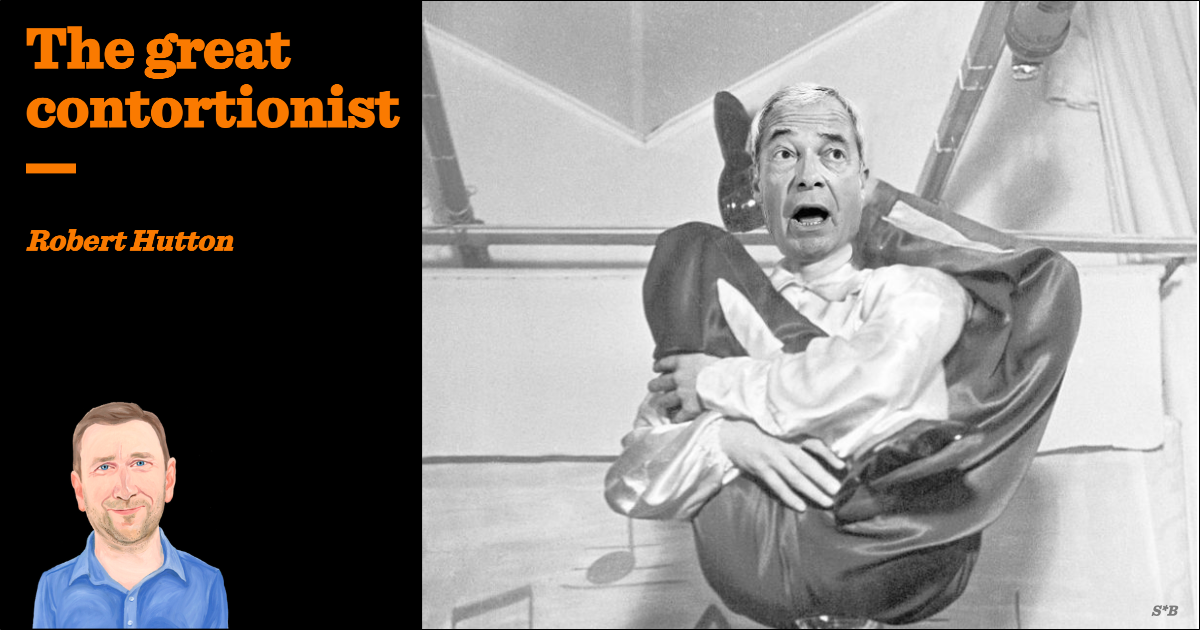
“I want to propose today a better, quicker, more open and more transparent solution!” Nigel Farage sounded like he was in an advertisement for soap powder. Thirty years ago he would have been going door to door, flirting with housewives before turning to the camera and telling us that Reform gives you whiter whites.
The subject of colour in advertising was a touchy one for the Reform leader on Monday. The weekend had been dominated by comments from Sarah Pochin, one of the less-than-brilliant whites that make up the party in the House of Commons. “It drives me mad,” Pochin told Talk TV, entirely of her own free will, “when I see adverts full of black people, full of Asian people.” She subsequently apologised “unreservedly”, using the definition of “unreservedly” in which to explain that you meant exactly what you said: there are too many brown people in TV ads.
For some months now Westminster observers have been wondering when people on the right would notice that they were now saying things that would have got them thrown out of their parties 20 or even 30 years ago. Would “It drives me mad when I see adverts full of black people” be the moment?
This was the question with which Conservative spokesman Chris Philp had been forced to wrestle on Sunday. In a painful series of broadcast interviews he had first insisted it wasn’t racist — after all, if it were then his colleague Robert Jenrick might have faced some difficult questions — and then, presumably after a phone call from headquarters, had revealed that he did now believe that expressing horror at the sight of dark skin probably was racism.
What would Farage do? To suspend the whip would have continued the one-in, one-out approach to gathering MPs that his party has operated over the past year, a somewhat embarrassing state of affairs for a man who hopes to form a government.
A lesser politician — a Philp, say — might have struggled to find a way through. Not Farage. Pochin’s words “could be read to be very, very unpleasant indeed”, he told the assembled press. We held our breath to see how he would escape. “However.” Go on, Nige, give it to us! “However, it was in the broader context of the DEI madness in the advertising industry.” So although there was one reading of her words that was “very, very unpleasant”, there was another one that she had a point.
“The way she put it, the way she worded it was wrong and was ugly,” he went on, “and if I thought that the intention behind it was racist, would have taken a lot more action than I have today.” There we had it. Pochin isn’t racist, because when she says there are too many black people on the telly, she’s right!
It isn’t easy being a leader of a political party, you know. “I don’t like the way in which she did it,” Farage explained, as the questions went on. “I am very unhappy with her indeed. But if I felt the intention was deliberately and genuinely racist, I would have taken a different course of action.” This was accidental racism. Let him among us who has not gone on television and complained that the sight of black people drives us mad cast the first stone.
Of course, Sarah Pochin is just one of Reform’s troubling figures
Farage had by now become quite snippy with all these questions about Pochin’s accidental racism, but there was time for one more: did he want ad companies to use fewer black actors? “I’m just not going to demean myself by answering that,” he laughed, but then he couldn’t help himself. “Other than to say the DEI industry has gone for actors.” There won’t be any more black Macbeths under a Reform government.
Of course, Sarah Pochin is just one of Reform’s troubling figures. We turned to Nathan Gill, the leader of the party in Wales, who’s just pled guilty to taking money from the Russians to spout their lines. “I’m deeply shocked,” Farage said. He’d known him for a long time. “For goodness’ sake, he was a bishop! He used to preach every Sunday morning in the Mormon church. He didn’t even drink coffee!” Poor Farage. Every party he leads finds itself recruiting deeply unpleasant people. If only he could find the common factor.
Perhaps Farage has his eye on a new celebrity recruit. We were there to discuss his call for a new kind of inquiry into grooming gangs. You might remember that, back in January, Farage demanded a public inquiry, and ministers replied that this would be horribly complicated and slow. Now we are having a public inquiry and Farage was furious because — who could have foreseen? — it is proving horribly complicated and slow. He now proposes a parliamentary inquiry, an idea we can be fairly confident he’ll denounce if it’s ever adopted.
On the subject of grooming, the Reform leader was asked for his thoughts on Prince Andrew.“Frankly, I think Parliament shouldn’t interfere in areas like this,” he said, at the end of a press conference that had been called to explain why parliament should be interfering in an area like this.