It is arguably the most infamous royal tour ever, sparking panic for both the Palace and government.
In October 1937, King Edward VIII accepted an invitation to visit Nazi Germany.
He was motivated by a desire to give his new wife Wallis Simpson a taste of royal life – and to carve out a public-facing role for the couple almost a year after the abdication crisis.
The Duke and Duchess of Windsor viewed the trip as a roaring success, according to historian Alexander Larman in his book The Windsors at War.
Edward reportedly enjoyed the visit because ‘it represented a change of scenery and an opportunity to be feted, rather than merely tolerated, on the international stage’.
And Wallis was given the royal treatment she so desperately craved, with Nazi officials referring to her as ‘Her Royal Highness’ – a title King George VI had denied her.
Although the British government tried very hard to make clear it was not a sponsored trip, a royal visit was a propaganda opportunity the Nazis were eager to exploit.
The couple were taken on a whirlwind tour, visiting beer halls in Munich as well as factories and housing developments.
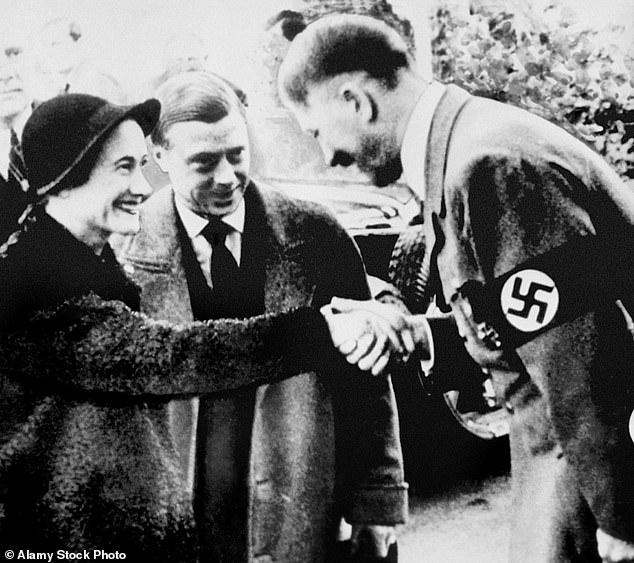
Adolf Hitler greets King Edward VIII and Wallis Simpson during their visit to Nazi Germany
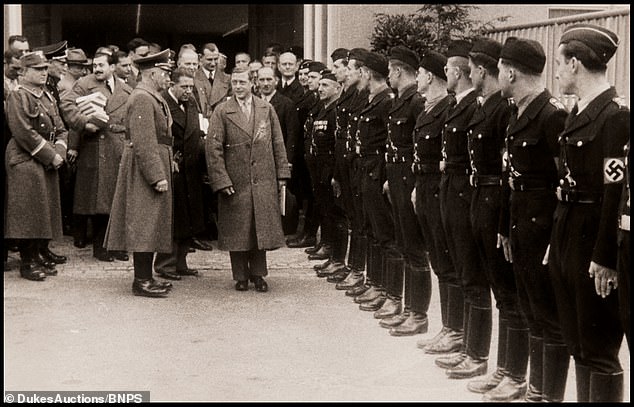
Edward during a tour of a German car factory. Edward reportedly enjoyed the trip because ‘it represented a change of scenery and an opportunity to be feted on the international stage’
They also met senior Nazis, such as Herman Goering. Propaganda chief Joseph Goebbels even praised the duke, calling him a ‘tender seedling of reason’.
The tour concluded with a trip to meet Adolf Hitler at his mountain retreat, the Berghof.
This encounter was ‘both auspicious and a fruitless one’, according to Larman.
Hitler kept the Windsors waiting for an hour and, once their meeting commenced, Wallis was not allowed to attend.
Larman claimed Hitler was ‘friendly and warm’ to Edward, but insisted on speaking through an interpreter despite the duke’s fluency in German.
Hitler viewed Edward as a friend of Germany, with the Duke allegedly offering a Nazi salute during a visit to a coal mine and when greeting the führer.
Edward did attempt to be more muted in his praise of the regime, choosing only to applaud what the country had achieved in terms of social welfare and housing.
After the ‘wonderful time’ spent with the führer at his Bavarian retreat, Edward also wrote a thank you letter. It read: ‘To the führer and [Chancellor], the Duchess of Windsor and I would like to thank you sincerely.
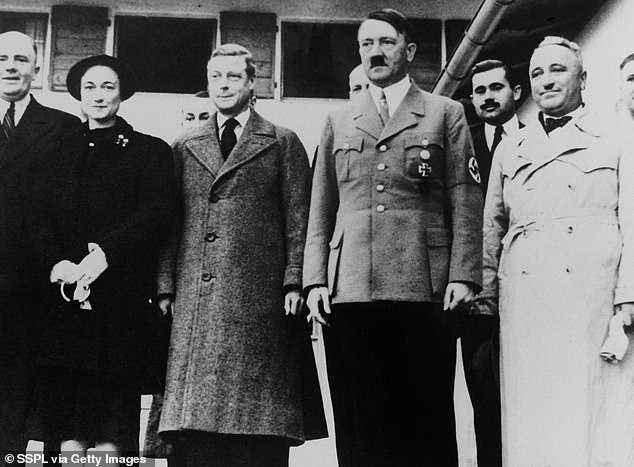
The Duke and Duchess of Windsor at Hitler’s retreat in Bavaria, where a meeting was held
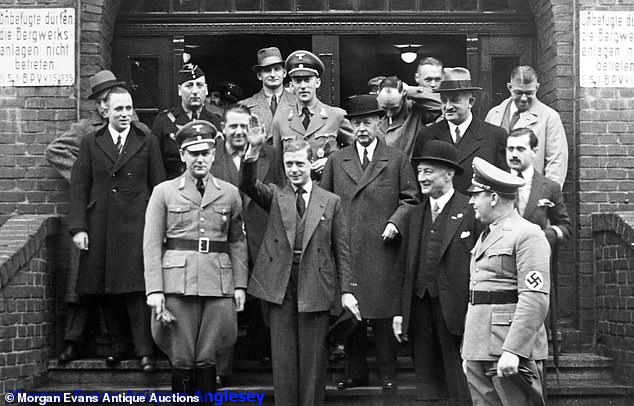
Edward inspecting a German mine. The royal visit was eagerly exploited by the Nazi regime
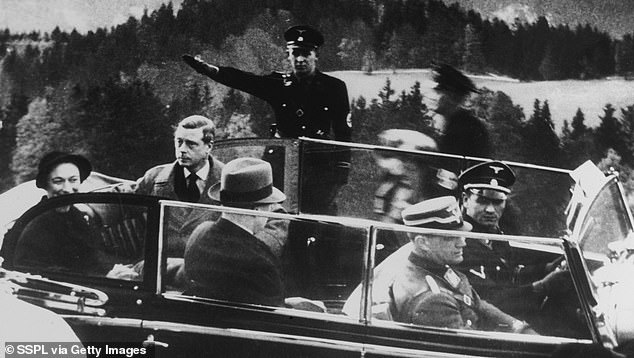
Wallis and Edward on their way to Hitler’s retreat, the Berghof, where they waited for an hour
‘Our trip through Germany has made a great impression on us. Many thanks to you for the wonderful time that we had with you at the [mountainside retreat] Obersalzberg.’
Larman wrote that the visit was a ‘propaganda coup for the Nazis’ and while Edward said the ‘apolitical visit had not caused offence’, it was far from the truth.
It had instead proved alarming in the UK, and only led the couple to become more ostracised from the Royal Family.
Their other flirtations with fascism included a recorded message the BBC refused to broadcast a month before war began in 1939.
The Duke urged Britain to do all it could to ‘come to terms with Nazi Germany,’ claimed AN Wilson, author of Hitler: A Short Biography.
Wallis was also known for her Nazi sympathies. The American was even tracked by the FBI as a result. It reported that ‘the Duchess of Windsor was exceedingly pro-German in her sympathies and connections’.
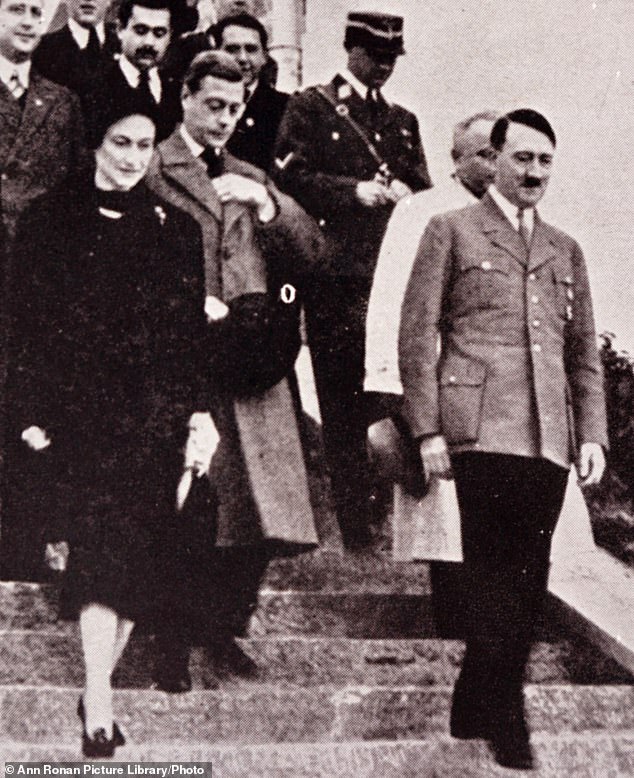
While Edward said that the ‘apolitical visit had not caused offence’, it was far from the truth
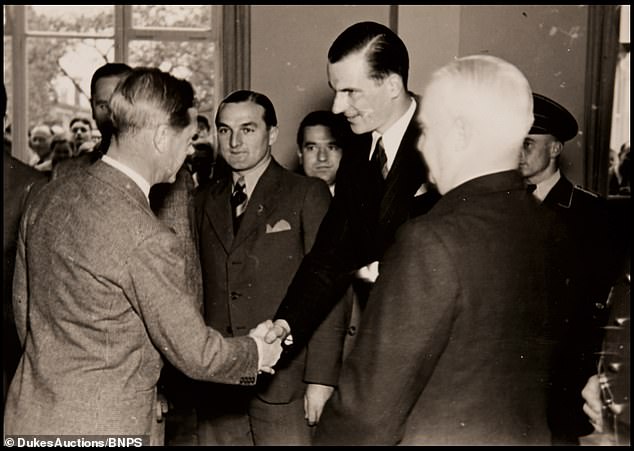
Edward shakes hands with Nazi officials during a tour of a German car factory. Edward did attempt to be muted in his praise of the regime, choosing only to applaud its welfare policies
When war broke out, the government was unsurprisingly wary of the Windsors.
King George clearly harboured the same suspicions against his brother. During the so-called ‘Phoney War’ – the period between war being declared and fighting beginning – the King gave Edward a military appointment in France with strict instructions that he ‘not be shown secret documents’.
In 1940, it was decided that the duke would take up the post of governor of the Bahamas.
Despite being thousands of miles away, they still caused controversy at home.
Wallis was blasted by the Press for a spending spree in the US at a time when Britons endured rationing and constant bombings.
Edward also reportedly told a journalist ‘it would be a tragic thing for the world if Hitler was overthrown’.
Despite their picturesque surroundings and year-round sunshine, their time in Nassau was far from happy.
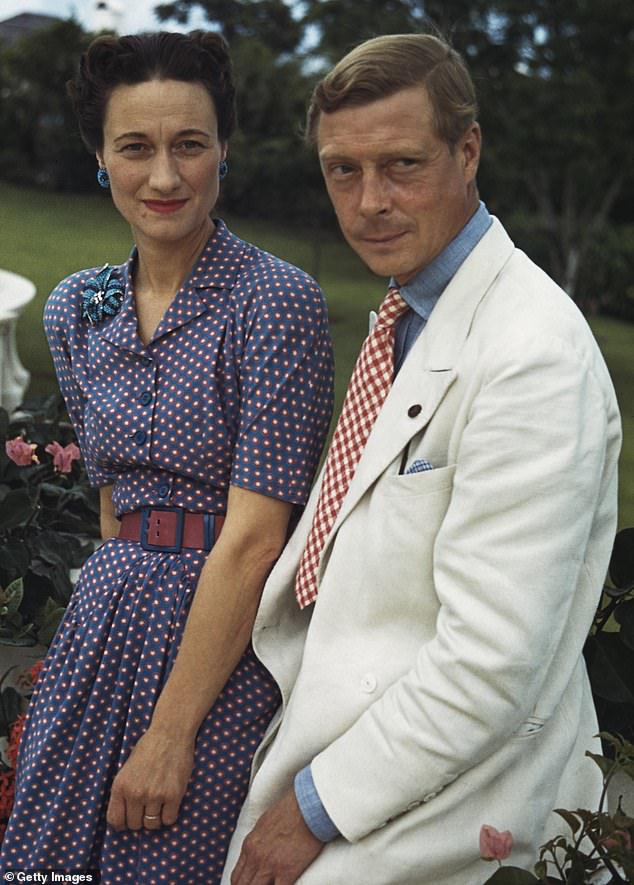
The couple were shipped thousands of miles when the duke became governor of the Bahamas
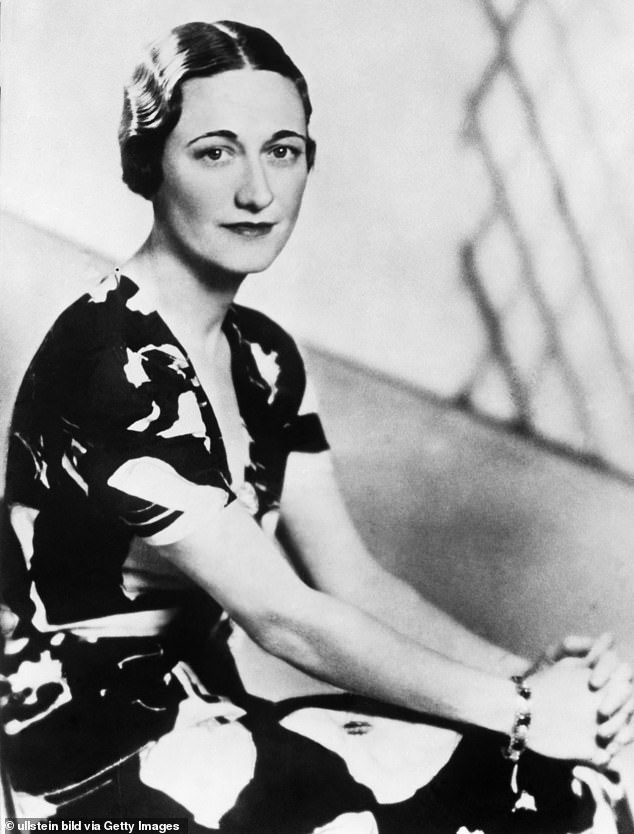
Wallis in 1936, the year in which Edward abdicated the throne so he could marry the divorcee
Wallis despised living in the tropical paradise so much that she referred to it as ‘St Helena’ – the barren rock where Napoleon was banished in the 19th century.
And she dubbed the house the couple stayed in as a ‘shack by the sea’.
This was in fact the sprawling 15,000sq ft Sigrist House, which was given to the couple while their official residence, Government House, was renovated.
At the end of the war, George and the government’s suspicions were vindicated when American diplomats uncovered files buried in the forest near Marburg Castle, including around 60 documents that appeared to contain correspondence between the duke and Nazi Germany.
Now known as the Marburg or Windsor Files, they contain details of a Nazi-devised plan to gain control of Britain, overthrow the monarchy and reinstate the Duke as King.
It is clearly stated that Edward was seen as a better ally than his brother, with the Duke urging the Nazis to bomb Britain ‘to make England ready for peace’.
In the event of a successful invasion, the alleged plan was for Edward to rule a German-occupied UK as a puppet monarch.
A cable from the German ambassador in Lisbon to Berlin reads: ‘[The Duke of Windsor] is convinced that if he had remained on the throne, war would have been avoided, and he characterises himself as a firm supporter of a peaceful arrangement with Germany.
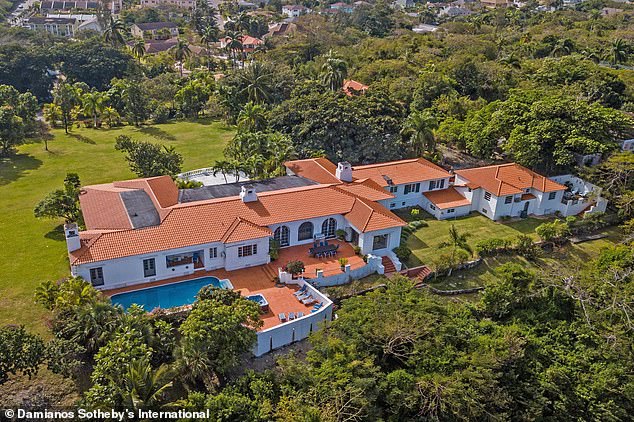
The Duchess of Windsor described the couple’s Bahamas house as a ‘shack by the sea’
‘The Duke definitely believes that continued severe bombing would make England ready for peace.’
After Edward’s tenure as governor ended in 1945, the couple led the life of the idle rich, attending parties in France and America and going on lavish holidays.
Though she lacked the status of an actual queen, it was the kind of high life the American duchess had always sought.