The Maccabi Tel Aviv protest is a lesson in how immigrant communities see themselves
If things were to go truly, badly wrong, out of all of Britain’s big cities, they could probably go the worst in Birmingham. But so far it hasn’t.
That was the opening paragraph of an article I wrote last year in the aftermath of a day of heightened ethnic tension in Birmingham. That tension was ultimately diffused — at least one stabbing notwithstanding — thanks to some judicious “community engagement” by West Midlands Police.
Once again, West Midlands Police (WMP) have stepped in to avert an outbreak of serious ethnic violence in the middle of England’s second city. As I wrote last year, the miles of potential intercommunal flashpoints across Birmingham would stretch the authorities’ ability to manage such a situation, way beyond their capacity.
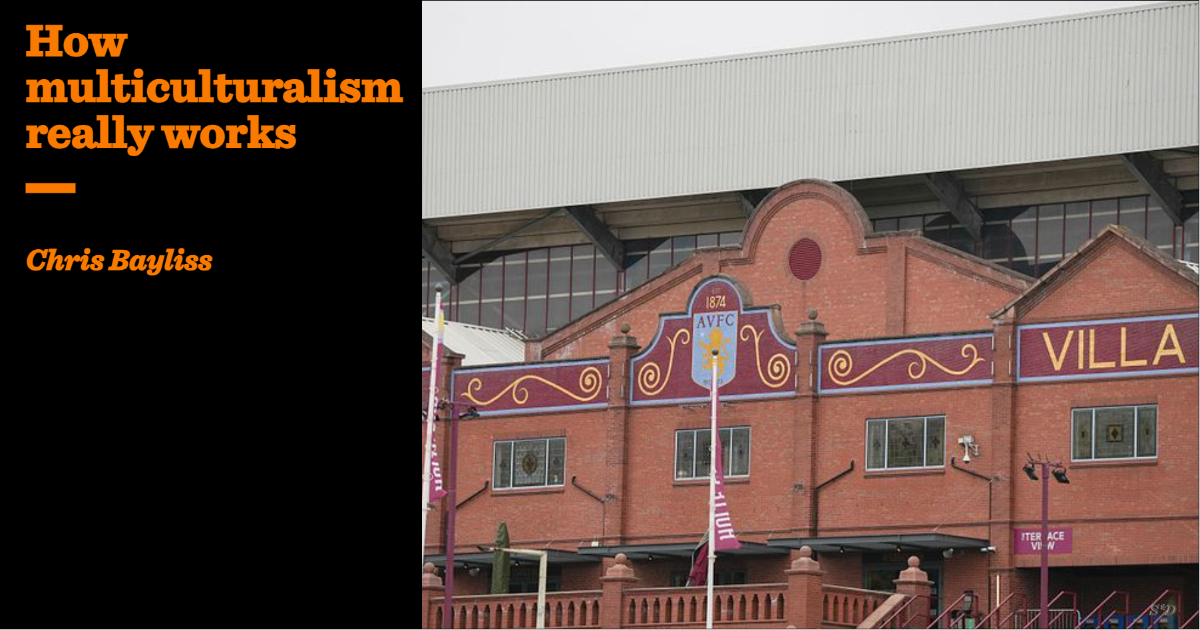
The story of Aston Villa’s fixture against Israel’s Maccabi Tel Aviv has already been comprehensively litigated. Joe Hackett set out in these pages the political and demographic background to the controversy. Very briefly, a campaign and petition was launched for Aston Villa to “boycott Maccabi Tel Aviv” and call the match off. This was spearheaded by neighbouring MP Ayoub Khan, who was elected in the Muslim-majority constituency of Perry Barr on a platform based around the Gaza conflict. Although Aston Villa itself is actually the constituency of Birmingham Ladywood, currently held by the Home Secretary Shabana Mahmoud. WMP have announced that away fans will not be allowed to attend, but so far, the match remains scheduled for November 6. The area around Villa Park is home to a large Muslim-majority population, overwhelmingly Pakistani in origin.
I think November 6 will play out something like this, if the match goes ahead with only home fans in attendance: In the days leading up to the fixture, there will be an increasing voluble campaign by Muslim and Leftist politicians for the match to be called off entirely. A demonstration of some kind will be arranged in Birmingham the previous weekend, possibly echoed in London and elsewhere.
On the day itself, a sizable Muslim mob will form in the vicinity of Villa Park — a large WMP presence will prevent any other element coming anywhere near it, but will police the crowd itself as gently as possible. Home supporters will be tightly corralled in limited numbers in and out of the ground until they are well away. Anything resembling a counter-protest will be dealt with extremely harshly, as will anybody wearing a Maccabi Tel Aviv strip, à la Tommy Robinson. There will be several violent antisemitic incidents throughout the city over the course of the week, but despite this, WMP will claim the day was mostly peaceful, and will pat themselves on the back for averting calamity. And to some extent, they will be right.
“British Values” was an attempt to re-create America’s melting pot, but without any heat from the stove
The lesson the police seem to have learned from the last few years is that they can afford to allow concentrated pockets of ethnic minority unrest to take place, providing they are not allowed to clash with the white population. But anything resembling ethnic unrest by whites risks spreading across a more diffuse geographical area that is far harder to police, so it is nipped in the bud as soon as it emerges. So we saw large and intimidating pro-Palestine demonstrations allowed to go on unchecked through Central London almost every weekend for two years, and counter-protestors very strictly controlled in their vicinity. Meanwhile the migrant hotel protests were very heavily policed, with ethnic minority and leftist counter-protestors escorted right up toward them.
This raises awkward questions for the security and ultimately the sovereignty of the state itself. The authorities have correctly identified white ethnic grievance as a force that genuinely poses a threat to state security. It is the sort of fundamental grievance that might give rise to what we would term “regime change” if it happened abroad. Pakistanis on the other hand might be able to cause serious damage and unrest in certain cities, but ultimately don’t pose an existential threat, other than in their capacity to precipitate unrest by whites. Better then to leave them be if they demonstrate, and not to provoke them into unrest by heavy handed policing, or by allowing them to come into contact with antagonists.
While this all makes some kind of sense as a short-term disaster mitigation strategy, it is becoming painfully obvious to the public, and is severely damaging trust in the police. It is leading people to ask difficult questions about whom the state exists to serve, which makes normal politics impossible; the two main parties combined are currently sitting at around 35 per cent in the polls. And it manifests itself in absurd ways, such as giving a relatively small minority community an effective veto over who English clubs can play football against, given that they live in large numbers around the grounds of pretty much every top flight team.
What tends to go unexplored in all of this is the role of the Pakistani community itself. How does the community think about its own position in the context of broader British society? Looking at them from the outside, it’s easy to see them effectively as a client community of the current political order, who are patronised, protected and subsidised by an elite which regards them as a partial justification for its own existence. A position of privilege perhaps, albeit a subaltern one; but it still looks like a vulnerable position if ever the political weather were to change.
But if the community itself feels that vulnerability at all, it certainly doesn’t show it. On the contrary, it is increasingly politically assertive and self-confident. Is this a result of its own voluntary social isolation? After all, many British Pakistanis do not experience daily life as a member of a minority, living as they do in geographic enclaves of varying size where they constitute either a plurality or an overwhelming majority.
Politically, the community has experienced growing political influence due to its concentration in particular constituencies; as a result, the British politicians they do meet are generally trying to ingratiate themselves. The community has a clear understanding of its own power to unseat those Labour MPs in areas where they predominate who fail to toe the line. After the next general election they are likely to end up as the single most influential bloc of voters in a left-wing alliance of potentially two or three dozen MPs. This influence is likely to be even more concentrated in local government in certain areas, especially in parts of Birmingham.
But beyond that, there seems to be a broader lack of awareness among Pakistani communities about their status as a political issue in their own right among the electorate nationally. There appears to be a general ambivalence about the seriousness of the rape gang issue. Iqbal Mohamed, another Independent Alliance MP, spoke quite openly in parliament last year about how marriage between first cousins was an accepted custom among Pakistanis, and should therefore be accommodated — seemingly without any awareness at all of how remarkable this would sound to the rest of the British population.
But why would the community and its spokesmen have any reason to think about the rest of the British population at all? What sits beneath Ayoub Khan’s campaign about Maccabi Tel Aviv, or Iqbal Mohamad’s statement in parliament about cousin marriage — and indeed the entire phenomenon of MPs being elected on platforms to do with Gaza — is Britain’s Pakistanis no longer thinking of themselves as a community of immigrants. Instead, they regard themselves as a settled part of the fabric of British life, with parity of esteem to insist that their own norms be accommodated on equal terms with those of the historic British population. And why shouldn’t they? That is after all what they have been told that they are.
The problem this poses for Britain’s supposedly multicultural establishment is that the framework they envisaged for community relations doesn’t allow for it, any more than it allows for a robust identity based on the established customs of the native population. “British Values” as they were termed, rendered down the blubber of human culture into pre-refined, bite-sized pieces of propositional chewing gum that were as good for one mouth as they were for any other. Decency, tolerance, fairness, equality, respect for democracy; abstract concepts that are as difficult to argue with in principle as they are to pin down in practice. In reality, it meant that anybody who foreswore terrorism and racism could be as “British” as anyone else.
But whilst this rendered down what it meant to be British in order to make that identity as accessible as possible to all comers, it had no potency as a solvent to the pre-existing cultural identities those people brought with them. It was an attempt to re-create America’s melting pot, but without any heat from the stove. And the framework has no dispute resolution mechanism; harmony was simply assumed, if all parties stuck to their British Values. And while the British Values are a sort of pastiche of generic liberal assumptions, they generally leave out the ones that might have pushed people toward “a live and let live” approach, such as freedom of speech and freedom of association.
But now we find ourselves with the kind of contested public spaces that are typical of cultural heterogeneity. And there are basically two tried and tested approaches to contested spaces in heterogeneous societies. One is that there is one community which is accepted as the majority or titular basis of the polity, and it is their customs and norms that prevail. Singapore functions on this basis very nicely today — it was also roughly how the Ottoman Empire worked. The alternative is some form of partition along local lines, in which specific areas are recognised as being the province of certain groups, where the feelings and propriety of that individual community are given not just parity, but priority of esteem.
The latter is the reality of multiculturalism, and is to some extent how things already work in Britain. Although it seems unlikely that we would have chosen at the outset to designate almost all of our larger towns and cities as areas of special minority interest, had we known that was how it would end up. Facing up to this reality would require a recognition that the form of civic national identity attempted under the framework of British Values had failed, and that all that was left to fall back on was a notion of “Britishness” that was essentially purely administrative in nature. For our current governing class, it feels rather late in the day for conversations like that.