The president of the Republic of Ireland is supposed to be a ceremonial rather than an explicitly political role. The outgoing head of state, Michael D. Higgins, constantly tested its boundaries by bringing his anti-British, anti-western, anti-semitic views into many aspects of his duties. After fourteen years of listening to this sanctimonious ideologue, you might expect the Irish electorate to be desperate for change. On Friday, though, as the Republic votes for its next president, it looks increasingly likely to choose an even more controversial and aggressive left-wing candidate.
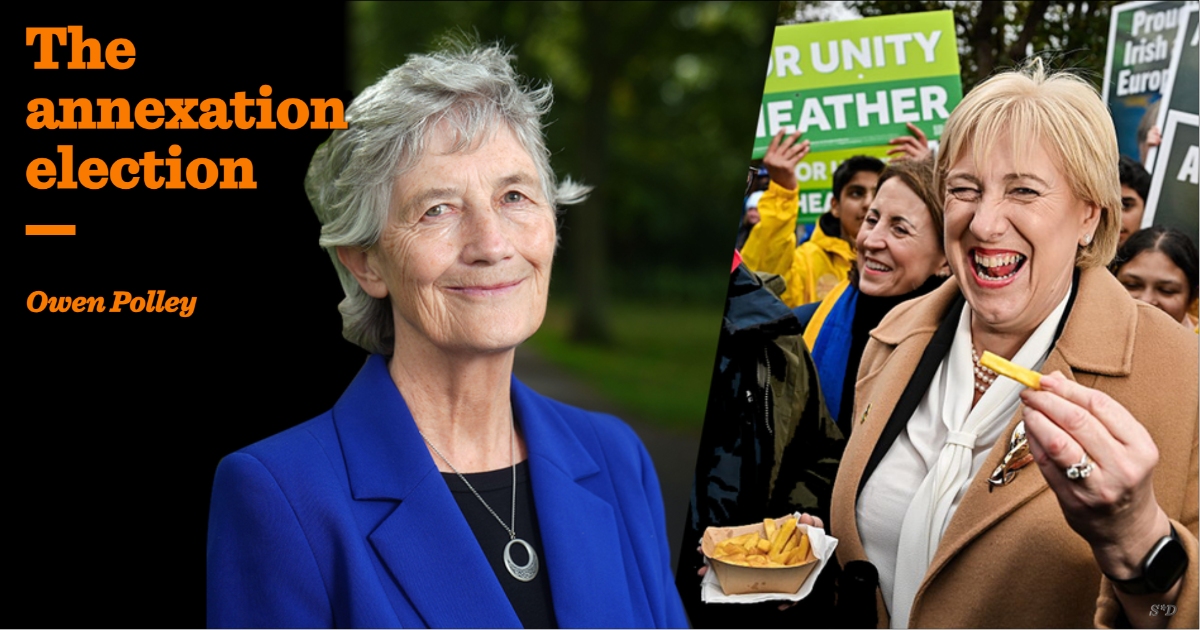
The front-runner for this election, Catherine Connolly, is currently 18 per cent ahead in the polls. She was formerly a member of the Irish Labour party, but this time she also has the support of a series of even more demented socialist parties, the most significant of which is Sinn Fein. You can probably guess many of her opinions already. She is anti-capitalist, accepts the most extreme forms of trans ideology and expresses sympathy with various anti-western despots. Being Irish, though, she reserves much of her venom for Israel.
The independent presidential candidate told BBC Radio Ulster last month that she was “reluctant to unequivocally condemn” the slaughter of Jews on October 7. These atrocities included the massacre of around 1,200 people and the kidnap of 251. But Ms Connolly described Hamas terrorists as “part of the fabric of the Palestinian people” and claimed that Sir Keir Starmer should not try to stop the group playing a role in governing a future Palestinian state.
This is the tax haven economy that requires politicians to express high-minded disdain for capitalism
This repugnant attitude to violence against Jews is usually left unexpressed, even among the casual anti-semites who make up the establishment in nationalist Ireland. The rationale, though, dripped with separatist self-pity that is familiar enough. “I come from Ireland which has a history of colonisation. I would be very wary of telling a sovereign people how to run their country.” Ms Connolly’s “anti-colonialism” led her to visit Syria under the rule of Bashar al-Assad and support its campaign against western sanctions.
This kind of rhetoric also resonates with younger Irish people, who reacted hysterically to Israel’s actions after October 7, and have been dubbed “generation Kneecap” by the journalist Gwen Halley. Dublin’s approach to the Gaza conflict, even though the government was made up of relative moderates in Fianna Fail and Fine Gael, caused Israel to close its embassy in Dublin, citing “extreme” Irish policies.
Those coalition parties have made quite a mess of the presidential election so far, which has allowed Connolly to gain momentum. The Fianna Fail candidate, Jim Gavin, stopped campaigning, after a row about his conduct as a private landlord, although his name will still appear on ballot papers. Some opinion polls suggest that 49 per cent of voters do not feel represented by any of the contenders. The Fine Gael candidate, Heather Humphreys, is worthy, but rather dull. It was revealing, though, that she was subjected to vicious attacks for her Presbyterian background and her husband’s apparent former membership of the Orange Order. The idea that the Republic is inclusive still does not seem to apply to anyone with the taint of Britishness or unionism.
Ms Humphreys may have protestant heritage, but she is certainly not a unionist. In fact, she has been careful to proclaim her republicanism and expressed support for Northern Ireland’s annexation by the Republic. She claims that unionists have “nothing to fear” from the destruction of their homeland and implies that they might be persuaded to vote for that outcome if Stormont were still to exercise some power in an all-Ireland state. Connolly, urged on by her backers in Sinn Fein, takes a more aggressive approach. The Dublin government, she claims, should start preparing to absorb Northern Ireland. Connolly has described her campaign as the start of a “movement” that will shape a new “republic”, presumably encompassing all 32 counties on the island.
Every political campaign in the Republic, even one for this ceremonial position, seems now to require candidates to set out their annexationist plans for Northern Ireland. This basic disrespect for British sovereignty has extended to another theme in this contest. Both candidates have supported the idea that the franchise in the next elections for president should be extended to Irish citizens in Northern Ireland (where the Dublin government grants a ROI passport to nearly anyone who wants one). This bid to encroach on territory that is part of the UK, and already has a head of state, is just another republican provocation that unionists are supposed to suck up.
In the polls, Catherine Connolly’s lead is comfortable, even if there are still lots of undecided voters. The expectation, therefore, is that the Republic will exchange one anti-western, left-wing president for another. Even if quieter, less youthful voters eventually save Heather Humphreys, the campaign told us a lot about modern nationalist Ireland. This is the tax haven economy that manages simultaneously to require politicians to express high-minded disdain for capitalism; the sanctimonious scourge of western foreign policy that shelters under the protection of NATO and the UK and the woker-than-though “inclusive” haven, whose reason for being is its hatred for Britishness.
Whatever the outcome, the election has reminded voters in Northern Ireland why they should continue to shun the campaign to break-up the UK and warned ministers at Westminster always to be wary of their resentful separatist neighbour.