
Nigel Farage wasn’t in his usual place for Prime Minister’s Questions. Instead he was sat in the public gallery, just next to the press benches. Beside him was Arron Banks, who for many years bankrolled Brexiteer efforts to make Britain into the global success story it is today. This ringside seat was his reward, just like the corporate boxes at Wimbledon and Wembley. It fair makes the heart soar.
Banks was wearing a Trump-style overlong red tie. The last few years seem to have been a long jolly for him, sucking up to the worst people on earth, something he has, by all appearances, thoroughly enjoyed. There are of course small clouds in every blue sky, and the six-part £60 million adaptation of his Brexit adventure, which The Telegraph promised would hit our screens in 2018, seems to still be stuck somewhere in the production process. Perhaps Benedict Cumberbatch, reportedly lined up to play Farage, is too busy with his Marvel commitments. Although the other name mentioned certainly has time on his hands, if anyone has a number for Kevin Spacey.
As it turned out, the supposed big event of the afternoon, the confrontation between Kemi “Big Bad” Badenoch and Keir “Still Stumped” Starmer, was fairly low-watt, even for them, but I’m sure Banks and Farage had fun. They’re probably still at lunch as I write this. And indeed as you read it.
The first question was from Lib Dem Roz Savage. There had been a little local excitement the previous day, because a Downing Street aide had been photographed carrying a draft of Savage’s lines. Was this a hack, or evidence that all parliamentary debate is a charade? In fact, it’s quite normal for Number 10 to ask MPs what their questions might be.
Starmer seems unable to sound like he means it even when he’s talking about his love of Arsenal, the club he has supported since he was a teenager
Dodgy as this sounds, how much an MP reveals depends what they’re trying to achieve with their question. If they want to embarrass the prime minister, surprise is their friend. But if they want the prime minister to endorse their call for a library to be saved, then it’s a good idea to let them know the topic in advance, so that Number 10 can read up on the subject and prepare a decent answer.
With that insight into sausage-making out of the way, it wasn’t clear why Savage had revealed her proposed question, as it was, if not actually savage, then certainly unfriendly. Perhaps her office didn’t realise it was allowed to say “no” to Number 10. She took the wisest course in these circumstances, which was to make a joke of the whole business. “I regret to inform the House that yesterday there was a very serious breach of national security,” she began. “It does make me wonder whether this government can be trusted with a digital ID scheme.”
Badenoch, to no one’s surprise, asked about the government’s calamity-strewn public inquiry into grooming gangs. The Tory leader quoted “Fiona”, one of the victims: “What’s the point in speaking up if we’re just going to be called liars?”
This was at one level a great question: direct, putting Starmer on the spot, and using the voice of a victim so that he couldn’t challenge it. But Badenoch didn’t explain who had called Fiona a liar, and what about. Perhaps she felt it was obvious. Perhaps the rest of us just need to spend more time on the far-right radicalisation channel that is Elon Musk’s X.
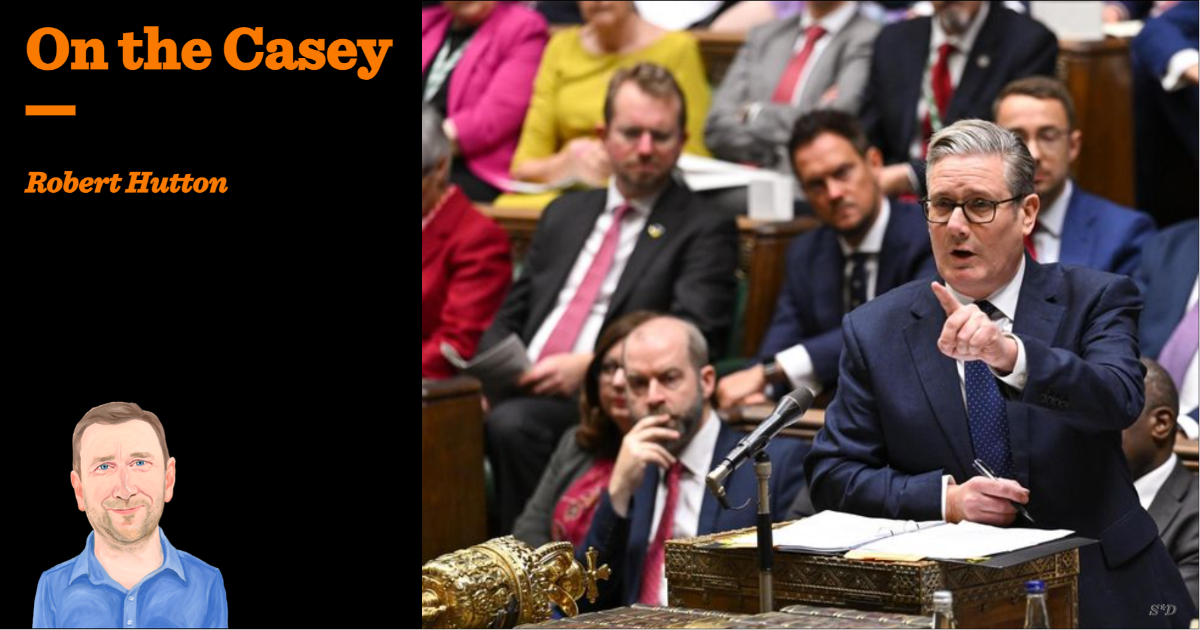
Starmer’s response was intended to be comprehensive. “The grooming scandal was one of the worst scandals of our time,” he began. He regretted that victims were unhappy, he wanted them to know the inquiry would leave no stone unturned. “The inquiry is not and will never be watered down, its scope will not change, it will examine the ethnicity and religion of the offenders, and we will find the right person to chair it.”
More than that, he was calling in his leading troubleshooter, Louise Casey, to get the inquiry moving. Whenever a problem is too big for Starmer, he reaches for Casey. She’s quite busy these days. The prime minister’s spokesman described her afterwards as “an incredibly able woman”. She’d need to be.
The two went back and forth over the ground, with Starmer explaining that things were going so slowly with the inquiry because of government efforts to make them go faster. Badenoch meanwhile demanded the dismissal of Safeguarding Minister Jess Phillips, for reasons she again felt were too obvious to explain. This was wild: Phillips used to run women’s refuges and has long been a vocal supporter of abuse victims in Parliament. However frustrated the grooming victims are with the slow pace of progress, it’s hard to think of anyone in the chamber more likely to stand up for them.
But the prime minister’s problem is his inability to articulate any of this. He’s the polar opposite of Farage. The Reform leader manages to sound authentic even as he contradicts words he’s uttered only minutes earlier, while Starmer seems unable to sound like he means it even when he’s talking about his love of Arsenal, the club he has supported since he was a teenager.
Someone who doesn’t have that problem is Angela Rayner, who gave her resignation statement later in the afternoon. There was a large turnout of supportive MPs to listen. She was neither entirely contrite about her tax affairs — this stuff is all very complicated, she said — nor defiant. But the account of her life had them nodding along. “People wrote me off,” she said, looking back on her days as a pregnant teenager. “I wanted to prove them wrong.”
She closed: “Elected office is not about us, but about our chance to change the lives of others. From wherever I sit on these benches, I will fight with everything I have to do exactly that.” It wasn’t quite a challenge to Starmer, but let’s just note that, if Labour found itself with a vacancy, she’s available.