Even though Pakistan and the Taliban were once allies, relations between them have been fraught ever since the latter reconquered Afghanistan in the summer of 2021.
The relationship has never regained its former footing. Their strained ties erupted this month into several days of fighting, which overlapped with signs that Afghanistan and India are strengthening their ties – a development that concerns Pakistan, and complicates the landscape for security in the region.
The Taliban – products of Pakistan’s madrasa system – came to power in 1996 partly because of military and logistical support from the Pakistani state, which has always believed it could control a group it helped create.
Why We Wrote This
Pakistan’s contentious relationship with the Afghan Taliban recently boiled over, complicating prospects for long-term security in the region. A fresh ceasefire could help the two sides lessen the tension.
In 2001, when the Taliban refused to extradite Osama bin Laden to the United States, President George W. Bush launched a regime-change operation. Pakistan, which the U.S. pressured into joining its “war on terror,” suddenly found itself in conflict with the same Taliban it had helped bring into power.
The recent armed clashes stemmed from Pakistan’s accusation that the Afghan government provides a haven to the Tehreek-e-Taliban Pakistan (TTP), a militant offshoot of the Afghan Taliban that launches regular terrorist attacks on Pakistani soil.
As those attacks intensified, Pakistan responded by subjecting Afghan refugees living within its borders to a massive deportation drive. As of last week, approximately 1.5 million Afghans had been repatriated, according to local news reports.
On Oct. 9, exasperated by what it claims is the Taliban government in Kabul’s unwillingness to act against the TTP, Pakistan launched a series of airstrikes on Afghan territory, including the capital. Cross-border fighting began the following day, with each side claiming to have done massive damage to the other.

The death toll from the conflict remains uncertain. Pakistan claims to have killed more than 200 militants, while the Taliban says they killed 58 Pakistani soldiers.
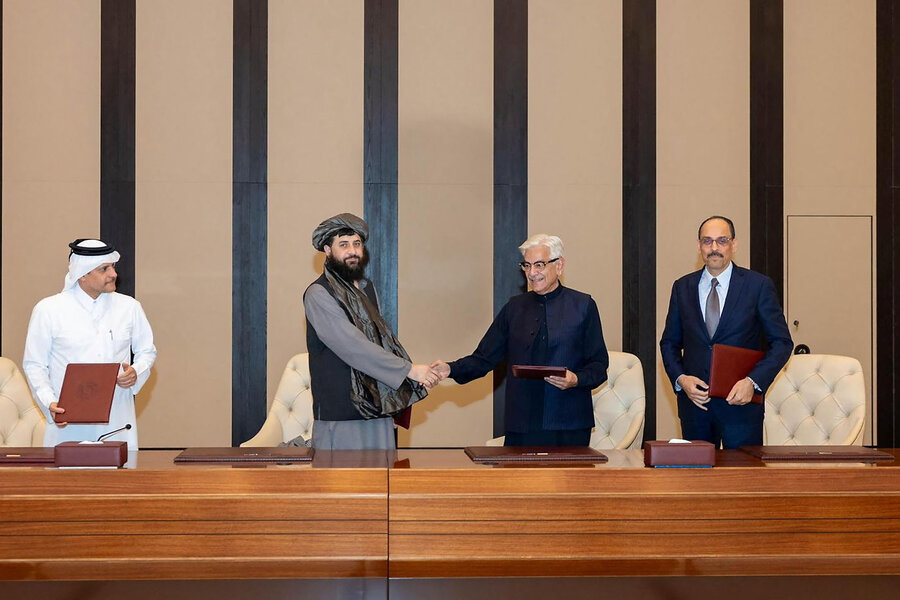
On Oct. 19, after more than a week of intense fighting, Pakistan and Afghanistan agreed to a ceasefire in talks mediated by Turkey and Qatar.
“The two parties also agreed to hold follow-up meetings in the coming days to ensure the sustainability of the ceasefire and verify its implementation in a reliable and sustainable manner,” Qatar’s Foreign Ministry said.
The same day, Pakistan’s minister of defense, Khawaja Asif, said “terrorism from Afghanistan on Pakistan’s soil will be stopped immediately” as part of the ceasefire agreement.
Ideological links
But experts are unconvinced that the Afghan government has either the appetite or power to stop the TTP from attacking Pakistan.
“We all know that there are very strong ideological links between the Afghan Taliban and the TTP,” says Farzana Shaikh, associate fellow of the Asia-Pacific Program at Chatham House. “The Afghan Taliban don’t regard the TTP as terrorists, whereas Pakistan clearly wants them to do so on grounds that they are striking Pakistani targets from Afghanistan.”
Part of the ideological link between the TTP and the Afghan Taliban is the rejection of the Durand Line as an international border. The Durand Line is a soft border spanning around 1,600 miles that separates Afghanistan and Pakistan and that successive Afghan regimes, including the Taliban, have decried as arbitrary. Pakistani diplomat Seema Ilahi Baloch says the ultimate aim of both the TTP and the Taliban is to “establish an Islamic caliphate in Pakistan.”
Her words are echoed by Yaqoob Khan Bangash, a Pakistani historian. “What is fascinating is that the Taliban still refer to it as the Durand Line and not the border,” he says. “That’s much more significant than just a choice of words.”

The Afghan Taliban may remain indebted to the TTP for bolstering their ranks with fighters during the U.S.-led war on terror, experts say. Pakistan’s role in that conflict – reluctantly siding with America and its NATO allies while giving sanctuary to some Taliban leaders – has fueled mistrust between Kabul and Islamabad, and led the Taliban to largely ignore the terrorist activities of the TTP.
The India angle
Pakistan is also wary of the growing rapprochement between Afghanistan and India. The October clashes coincided with Afghan Foreign Minister Amir Khan Muttaqi’s visit to India and New Delhi’s announcement that it is planning to reopen its embassy in Kabul.
“What Pakistan wants more than anything is to keep the Indians out of Afghanistan,” says Georgetown University Professor C. Christine Fair. “But the Taliban see a lot of benefit from the Indians – international legitimacy being one of them, financial investment being another.”
A joint statement from India’s minister for external affairs, S. Jaishankar, and Mr. Muttaqi highlighted the financial possibilities: “Considering Afghanistan’s pressing requirement for economic recovery and development, both sides agreed that India would further deepen its engagement in development cooperation projects, particularly in the sectors of healthcare, public infrastructure, and capacity-building.”
That same statement referred to the disputed territory of Jammu and Kashmir as part of India, drawing sharp condemnation from the Pakistani foreign office. The Himalayan region has been a regular flashpoint between India and Pakistan since they became independent countries in 1947, with both claiming the territory in full but administering it only in part.
The statement has raised fears in Pakistan that India is planning to use Afghanistan as a proxy. “My own opinion is that we are not fighting Afghanistan; we are fighting India,” says Khurram Dastgir Khan, a former Pakistani foreign minister.
India and Pakistan have long accused each other of using militant groups as proxies, and fought a war as recently as May 2025 after a terrorist attack in Indian-occupied Kashmir killed 26 tourists. The introduction of Afghanistan into this age-old conflict may unsettle the prospects for long-term security in a region that houses three nuclear powers – India, Pakistan, and China – and just under a quarter of the world’s population.
Some analysts are particularly concerned that Pakistan may look to topple the Taliban government.
“For the first time … we are hearing talk in Pakistan of potentially a regime change in Afghanistan,” says Dr. Shaikh, the fellow at Chatham House. “It’s risky and dangerous … but it would also be a damning indictment of how little we have learnt” from the war on terror.