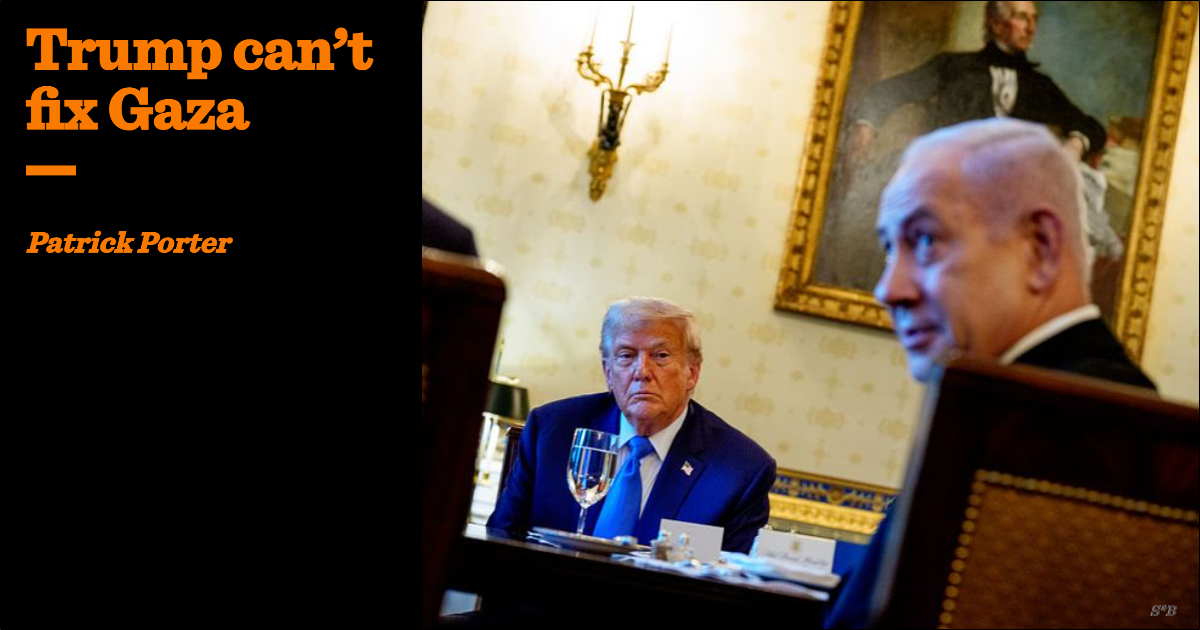
Before the latest ceasefire between Israel and Hamas was rocked by fresh fighting, there were hyperbolic, excited and downright silly proclamations about President Donald Trump making “peace” in the Middle East. We heard that Trump and his envoys with their private sector, deal-making expertise had mastered the aristocratic essence of coercive diplomacy. We heard that Trump, a man of will unlike his predecessors, the new Cyrus the Great, had torn up the historic playbook of professional diplomats and used personal ties and business deals to bring the warring sides to the table. We heard that Trump is transformational abroad. We witnessed the undignified scramble of governments sprinting to claim a share of the credit. And with all this, an old conceit revived, that it falls to a western strongman (or alternatively, a visionary-technocrat) to make peace in the Middle East. Where once that would be a Clintonian liberal peace, then a Bush-style revolutionary peace, it would now be a peace of Trumpian capitalism.
Trump and his MAGA movement can’t pacify Gaza, let alone pacify the region
As the renewal of fighting demonstrates, Trump and his MAGA movement can’t pacify Gaza, let alone pacify the region. Trump cannot do so any more than George W. Bush and his visionary doctrine of Washington-backed democratic revolution. They cannot do so any more than more technocratic, gradualist approaches, with all their pieties about “root causes” and land swaps and “two state solution(s)” and consensual conflict resolution.
For outsiders, neither the outstretched hand nor the sword, nor some combination of both, has fared well in forging fundamental resolutions to the conflicts between Israel and its adversaries. Where there are the beginnings of stability, namely in the form of the Abraham Accords, some credit to Washington is due. But these agreements grew mainly out of local contacts and collaborations — well before Trump’s presidency — to a common fear, the belligerent and imperial Republic of Iran, not because of western demands. Trump did not cause the realignment between Israel and the Gulf monarchies, any more than Henry Kissinger caused the Sino-Soviet split. If westerners are architects in outbreaks of peace in the region, it is usually and largely around the edges.
The west’s incapacity to make peace in the region is so not because of its varying level of competence. Multiple efforts at diplomatic resolution, though hardly perfect, are testament to the problem that “we” have neither the leverage nor sufficient self-interest to do it for them, or even to broker it: Madrid. Oslo. Camp David. Taba. Annapolis. Washington. Peace-making on western terms and timetables has been elusive because those locals who exercise power have a way of deciding for themselves whether to make peace, and on whose terms.
In Gaza, the arithmetic is brutally simple. A ceasefire there may be. But Hamas is not going to abide by any agreement to commit suicide politically as the price of a transitional political arrangement in Gaza. Their atrocities in Gaza since the truce began are testament to their determination to hold on to power and eliminate rivals. Hamas is not a force for negotiated co-existence. When Israel evacuated Gaza in 2005, this movement from the hard-right of Palestinian politics seized power and began rocketing Israel. They are interested neither in retirement nor in compromise. Not even Tony Blair can successfully show them the door as a necessary step in Gaza’s reconstruction. Neither are those forces in Gaza that wait in the wings any more minded to high-minded grand bargains.
For its part, Israel, or those in its ascendancy, is not anytime soon going to run the experiment of accepting a Palestinian state. A state is defined partly by being an authority that wields a monopoly on legitimate force. Israelis tasted what that future might bring, when Hamas seized a local monopoly of violence on 7 October 2023, inflicting the largest slaughter of Jews since the Holocaust. Reeling from that pogrom, Israel then struck hard into Gaza, razed it and committed atrocities of its own. That history — that strategic shock — happened. It’s hard enough to induce Tel Aviv to stop illegal settlement expansion in the West Bank, let alone ask it to run the risk of handing its adversaries a swathe of land to govern. So Israel, or at least the Israelis who determine where power lies in Israel, won’t be deferring to European lectures on two-state solutions, thank you. Even if public sentiment begins to shift, there are too many spoilers.
With all this in mind, no well-intentioned detailed blueprint for a two state solution can legislate away this unstoppable force (anti-Israel rejectionism) and this unpassable object (Israel’s refusal to cede sovereignty to a population where rejectionism thrives).
Similarly, as is now becoming clearer, no campaign of U.S. airstrikes can eliminate Iran’s determination to keep the nuclear option alive, even if Trump fires intelligence analysts who claim otherwise. Contrary to facile “great man” daydreams, from Ukraine to Kashmir to Gaza, there are stubborn forces for conflict that western exertion cannot extinguish.
There is no clear, effective policy fix here
Some may suggest that the withdrawal of western patronage would make Tel Aviv more flexible. Getting out of the region generally has its merits as an idea. But if Israel regards the creation of an Islamist-run state an existential affair, its likelier response to the end of western largesse would be to seek more patrons, lean even more heavily on its nuclear deterrent and remain inflexible. There is no clear, effective policy fix here.
This issue goes beyond Trump’s flawed personal view, more showbiz than substantive, that he can end wars and terminate crises by fiat. It points to a general difficulty in western attitudes to the Middle East. Too many observers and actors still are tempted to regard their states as grand fixers. This is either because of a residual self-regard, or because of a certain kind of narcissistic guilt, and the assumption that because we inadvertently contributed to problems historically, it is in our gift to solve them.
The Middle East lately may have become central and as totemic to some groups in our politics. For many, Gaza may have become a moral cause and rallying banner more than a real place. Still, the region Trump once yearned to withdraw from is simply not important enough for the west to forsake all else, invest more heavily and make a serious attempt at imperial reordering. Even in that impossible counterfactual, the existence of determined wills — Islamist, nationalist, sectarian — would make it an exhausting and thankless task. The history for Britain is not encouraging. If there is to be a wave of peace in the Middle East, it will not flow from western diplomatic projects or arms. We have minimal interests over there to defend from a remove, such as the sea passages and shipping routes. Beyond that, it is not for us to steer its destiny.