Scotland Yard has vowed to stop investigating non-hate crime incidents in a move that experts predict could bring an end to ‘Thought Police’-style doorstep interviews for sending tweets.
The Met says it will end the practice of investigating NCHIs after dropping a case against Father Ted writer Graham Linehan over tweets he made about trans activists.
Its decision on Monday night came after top police chiefs expressed concern at the time and effort put into following up NCHIs instead of tackling real crime.
Justice minister Sarah Sackman has even hinted that she would like to see other forces follow suit following a flurry of cases that led to no action – but wasted hours of police time.
She told the PA news agency she was glad to see the Met focusing on what matters: ‘Violent crime, phone-snatching, mugging, antisocial behaviour, the kind of crime that eats into the core of our communities.’
On whether she wants to see other police forces to the same, she added: ‘I think that other forces need to make the decisions that are right for their communities.
‘But I’m sure that communities up and down the country would want that renewed focus on violent crime, on antisocial behaviour, and on actual hate crime.’
Among the incidents probed in recent years have been a tweet from newspaper columnist Allison Pearson mistakenly branding a pair of activists for a Pakistani political party ‘Jew Haters’, for which she was visited by police.
Others included a window display featuring Enoch Powell, a swastika made up of Pride flags and rude words being spelt out with alphabet cups in a supermarket. None led to any criminal action.
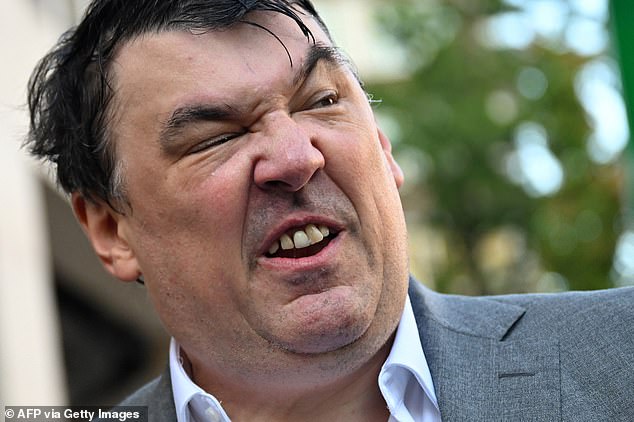
A police probe into tweets made by Graham Linehan about transgender people has been dropped – and the Met says it will no longer probe alleged non-crime hate incidentsf
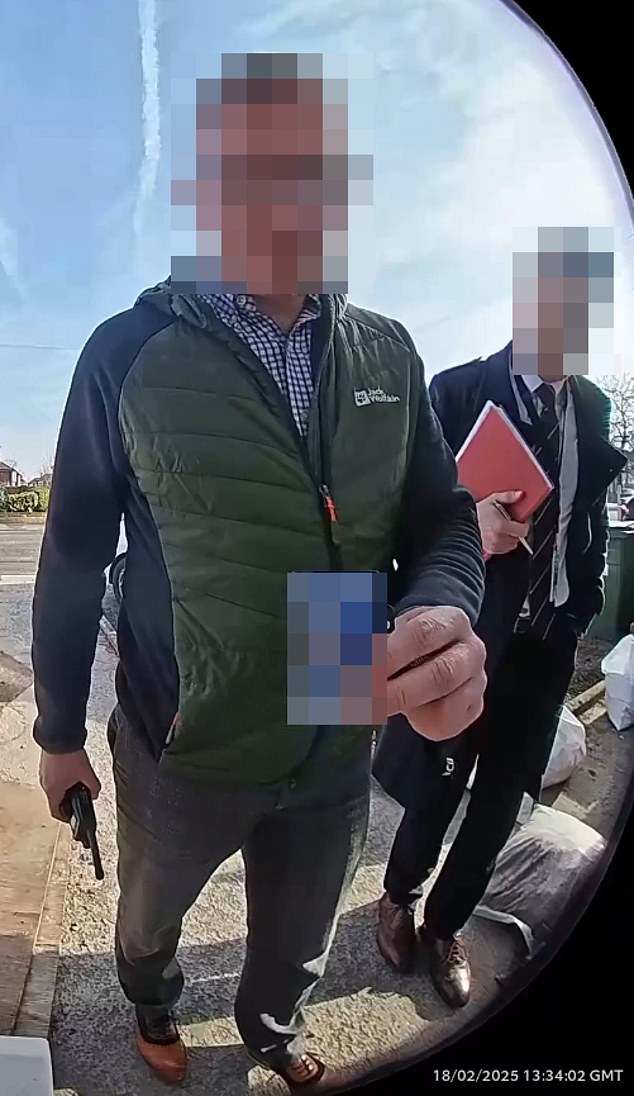
Door cam footage of the police visiting Helen Jones’s house on Tuesday, February 18 after she posted on social media calling for a local councillor to quit. Such visits could become a thing of the past
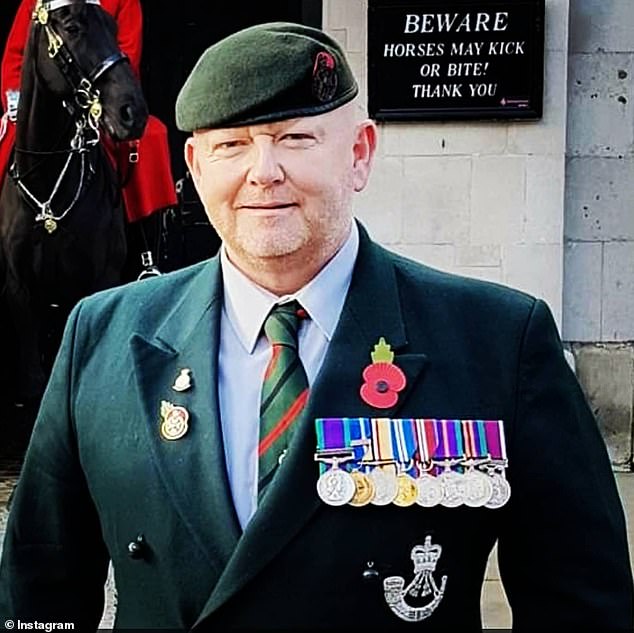
Army veteran Darren Brady was visited by police after he shared an image of four Pride flags arranged into a swastika – which he was told had ’caused anxiety’
Professor Andrew Tettenborn, a professor of law at the University of Exeter, told the Daily Mail today that he expected other police forces to follow the Met’s lead – but notes that NCHIs will continue to be recorded, even if they aren’t followed up.
‘If I were a betting man I would say within a month we will see all the other forces within England going the same way,’ he said.
‘When the Met jumps, I think other forces will find it very difficult not to jump too.’
He has cautioned, however, that Scotland Yard will continue to record non-crime incidents – which can be flagged in enhanced disclosure checks carried out by employers for sensitive jobs such as in care or working with children.
Prof Tettenborn added: ‘You have to look very carefully at what has been said and what hasn’t been said (by the Met). They had said they won’t investigate non-crime hate incidents but they do say they will continue to record them.
‘What that means is Allison Pearson won’t get doorstepped again, which is the good news, but absolutely nothing else changes.
‘Police can record non-crime hate incidents as something that anybody is seeing as a hate incident, even if it isn’t.’
NCHIs were first floated following the conclusion of the Stephen Lawrence inquiry, which recommended that police forces find a way of logging incidents of racism that did not meet the threshold for a hate crime.
This, the inquiry said, could be used to measure community tensions. Guidance was then first published by the College of Policing in 2005, and formalised in 2014.
Thereafter the Home Office issued statutory guidance in 2023 after ex-police officer Harry Miller won a legal challenge against his own NCIH, which was logged after he expressed the view that transgender women weren’t women online.
The Court of Appeal noted that the College of Policing had, at the time, cast an ‘exceptionally wide’ net for what constitutes hostile speech ‘regardless of whether there is evidence that the speech is motivated by such hostility’.
‘Being offensive is not, cannot and should not be an offence,’ he said outside court.
A 2024 report by justice watchdog the HMICFRS found that police officers and staff find NCHIs ‘confusing’ – and often can’t differentiate between crimes and non-crime incidents, or what might constitute ‘freedom of expression’.
On average, 13,000 are reported every year in England and Wales. The think tank Policy Exchange, which has called for NCHIs to be scrapped, estimates they take five hours to log each, thereby costing some 65,000 hours of police time each year.
Among some of the most divisive incidents using up police time were girls falling out on Snapchat, a dispute over a parking space, and an occasion when two secondary schoolgirls said that a child smelled ‘like fish’.
And among that has been early morning door knocks, visits to businesses and what some have described as activities similar to that of the Stasi, the East German secret police.
Enoch Powell window display
Earlier this year, a shop display belonging to Elizabeth Griffiths was logged as an NCHI after she put up pictures of Enoch Powell and Keir Starmer, as well as references to the Conservative MP’s contentious ‘Rivers of Blood’ speech.
The display was put up in the days after Keir had warned Britain could become an ‘island of strangers’ – with language that was compared to Powell’s monologue that he later said he regretted.
Ms Griffiths, a Reform UK activist, said she had put the display up to promote ‘powerful leaders’, adding: ‘I deal with Muslims every week. The Muslims I deal with are generally entrepreneurial. They haven’t come across on boats.’
West Mercia Police said it was logged as a non-crime hate incident.
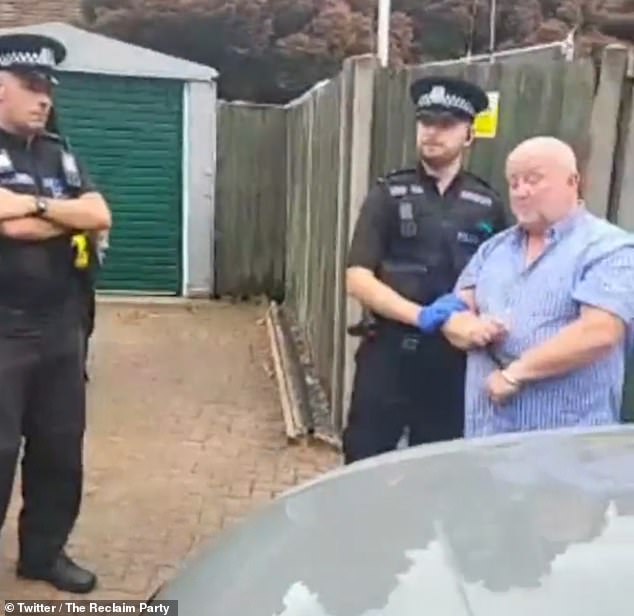
This is the moment army veteran Mr Brady (pictured) was arrested by Hampshire Police for ‘causing anxiety’ after retweeting a picture of a swastika made out of Pride flags
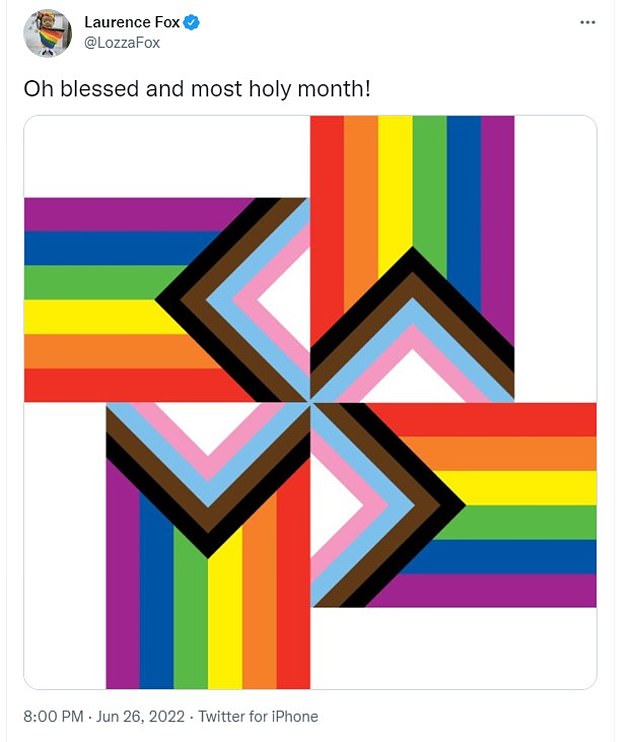
The tweet, originally by online provocateur Laurence Fox, showed four LGBT pride flags positioned to make a swastika, captioned with the words, ‘Oh blessed and most holy month’
Pride ‘swastika’ flag
Other incidents befitting of the NCHI mould have come before.
In 2022, then-51-year-old Army veteran Darren Brady was arrested by Hampshire Police officers after, he was told, ‘causing anxiety’ with a social media post.
Mr Brady had shared an image of four Pride flags arranged into a swastika, an image first shared by online provocateur Laurence Fox on X.
In a viral video of his arrest at his home in Aldershot, he could be heard asking the three police officers: ‘Why am I in cuffs?’.
One officer answered: ‘Someone has been caused anxiety based on your social media post.’ He was later released with no further action taken.
Damaged Quran
In 2023, four schoolboys were suspended from school in Wakefield after a copy of the Quran was dropped on the floor and damaged.
The holy book had been brought in by a severely autistic 14-year-old pupil as a forfeit for losing at a game of online shooter Call of Duty, and was lightly damaged by the fall to the floor. But rumours persisted that it had been burnt.
However, police recorded the incident as a non-crime hate incident all the same.
A video shared by the boy’s mother online noted: ‘He didn’t have any malicious intent, but he’s a very, very silly 14-year-old boy.’
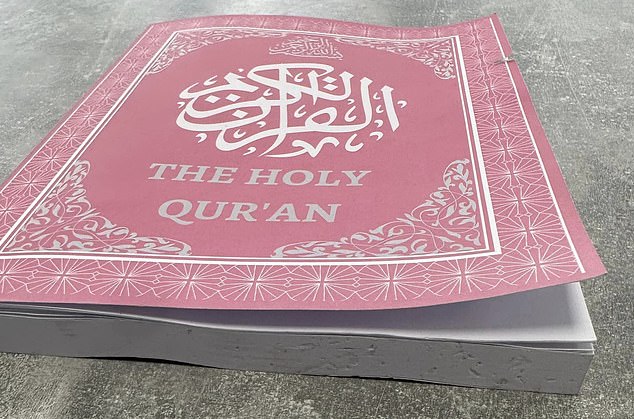
The Quran had a slight tear on its cover after it was dropped on the floor
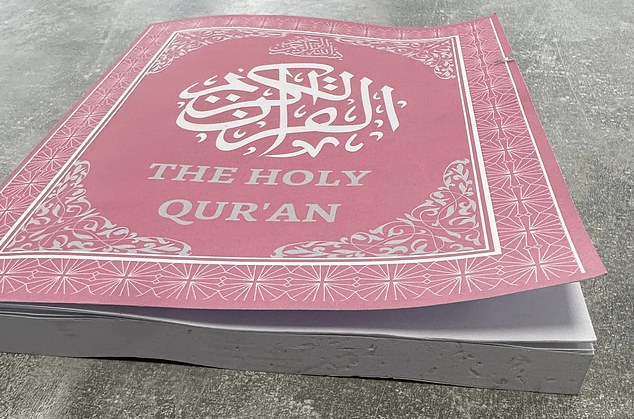
The Quran had a slight tear on its cover after it was dropped on the floor
‘Jew haters’ tweet
Newspaper columnist Allison Pearson was visited by Essex Police officers after she posted a tweet – later deleted – in which she called two men expressing support for a Pakistani political party ‘Jew haters‘.
The men were pictured with two police officers from Manchester – but Pearson had tagged the Metropolitan Police in her tweet.
It was alleged by some users on social media that Pearson had confused the political party flag with that of Hamas, and had thought the picture was taken in London with Met Police officers. She rapidly took the tweet down after the error was pointed out.
Pearson, who denied claims the tweet was racist and inflammatory, was then visited by Essex Police officers. Later, the case was dropped, and the incident was not logged as a non-crime hate incident.
However, in a report that commended officers’ ‘professionalism’, Essex Police noted: ‘We do not take the view that a crime did not take place, rather that there was no realistic prospect of a conviction based on the evidence available.’
Councillor fury
Earlier this year, Helen Jones was called by two plain-clothes police officers after she had posted online that she wanted to see a Labour councillor resign for being a member of an offensive WhatsApp group.
The officers, who had sought to visit her at home in Stockport, appeared to suggest that Cllr David Sedgwick had complained to police about her – before telling her that she had, in fact, committed no crime.
Mrs Jones said she was being ‘given advice’ by the officers, despite not being under investigation.
‘It was actually quite scary. It made me think I best just keep quiet for the rest of my life, because you just can’t say anything these days,’ she said.
Greater Manchester Police later said: ”No further action is necessary as no crime has been committed.’
Will other forces follow suit?
GMP’s chief constable, Sir Stephen Watson, is actually among the high-ranking officers calling for a rethink on NCHIs.
‘It’s easy to assume that we have some sort of weird fetish chasing stuff in social media, frankly we would rather really not if we can avoid it,’ he said in July.
‘In the context of things that are communicated online, people will accuse us sometimes of pursuing hurty words on the basis, somehow, it’s an attack on free speech.’
It looks increasingly likely other forces will follow suit after Linehan’s high-profile arrest at Heathrow in September ultimately led to nothing.
But the Met says it will continue to record the incidents, while upping the threshold at which it will treat them as meriting serious investigation.
Officers were preparing a case on the basis of three tweets, including one in which he said of transgender women in female bathrooms: ‘Make a scene, call the cops and if all else fails, punch him in the balls.’
He had also described a photograph of a trans rights protest as ‘a photo you can smell’, and said of the activists pictured: ‘I hate them. Misogynists and homophobes. F*** em.’
The Met later downgraded a potential public order criminal offence to a non-crime hate incident before the Crown Prosecution Service abandoned the case altogether.
He has vowed to sue the Met over a claim of wrongful arrest and for breaching his human rights, backed by campaign group the Free Speech Union.
He has not worked in entertainment for eight years after being ostracised for his views on transgender people, which also cost him his marriage.
In a statement released on Monday, the Met said Commissioner Mark Rowley had been clear in his belief that officers should not be policing ‘toxic culture war debates’.
It said of Linehan’s case: ‘We understand the concern around this case. The Commissioner has been clear he doesn’t believe officers should be policing toxic culture war debates, with current laws and rules on inciting violence online leaving them in an impossible position.
‘As a result, the Met will no longer investigate non-crime hate incidents. We believe this will provide clearer direction for officers, reduce ambiguity and enable them to focus on matters that meet the threshold for criminal investigations.
‘These incidents will still be recorded and used as valuable pieces of intelligence to establish potential patterns of behaviour or criminality.
‘We will continue to investigate and arrest those who commit hate crimes, allowing us to comply with statutory guidance while focusing our resources on criminality and public protection.’