Remind me never again to complain when there’s a lack of news about my football team during an international break.
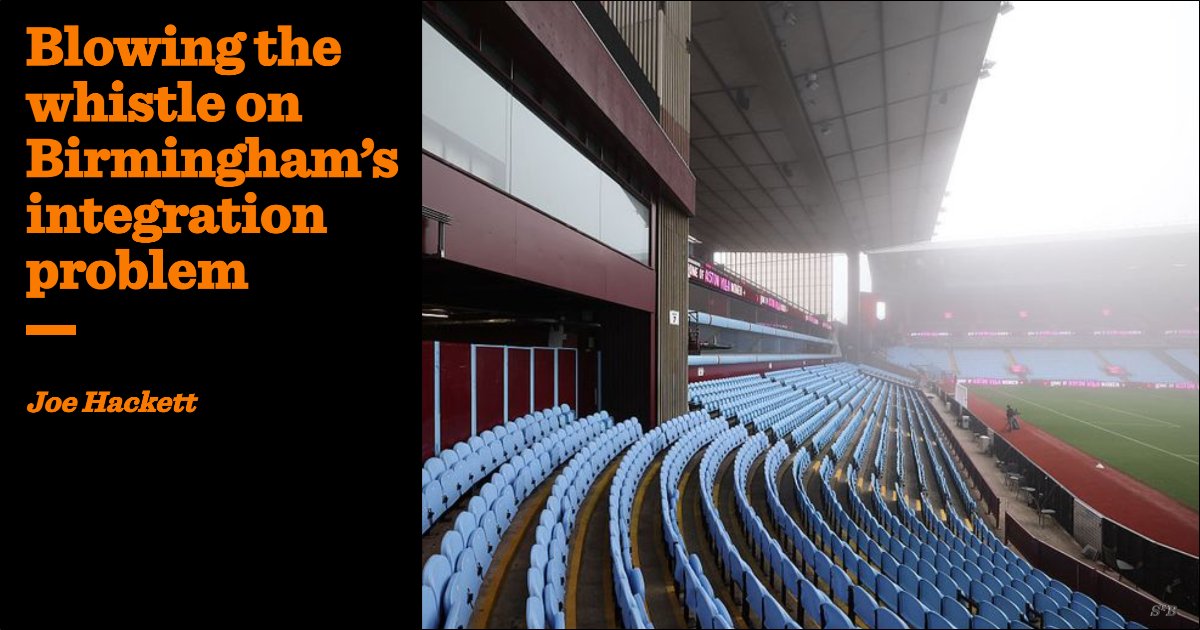
Aston Villa, whom I’ve supported for 25 years of frequent downs and occasional ups, has found itself at the centre of national controversy after a Birmingham City Council led safety group decided, apparently on the advice of West Midlands Police and the “community representatives” the cops consulted, to ban Maccabi Tel Aviv fans from attending their Europa League match at Villa Park.
Politicians have condemned the decision and ministers are reportedly on manoeuvres to get the decision overturned. The social media backlash has been even more furious and, at times, bizarre. One commentator wanted Villa to forfeit the match (that’s a no from me). One wanted Villa to be banned from the Europa League altogether (not a fan of that idea either).
But the ban has its defenders, who just happen to mostly be far-left commentators and Gaza independent MPs.
Their primary justification is that Maccabi Tel Aviv, seemingly unbeknownst to anyone before 2023, are apparently the most violent fanbase in European football, and need to be banned in case they rounded on Villa fans or unsuspecting locals. Aaron Bastani described them as “the most violent firm in Israel”, which if nothing else would come as a surprise to Beitar Jerusalem’s ultras.
This is usually backed up by (admittedly unpleasant) clips of Maccabi away fans at one single match, against Ajax in Amsterdam last year.
But that’s not the whole story. Other clips showed local mobs beating up Maccabi fans, chasing them into canals, and hurling antisemitic slurs at them. Evidence has emerged that at least some of the violence was part of a premeditated “Jew hunt”.
That probably helps explain why no action was taken against Maccabi, and since then their away fans have been allowed to travel to Norway, Cyprus, Greece, Poland, and Malta on their club’s European adventures, apparently without causing much trouble.
Maccabi, it seems, are no Legia Warsaw. Legia, whose fans have a longstanding record of misbehaviour to the point where the club was fined by UEFA after 17 out of 30 European matches over two seasons, played Villa in autumn 2023.
Beforehand, Legia fans had also been involved in violence on an away trip to the Netherlands, against AZ Alkmaar, leading UEFA to ban their away fans from a match in Bosnia and limit their numbers (but, crucially, not ban them) for their visit to Villa Park.
The Legia fans who made the journey to Birmingham then engaged in “planned and systematic violent acts against West Midlands Police officers,” leading the police to ban all Legia fans from entering Villa Park about an hour before kick off. UEFA duly fined Legia (again) and banned them from five European away games.
The double standard is clear. The Legia fans’ rap sheet was much longer, more recent, and more clear cut than Maccabi’s, but West Midlands Police felt more confident of handling them (at least until the evening itself), and none of the hard-left commentators or MPs who’ve demonstrated such an interest in football hooliganism over the last 24 hours were clamouring to ban them before the match.
In fact, none of these people batted an eyelid when Legia returned to these shores earlier this year to face Chelsea at Stamford Bridge. The away fans came to London, let off flares inside the stadium, and left their club facing yet another fine.
Cops deal with potentially violent fanbases, many with a much worse reputation than Maccabi, all the time. At the risk of pointing out the obvious, West Midlands Police have managed dozens of bitter derby matches between Villa and Birmingham City.
In short, if you think this ban has anything to do with either set of fans, then you are, as Nigel Pearson would say, an ostrich.
It’s hard not to conclude that the real reason for the ban is fear of how people who literally elected a Gaza independent MP might react to the presence of a small group of Israeli football fans, and whether the cops would be able to control that situation.
The local MP covering Villa Park is indeed Ayoub Khan, a Gaza independent who previously served as Lib Dem councillor for Aston, during which time he was offered antisemitism training after social media posts made in the wake of the October 7th attack.
It’s fair to say that Khan is much more interested in Israel than he is in the local football club. Before he launched his campaign to “boycott Maccabi Tel Aviv” in September, he tweeted the word “Villa” precisely once, supporting a jobs fair at Villa Park.
The same goes for his Gaza independent colleague, Iqbal Mohamed, who responded to the decision to ban the Maccabi fans by enthusiastically declaring his interest in the “safety of Aston Villa fans.” Mohamed hadn’t previously demonstrated any interest whatsoever in Villa, which is unsurprising given that he represents an area 80 miles away from Aston, albeit with similar demographics.
What’s also unsurprising is that this decision has sparked a victory lap from Robert Jenrick, who sparked mainstream media outrage just days before by describing Handsworth, near Aston, as one of the worst integrated parts of the country.
Jenrick is right to consider himself vindicated. But why did it take so long for any mainstream politician to acknowledge this? And why are there so many ostriches who still refuse to do so?
I grew up in Small Heath, another part of inner-city Birmingham with similar demographics to Aston (it’s also the home of Birmingham City, so I was a minority in more than one respect). What’s clear to Jenrick now has been clear to me for most of my life.
While the Gaza independents’ support base has grown to the point where they can win parliamentary seats, and thus can’t be ignored by the mainstream press, their sectarian brand of politics isn’t a new phenomenon: in Small Heath, we had councillors from a single-issue outfit called Justice for Kashmir, which grew out of a campaign to free two Kashmiri nationalists who murdered an Indian diplomat. They might have had more success had Labour not rigged the elections with postal vote fraud.
Since my family moved out in 2003, Small Heath and the surrounding area have been in the news for, among other things, terror raids, a local mosque being exposed on Channel 4 for preaching extremism, the Trojan Horse scandal where Islamists sought to impose their religious agenda in schools, Islamist “counter-rioters” slashing a Sky News van’s tyres and attacking a nearby pub last year, and masked men throwing boxes of live mice painted in the colours of the Palestinian flag into a local McDonalds. It should go without saying that none of this is exactly normal for most of the country.
The decision to ban Maccabi fans from Villa Park is the latest in a series of increasingly high-profile events that have shone a light on the problems that have persisted, and grown, in working-class inner city parts of Birmingham, and other towns and cities, for decades. It was easier for the political and media mainstream to ignore when I was growing up there; it’s much less so now.
If there’s one thing being an Aston Villa fan teaches you, it’s a degree of pessimistic fatalism
That should be heartening, but it’s also deeply disheartening that it’s had to get to this point for that awakening to even begin. The “muscular action to make integration a reality” that Jenrick rightly wants to run will doubtless be much harder to implement now than it would have been if our leaders had got their heads out of the sand earlier.
But if there’s one thing being an Aston Villa fan teaches you, it’s a degree of pessimistic fatalism. We are where we are. The best time to end mass immigration and start Jenrick’s integration campaign was 25 years ago. The second best time is now.