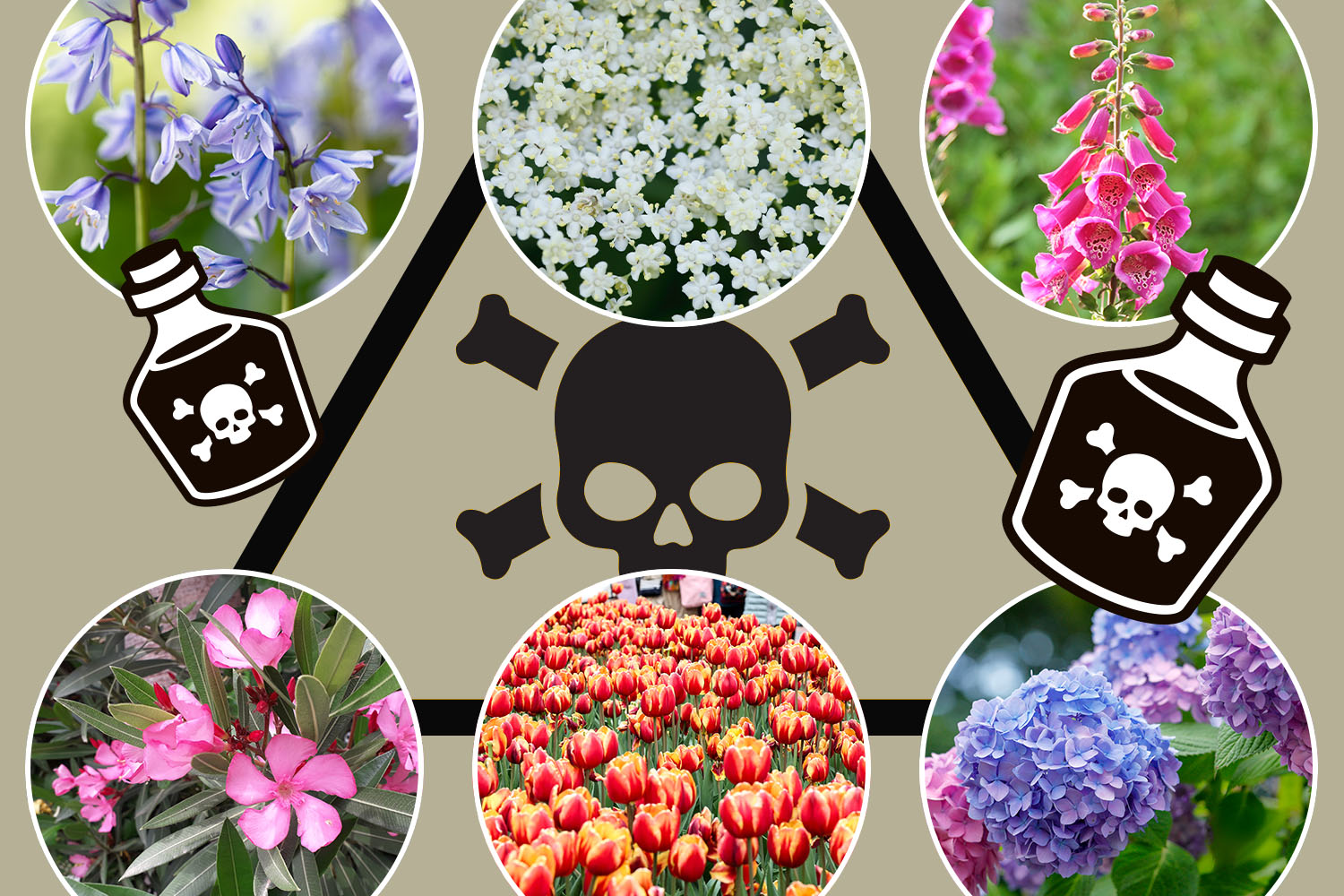
GROWING elderflowers? Brightening up a shady spot with some Foxgloves or Lily of the Valley?
Or have you recently planted some lovely Oleander as a privacy fence?
If so, I’d like to warn you that these plants are some of the most poisonous in the UK, and can cause all sorts of nasty symptoms.
Thankfully, they are all safe to grow, provided you don’t eat them – or in the instance of Euphorbia – brush against their sap.
I haven’t included Giant Hogweed in this list as it’s not a plant gardeners generally grow in their outside spaces.
But just to keep you in the know, here’s ten of the most popular poisonous plants you can find in your outside spaces.

HYDRANGEA
The buds, flowers and leaves of Hydrangea’s contain glycoside amygdaline – which can break down to produce cyanide.
Particularly toxic to dogs and cats, they can still make children ill if they ingest a large amount. Can cause diarrhea, stomach pains and vomiting.
TULIPS
All parts of tulips are poisonous, but it’s the bulbs that can cause major problems if they’re mistaken for an onion!
Can cause an upset stomach – and ‘tulip fingers’ which is a rash that will occur in people that handle tulips for a living.
BLUEBELLS
All parts of bluebells are toxic to humans, cats and dogs – and can cause serious stomach upset, vomiting and can lower your blood pressure.
The sap can also irritate skin. Eating large quantities can be fatal.
ELDERFLOWERS
You MUST cook, ferment or pickle elderflowers before eating. Raw berries, seeds, leaves and stems can be poisonous – causing nausea, vomiting and diarrhea.
But once cooked there’s so much you can do with it – wine, jam, cordial
FOXGLOVE
Consuming any part of the plant can cause dizziness, oral and abdominal pain, vomiting, diarrhoea and in severe cases, heart and kidney problems.
Can be fatal if a large amount is consumed, but that’s very rare.
LORDS AND LADIES or CUCKOO PINT
Poisonous to humans, especially it’s bright red and orange berries which contain oxalate crystals.
Can cause immediate and severe irritation to the mouth, which can lead to swelling and burning pain, and potentially breathing problems.
Not generally grown , but often creeps into unattended or wilder parts of the garden.
OLEANDER
All parts of this pretty privacy fence plant are very toxic for both humans and animals.
The clear sticky sap can cause skin irritation or a rash and ingestion can cause vomiting, lightheadedness, abdominal pain, diarrhea, blurred vision and very occasionally, seizures followed by a coma.
LILY OF THE VALLEY
Often used in bridal Bouquets – including The Princess of Wales – its highly toxic and can cause serious illness or death if you eat any part of it – especially for children.
The roots and flowers are particularly poisonous – and problems often arise when it’s mistaken for wild garlic.
EUPHORBIA
It’s hit and miss with this one – you’re either affected by the white milky sap that comes when you prune it – or you’re not.
But if you are – be aware that it’s an irritant that can cause skin burns, blisters, and eye irritation – and in extreme cases – temporary blindness so wear eye protection and gloves.
DEADLY NIGHTSHADE
More common in woodlands – it’s one of the UK’s most deadly plants – even eating a couple of its shiny black berries would be enough to kill a human.


Causes headaches, blurred vision, rashes, hallucinations, convulsions and ultimately, death
Also in Veronica’s Sun Gardening column this week…

Top tips, news, competitions,
For more gardening content, follow me @biros_and_bloom
NEWS! A new book by Jane Perrone ‘The Atlas of Deadly Plants’ tells botanical tales of the world’s most intoxicating, poisonous and dangerous specimens.
Filled with beautiful illustrations by Alice Smith, historical facts and references about each plant, name origins and a helpful world map – the 255-page book covers The Americas, Europe, Africa and Australasia.
Jane writes: “One of the key things I have learned through researching and writing this book is that many, many plant poisoning cases start with a forager mistaking a plant, any plant, for wild garlic.
“The harsh reality is that most plant poisonings take hours or days to do their work – with the initial symptoms often masquerading as other conditions, such as food poisoning.”
She added: “Now that I have scared you half to death, let me reassure you that just 5 per cent of human poisoning cases reported to poison control centres in North America and Europe relate to plants.”
The Atlas of Deadly Plants, by Jane Perrone, is released on October 23, £30 by Goldfinch Books.
TOP TIP! HAVE your lawns suddenly and inexplicably filled with mushrooms? It’s because it’s fungi season – thanks to a combination of warm temperatures, rainfall and decaying organic matter in the soil. This could come in the form of leaves, thatch, grass clippings, or buried wood – which are all around at the end of summer. But the good news, is that it does mean you’ve got healthy soil – and the mushrooms will break down the organic matter – which then adds nutrients back into the soil.
TOP TIP! IF you’ve seen your spring bulbs start to poke through the soil already – don’t panic. Climate change is increasing temperatures, and we’ve had a really warm summer – which is encouraging the bulbs to grow shoots sooner. But as long as the flower buds are still below the soil, you should be ok. When the cold weather comes in, the growth will stop and many bulbs return to dormancy. Then reappear when the soil warms up in Spring.
NEWS! THE RHS has a new exhibition – all about the competitive world of fruit and vegetable growing. Kicking off today (18th) it takes place at RHS Wisley’s Old Laboratory. Not only will it display the triumphs of competitive growers from Victorian times, it also involved modern day record breakers.
WIN! Dobbies Garden Centre are offering one Sun Gardening reader a £200 voucher to spend in store – perfect for Halloween decorations. To enter, visit www.thesun.co.uk/DOBBIESHALLOWEEN or write to Sun Gardening Dobbies competition, PO Box 3190, Colchester, Essex, CO2 8GP. Include your name, age, email or phone. UK residents 18+ only. Entries close 11.59pm. November 1, 2025. T&Cs apply
PLANT OF THE WEEK! Geranium ‘Rozanne’ – a firm favourite of the gardening company I work for – a perennial that’s still just about still flowering now, spreads beautifully, with green leaves and lovely violet blue flowers.
JOB OF THE WEEK! Harvest pumpkins if you were clever enough to grow them in time (I wasn’t) Cut back perennials that are done – although make sure you leave some as shelter for wildlife