THEY certainly didn’t look like the usual tourists exploring London’s busy streets.
A group of 30st sumo wrestlers got plenty of heads turning this week as they drank pints of Guinness, recreated the Beatles’ pose for the Abbey Road album cover and tried riding the capital’s ubiquitous Lime bikes.
Forty of the jumbo grapplers — known as rikishi — are in town for a five-day Grand Tournament at the Royal Albert Hall — the first time the Japanese sport has been staged here since 1991.
And the venue’s management have even had to install new chairs and reinforce the toilets to bear the fighters’ colossal weight.
The heavyweight heroes lit up the venue with their show on Thursday — and I was one of the lucky 5,000 there to witness it.
Sumo wrestling is without doubt one of the most entertaining things I’ve ever witnessed.


From the ritual foot-stomping and salt-throwing to the thundering clash of these giants, the sport — steeped in 2,000 years of history — is gripping.
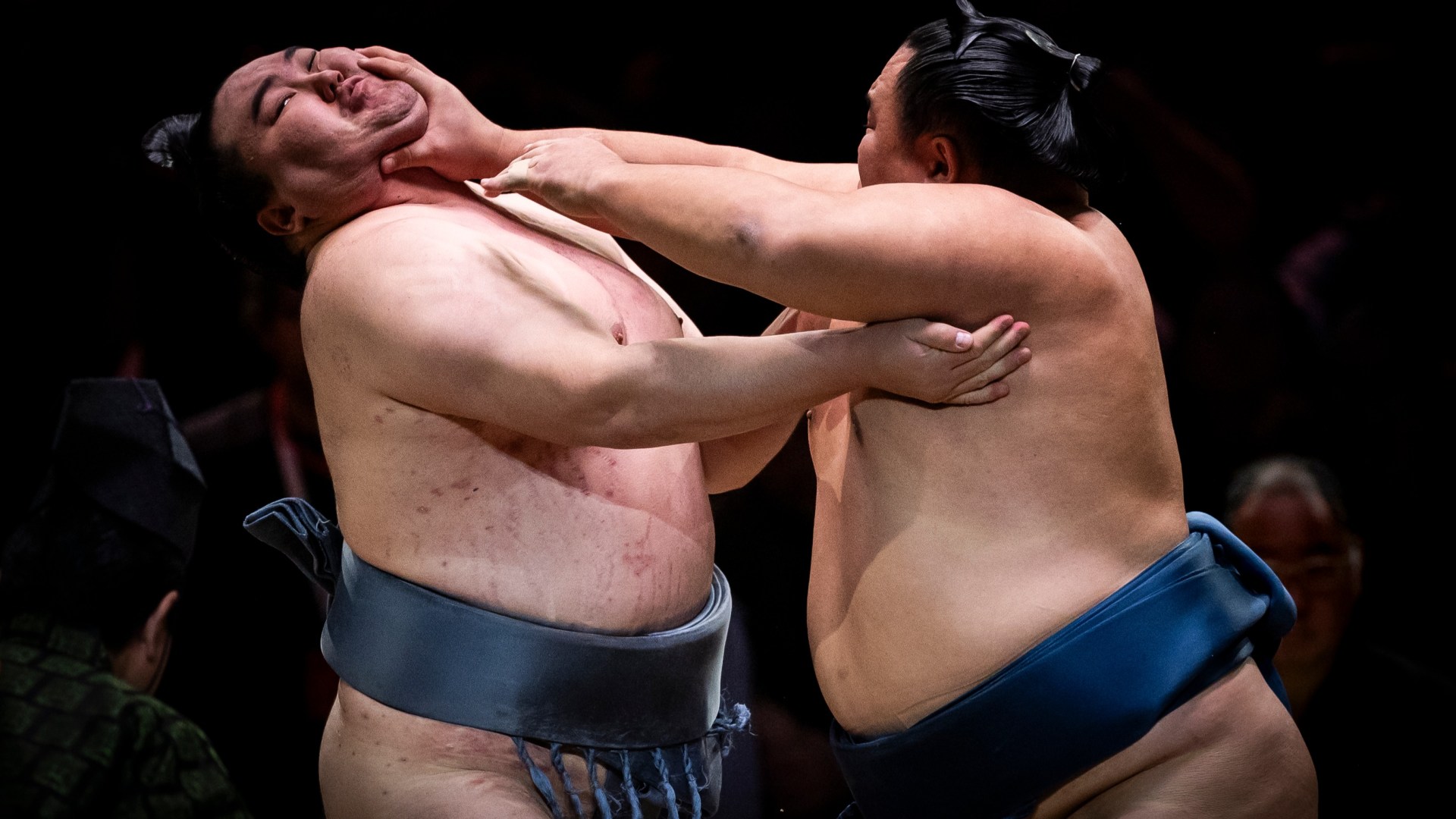
It somehow balances poise, meditation, respect and gentleness with aggressive slapping, butting, throwing and charging to try to get their opponent out of the ring.
Part of it is almost pantomime-like, with its cast of characters each having a particular fighting style, costume and even nickname such as the Flying Monkey.
Think of Gilbert and Sullivan’s Mikado meets Big Daddy from all-in wrestling.
Most read in Other Sports
Polite bow
But beyond the comic facade there is a deeper vein which speaks to the traditions of this ancient sport. For a start, the referee must take an oath that if he makes a wrong decision, he has to commit harakiri, the ritual suicide by a sword to the belly.
No VAR let-off here.
And the fighters, top-knotted gentle giants who greet fans with a polite bow, are clearly loving the limelight on this rare foreign tour — only the second time they have fought outside Japan in 150 years.
And I was even able to grab a selfie with one, 25st comparative lightweight Hitoshi Hidetada, who was chilling outside and meeting fans before his bout.
The packed Albert Hall, more used to hosting the Last Night of the Proms, has been transformed into a Japanese fighting arena, with a clay dohyo, or ring, at its centre and a suspended roof above it to mimic the old pagoda-style huts in which sumo matches were traditionally fought.
In this top tier, any two fighters can be matched, so you can get vast David-and-Goliath mismatches in size and weight.
This makes it even more exciting when an underdog throws, flips, pushes or slaps their bigger opponent out of the ring.
After throwing the salt to purify the arena, the wrestlers crouch to face each other.
Apparently much can be told by the way each reacts at this point, before they turn away and back into their corners.
In one bout, a cheeky contender deliberately turned quickly and showed his substantial stern to his opponent, to cheers and laughs from the crowd.
After much enjoyable ritualistic clapping and waving of hands, theatrical foot- thumping and staring each other out, they finally charge — like two great bulls — and slam into each other.
And within seconds it’s all over, with the defeated sumo leaving the arena while the victor soaks up the adulation.
There is not a huge amount to get about sumo wrestling — but there is a massive amount to enjoy.
THE RULES
SUMO is fought in a “dohyo” – an elevated ring about 4½ metres across, made of clay and covered in a thin layer of sand.
The rules are simple: whoever exits the ring first, or touches the ground with any part of their body other than the soles of their feet, loses.
Bouts can last anywhere from a few seconds to a few minutes.
And because there are no weight limits or weight classes, it’s not uncommon to see two wrestlers of wildly different sizes take each other on.
RITUAL IN THE RING
SUMO wrestling – Japan’s national sport – has returned to the UK for the first time in more than three decades.
With roots possibly dating back at least 2,000 years, the sport began as an ancient ritual designed to ensure a good harvest – a show of strength to impress and entertain the spirits.
Then over the centuries, sumo itself became the main event, and by the Edo period beginning in the 17th Century the first professional wrestlers, or rikishi, had emerged.
Sumo remains steeped in tradition and firmly entangled with its religious origins, with the symbolic purification of the ring using salt just one of the many rituals still observed.
Every year, six 15-day tournaments are held by the sport’s professional body, the Japan Sumo Association, the outcome of which determines a wrestler’s ranking – and at the very top are the elite yokozuna.
But change is also under way. In recent decades, wrestlers from other countries have dominated the rankings, with six out of the seven wrestlers who were promoted to yokozuna coming from Mongolia.
The highest-ranking sumos have celebrity status in Japan, with their own fan clubs, servants and other special privileges.
But despite its illustrious history, the sport has not been free of scandal.
Over the years it has had to deal with an illegal betting ring linked to the yakuza mafia, wrestling champions involved in bar brawls and even the shocking revelation that one top wrestler had paid off a female fan with whom he had been having an affair.
STRAIN ’N’ PAIN
THE path to becoming a pro sumo wrestler is gruelling, painful and long.
Hopefuls aged just 15 are invited to join a “stable” – a boarding house in which they sleep, eat and train under the strict supervision of the stable master.
Novices must be up at 5am daily for training, and are also expected to tend to the needs of the higher- ranking wrestlers.
Traditional Japanese clothing must be worn at all times, even outside the stable, while driving, mobile phones and girlfriends are banned for fighters outside the top two divisions.


Wrestlers feast on huge amounts of chanko nabe, a calorie-rich meat and veg stew. It is not uncommon for fighters to consume up to 10,000 calories a day.
But the brutal lifestyle takes its toll, with a wrestler’s life expectancy around 15 years less than the average Japanese man’s.