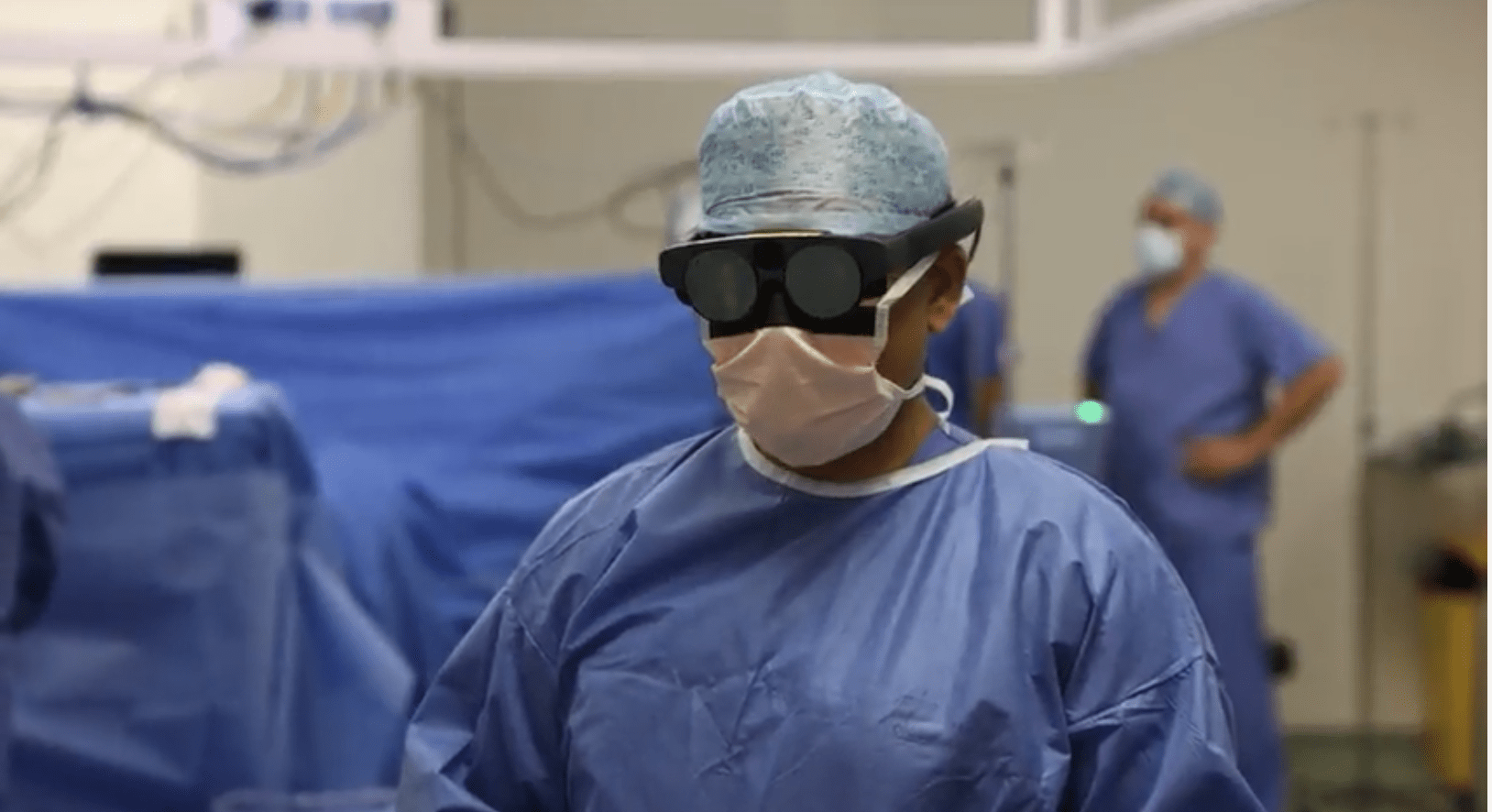
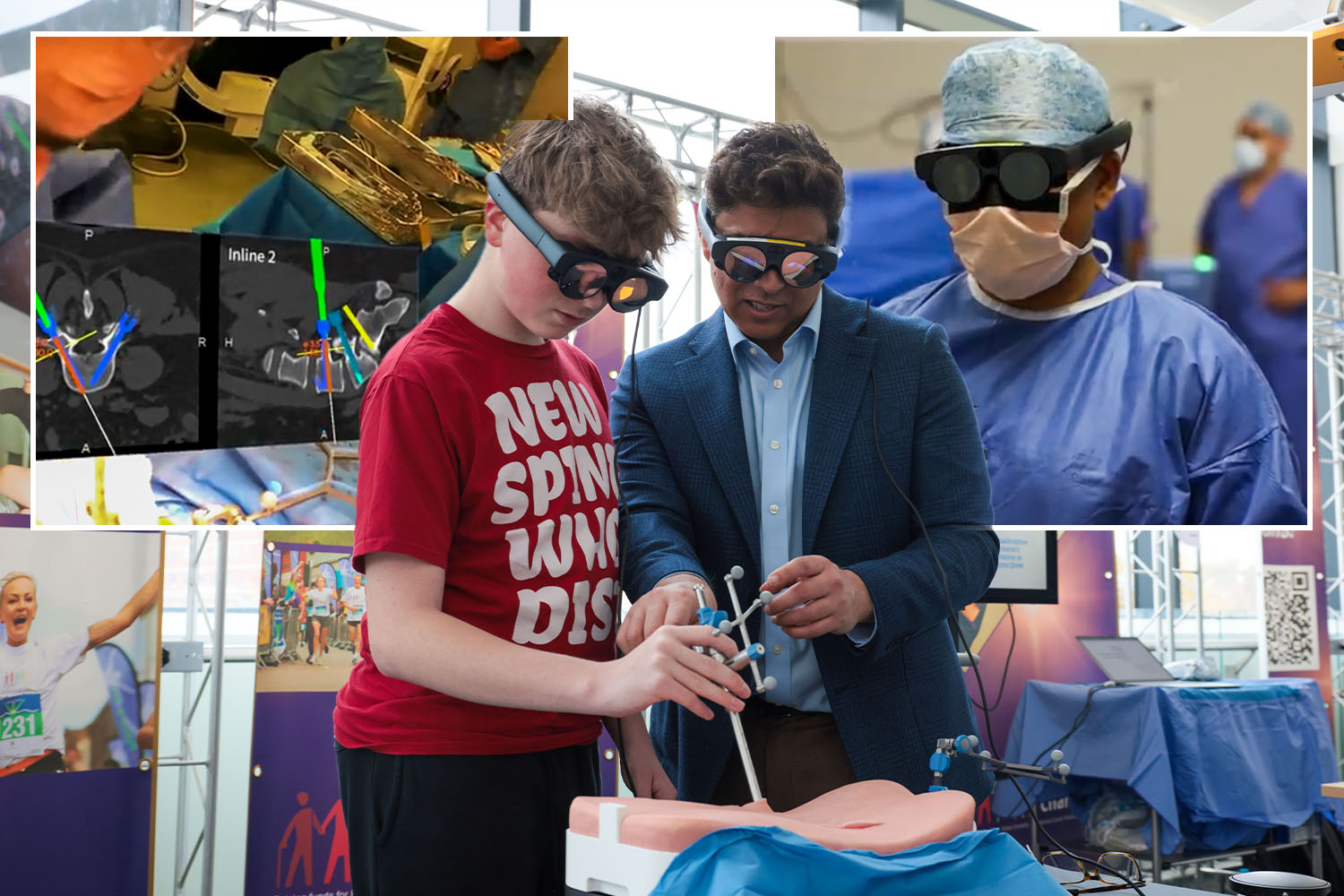
NHS surgeons now use incredible virtual reality goggles to see patients’ scans on their bodies and create a “road map” while they are operating.
Fourteen-year-old Dylan Jaxon in March became the first patient in England treated with the gear, at the Royal Stoke University Hospital.
The teen said the £50,000 headsets, rigged up to an £800,000 surgical robot for a six-hour operation to fix scoliosis in his spine, were “phenomenal”.
Dylan, from Wolverhampton, added: “It’s weird to think I had all of that equipment used on me – it’s out of this world.”
The sci fi-looking goggles are worn by surgeons to show detailed spine scans laid out on the patient’s skin and next to their body while they are on the operating table.
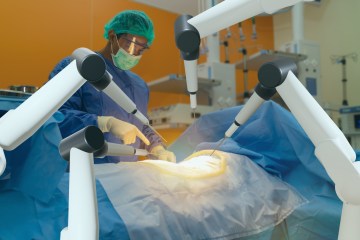
This augmented reality links up to surgical robots so medics’ tools, screws and implants can be lined up to go in exactly the right places.
Read more on robotic surgery
It allows docs to see precisely where nerves, blood vessels and bones are without looking up.
Grace Watts, 17, also had the surgery at Stoke this year, and said: “I think it’s cool, I don’t feel like as much can go wrong with stuff like this.”
Top spinal surgeon Mr Vinay Jasani said: “This gives us groundbreaking accuracy – it’s like Google Maps for surgery.
“It allows us to merge different images instead of just one X-ray or one MRI.
“In the past we would have had to pause operating to go and look at a scan on a screen, or most of us would just memorise what we needed to do.
Safety boost for high stakes surgery
“The tolerance in spinal surgery is very low because either side of the bone are the spinal cord and a big artery.
“There are risks of paralysis or even death, and this is about trying to reduce the number of complications.
“Anything that makes a patient outcome safer and more accurate has to be something that we push for.”
The Royal Stoke has become the first hospital in the NHS to use the Magic Leap goggles, paid for by donations from the Denise Coates Foundation.
It will be used for around 600 spinal patients per year to begin with, and could be used for brain surgery in the future.
Ms Coates, chief of bet365 and one of Britain’s richest women, said: “It is particularly pleasing that this pioneering technology will benefit patients in a part of the country that is so important to me.”
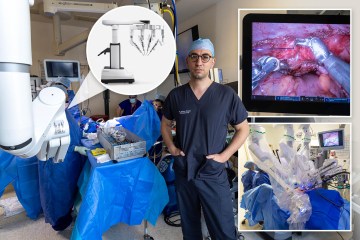
ROBOTIC SURGERY ‘WILL SLASH NHS WAITS’
ROBOTIC surgery will slash waiting lists within a decade, the head of the NHS hopes.
NHS England estimates robotic systems will be used in half a million operations per year by 2035, compared with 70,000 last year.
That will include nine out of ten keyhole ops in the gut and pelvis, and increasing numbers of emergency surgeries.
Health service boss Sir Jim Mackey said in June: “We have pledged to return to shorter elective waiting times by 2029 and we are using every tool at our disposal.
“Robotic surgery will play a huge part in this.
“Not only does it speed up the number of procedures the NHS can do, but it also means better outcomes, faster recoveries and shorter hospital stays.”