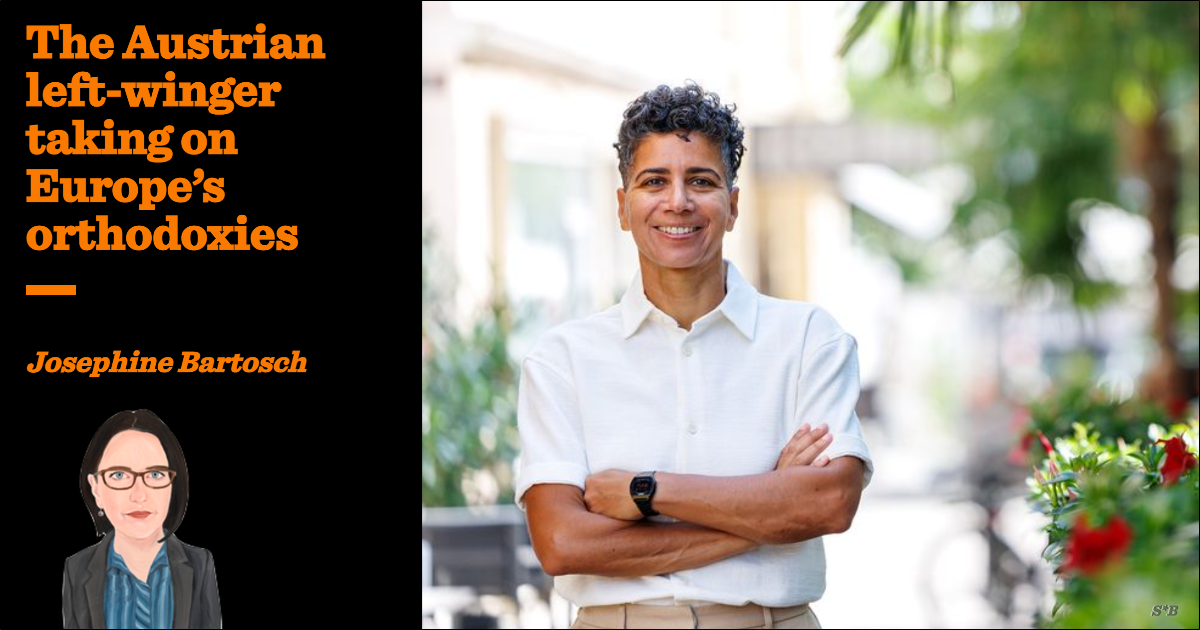
Faika El-Nagashi has bravely challenged her own political tribe on sex and gender

Seven years ago, when she was still a Green MP in Vienna, Faika El-Nagashi first sensed something was badly amiss in the movement she had helped build. At the inaugural European Lesbian* Conference — the asterisk, absurdly, signifying that straight men who “identified” as lesbian were welcome — an old friend from her youth-activist days leaned over and whispered: “You know trans women aren’t really women.”
“Back then,” El-Nagashi recalls, “Saying such a thing felt like heresy. I was shocked, but I trusted her and started to look into what ‘trans identity’ meant and what activists were pushing for.”
She describes what she discovered as both isolating and life-changing.
“It felt like coming out all over again — like when I was sixteen, searching the phone book for anyone to talk to.”
By the time she spoke publicly in early 2022, graffiti reading “Kill all TERFs” had appeared across Vienna.
“I had a parliamentary mandate,” she says. “I felt I had to address it. And when I did, what happens to everyone who speaks out against gender ideology happened to me. I lost almost everything.”
Because her whole life was bound up with activism — feminist, anti-racist, migrant-women, refugee NGOs — colleagues and friends all publicly distanced themselves. There were open letters against her, signed by politicians in her party and others. Almost everyone she knew felt they had to shun her. It was a performative, aggressive purge.
After years of internal harassment, El-Nagashi finally left the Green Party in June 2025.
“I’ve been called hateful, transphobic, fascist — by people who know my record, who’ve worked with me for decades. It’s a betrayal.”
Yet El-Nagashi has not withdrawn from politics. She is now helping to lead a nascent European resistance to gender ideology through the Athena Forum — a network exposing the policy capture of Brussels by well-funded NGOs. “One of our aims is to breach the media silence,” she says. “We’re translating what’s happening inside the European institutions — the EU and the Council of Europe — into something people can understand and respond to.”
She has watched the UK’s legal victory over gender ideology with keen interest. Earlier this year, the Supreme Court reaffirmed the common-sense view of sex and, crucially, confirmed it in law. But she warns that Brexit will not insulate Britain, and that our institutions are still at risk from gender ideologues.
“There’s a whole SOGIESC unit — sexual orientation, gender identity and expression, sex characteristics — training police, judges, equality bodies and administrators across Europe. So while you debate withdrawing from the ECHR, the institutions themselves are being ideologically trained.”
“The public debate in the UK is a decade ahead of the rest of Europe,” says El-Nagashi
Across most of Europe, trans advocacy only grows more powerful. Last week, just after Athena’s formal launch, EU Commissioner Hadja Lahbib unveiled the LGBTIQ+ Strategy and pledged to “protect LGBTIQ+ people from harmful practices and hate-motivated offences.” Days later the Council of Europe’s Human Rights Commissioner, Michael O’Flaherty — a long-time advocate for erasing sex as a legal category — admonished Britain for upholding single-sex services. The lawyer, who was appointed to his role, reminded British politicians that the European Court of Human Rights had ruled states must provide legal gender recognition to prevent “trans people living in an ‘intermediate zone’ between sexes.”
“The public debate in the UK is a decade ahead of the rest of Europe,” says El-Nagashi. “Across most of the continent it’s still impossible to speak freely. We’ve had messages from Iceland, Sweden, Germany, Greece; people want to help but can’t risk going public. Different countries, professions, seniority — always the same story.”
As a former MP, she saw how this fear shapes policy. She recalls during one networking meeting, during which she planned to address the topic of integration, “a Muslim organisation I’d supported for years told me they couldn’t attend because they had no internal position on ‘the trans issue’, and silence would look suspicious. They feared pressure from other NGOs — about an issue they shouldn’t have had to opine on at all. That’s capture of civil society.”
El-Nagashi thinks the left’s historic deference to activist NGOs has left it paralysed.
“Among progressives and Greens there’s a legacy of supporting civil society and what was once the LGB movement,” she says. “They assume today’s LGBTIQ+ is an organic continuation of lesbian-and-gay activism and trust the same organisations without scrutiny. That trust, plus political laziness, means activist demands go unchallenged.”
And once a cause attaches itself, it’s almost impossible to shake off. “Civil-society sectors — climate, anti-racism, queer, queer feminism — are strategically allied and bound together. They become each other’s hostages; none can leave the ideological train.”
Nor does she spare conservatives. “Progressives are open to influence from NGOs; conservatives and liberals from industry and corporates. Even Ursula von der Leyen — a conservative, a doctor, a mother of seven — has failed to defend women’s rights. Under her Commission we’ve seen proposals for EU-wide ‘conversion-therapy’ bans on gender identity and expansions of hate-speech law. It’s a trans-activist wish-list implemented without scrutiny.”
The consequences, she says, reach every level of policymaking. “The ideology is embedded in the EU’s understanding of equality and human rights. To dissent is to risk defamation, reputational ruin, and loss of funding.”
When I ask why bureaucrats show so little fear of public backlash, she shrugs. “They dismiss the public as ignorant, far-right, or ‘educable’. They believe in their own perpetual relevance. The ideology is circular; once you’re on the train, you can’t get off.”
For El-Nagashi the problem is as intellectual as it is moral.
“The left lacks ideological renewal. Confronted with rapid change — geopolitics, AI — progressives have no coherent framework from which to respond. Conservatives can still refer to certain values. What remains on the left is an imagined primacy of self-determination and autonomy, elevated to a quasi-human right. Hence ‘self-ID’. It’s presented as a human right to choose your sex. This lack of ideological depth drives policy everywhere.”
The left, she says, is not quite dead. “But it is suffering — and making us all suffer. Much of this stems from the bureaucracy of Brussels and Strasbourg. The machinery has immense resources and controls the narrative. It has also set the terms of polarisation, deciding who counts as ‘left’ or ‘right’.”
“With Athena Forum we’re demanding to be let in,” she says. “At present, the EU funds and listens to only one side — open doors for them, closed for us. We just want democratic accountability restored.”
“As terrible and traumatic as it’s been, I’m grateful,” she says
Standing up for her principles, and for truth itself, has cost El-Nagashi her career within the Green Party and her friendships. But it has strengthened her conviction.
“As terrible and traumatic as it’s been, I’m grateful,” she says. “I’ve reconsidered many beliefs. I’ve publicly changed my mind on prostitution, for instance. It’s disconcerting but exhilarating to be free to question again.”
She smiles. “Who would have thought learning something this profound — almost bodily — was still possible at this stage of life?”