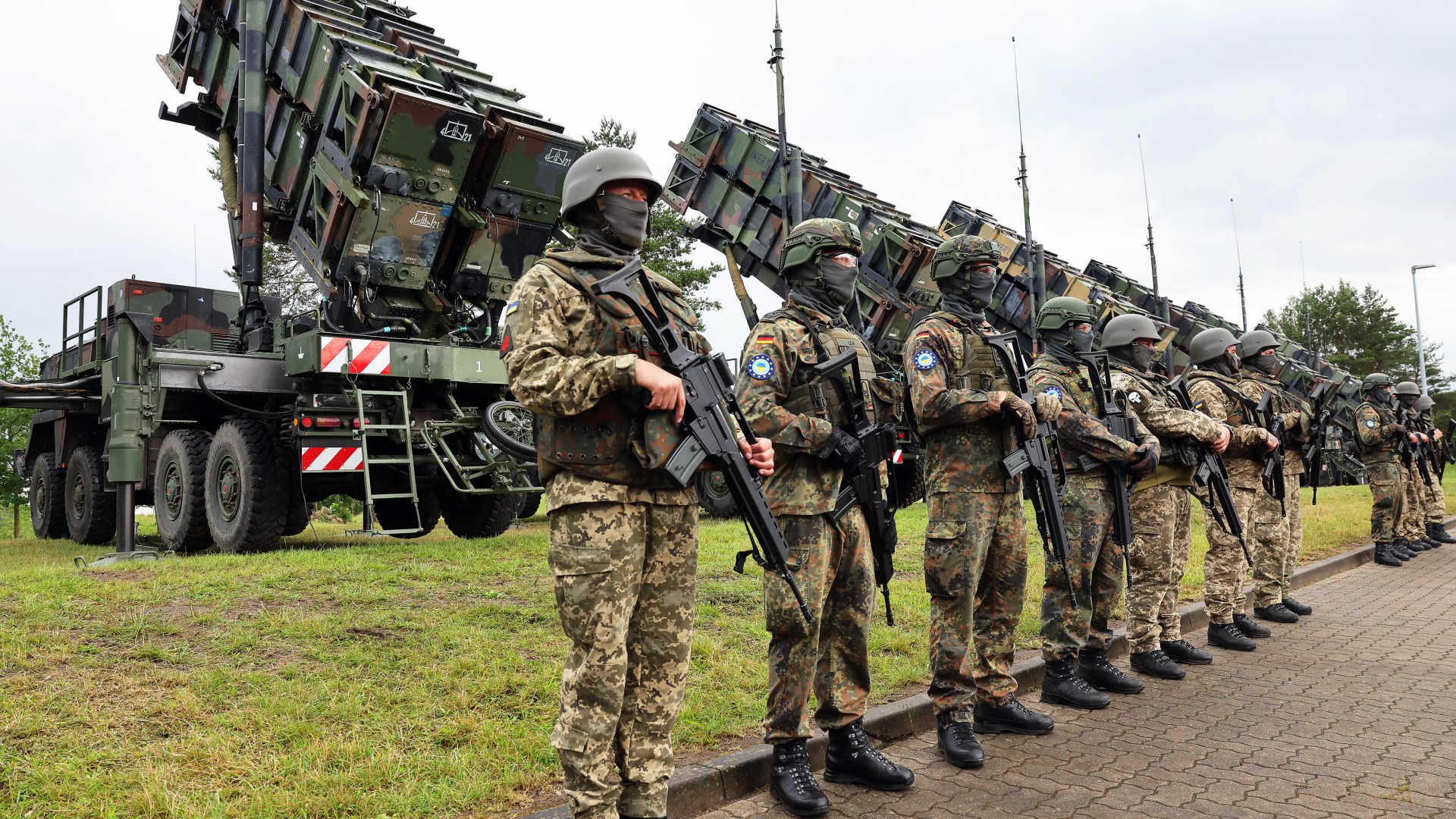
EUROPE is gearing up to defend against Putin’s tyrannical WW3 ambitions with an incredible four-pronged plan – air shield, space shield, drone wall and flank watch.
After Moscow‘s repeated – and unprovoked – aerial invasions threatening Europe’s security, the continent is now on a war footing to fight Vladimir Putin’s aggression.
The decision comes after a spate of incidents in which Europe’s borders and airports have been tested by rogue drones.
In the last few weeks, Europe has witnessed fighter jet face-offs, mysterious large drone sightings and coordinated sabotage activities that crippled operations at major airports.
Earlier this month, European Commission President Ursula von der Leyen called for a multi-layered air-defence system that could tackle a wave of drone incursions launched by Russia.
The European Commission has now proposed four European flagship defence projects – including a counter-drone system and a plan to fortify the eastern border – to defend itself against Russia by 2030.
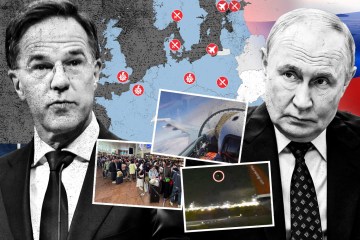
Plans are to create a European Air Shield, which will defend against missiles and other airborne threats.
Meanwhile, a European Space Shield will be created to protect European space assets and services.
And nations on Nato‘s eastern flank will build a multi-layered air defence system that will help detect the drones early and take them down.
Alongside the drone initiative is a broader “Eastern Flank Watch” programme designed to bolster air and ground defences along the EU’s border closest to Russia by the end of 2028.
Several frontline European nations attended a virtual meeting to assess how to protect their borders with the drone wall – which officials say is the need of the hour.
They include the Baltic republics, Poland, Romania and Bulgaria, along with Ukraine.
Although Ukraine is not part of the project, it has the most expertise in bringing down drones.
The aim of the “drone wall” is to build a sophisticated, multi-layered air-defence system that can detect, track and take down rogue drones – without having to scramble fighter jets and use million-dollar missiles as the first response.
EU foreign policy chief Kaja Kallas said: “Danger will not disappear even when the war in Ukraine ends. It is clear we need to toughen our defences against Russia.”
So far, the EU has not given a concrete estimate for how much it thinks the flagship projects will cost.
There is also so far no announcement on potential new financing — despite calls from EU countries close to Russia for the bloc to help spread the burden of new investments.
It comes as Russians have been accused of escalating a dangerous hybrid war against Nato with tricks from Putin’s classic playbook in a bid to sow chaos in Europe.
All the attacks in the past few weeks bore hallmarks of Moscow’s increasingly varied hybrid war on the continent.
Security and military experts also pointed their fingers at Putin, who has a chilling past of orchestrating sabotage activities and other hybrid warfare techniques against the West.
A sighting of a suspected drone briefly shuttered a Danish airport on Friday for the second time in a few hours, after the country’s prime minister said the flights were part of “hybrid attacks” that may be linked to Russia.
Drones have been seen flying over several Danish airports since Wednesday, causing one of them to close for hours.
It came after a sighting earlier this week, which prompted Copenhagen airport – the busiest hub in the Nordic region – to shut down.
That followed a similar incident in Norway, drone incursions in Polish and Romanian territory and the violation of Estonian airspace by Russian fighter jets.
And last weekend, operations at three major airports in Europe, including Heathrow, were crippled after a massive cyberattack.
All these events, which happened in the span of a few weeks, have raised tensions in light of Russia’s ongoing invasion of Ukraine.
Pushing the limits
Nato has now said it will shoot down any Russian aircraft that violates the alliance’s airspace.
But the bold declaration has attracted an ominous threat from Moscow, which said that acting on it would mean war.
Alexey Meshkov, Russia’s ambassador to France, said: “You know, there are many Nato planes that violate Russian airspace, deliberately or not, but it happens quite often. They are not shot down afterwards,” he told RTL, without providing an example.


He doubled down on Russia’s denial of any involvement in recent drone incursions across Eastern Europe.
“Russia doesn’t do that, play with anyone. It’s not really our thing,” he added.