Sir Keir Starmer is facing major questions about Labour‘s attitude towards China today after evidence submitted to a court case against two alleged spies stressed Britain wanted a ‘positive relationship’ with Beijing.
The Prime Minister is mired in a deepening crisis over the role played by No10 in the collapse of the trial of two Britons accused of espionage on behalf of the Communist regime.
Three statements provided by deputy national security adviser Matt Collins as part of the Crown Prosecution Service’s case against Christopher Cash and Christopher Berry were published late on Wednesday night.
The CPS dropped the case earlier this year after deeming the evidence did not show China was a threat to national security. Both men deny any wrongdoing.
The documents were released as it was revealed that separately China stole Britain’s state secrets for years using a backdoor into sensitive Whitehall computer systems.
The Daily Mail understands that in a catastrophic blunder exposed in 2020, the Chinese were allowed to buy a company that controlled a data hub used by government departments to exchange information, including on highly classified projects.
In his statements, Mr Collins called China ‘the biggest state-based threat to the UK’s economic security’.
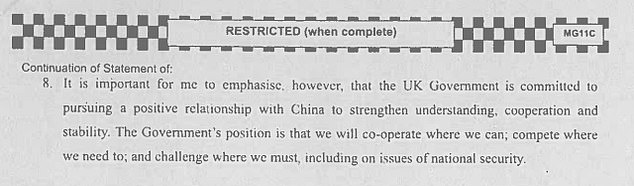
But in the last paragraph of his third and final statement submitted in August this year, just weeks before the case collapsed, he set out the Government’s approach to China.
He said it was ‘important for me to emphasise’ that the Government ‘is committed to pursuing a positive relationship with China to strengthen understanding, co-operation and stability’.
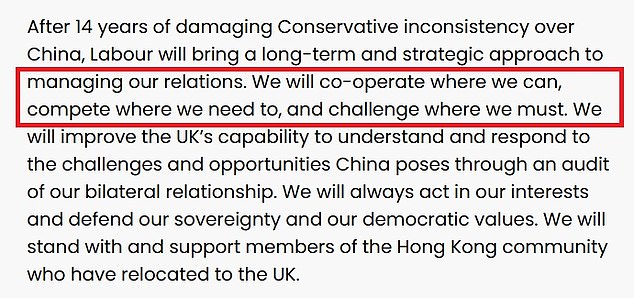
He then added ‘we will co-operate where we can, compete where we need to, and challenge where we must’, which is an almost word-for-word repetition of Labour’s attitude to China set out in its 2024 election manifesto.
Tory leader Kemi Badenoch demanded to know whether this was added at the behest of a minister or adviser, amid claims – denied by No10 – that national security adviser Jonathan Powell was involved in handing evidence to the trial.
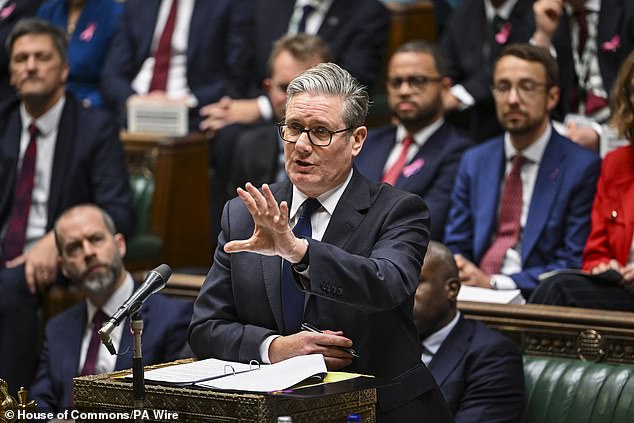
The Prime Minister is mired in a deepening crisis over the role played by No10 in the collapse of the trial of two Britons accused of espionage on behalf of the Communist regime.
But in the last paragraph of his third and final statement submitted in August this year, just weeks before the case collapsed, he set out the Government’s approach to China.
This was which is an almost word-for-word repetition of Labour’s attitude to China set out in its 2024 election manifesto (above)
She said: ‘Yesterday the Prime Minister insisted that the deputy national security adviser’s witness statements reflected the last Conservative government’s policy towards China.
‘Now we discover that a witness statement sent under this Labour Government included language describing the current Government’s policy towards China, which was directly lifted from the Labour Party manifesto. Did an official, adviser or minister suggest that this should be included?’
She called on Sir Keir to publish any correspondence and minutes of meetings relating to the case, claiming Sir Keir ‘doesn’t have the backbone to stand up to Beijing’.
In the Commons this morning shadow minister Neil O’Brien accused ministers of acting to ‘weaken the case’, adding that the wording of the latest statement ‘makes it less clear that China is a threat to our national security’.
The head of the CPS, Stephen Parkinson, is also facing questions over his role in the case’s collapse.
Mr Collins’ initial statement said Beijing’s ‘highly capable’ intelligence services are carrying out ‘large-scale espionage operations against the UK to advance the Chinese state’s interests and harm the interests and security of the UK’.
The Chinese activities ‘threaten the UK’s economic prosperity and resilience and the integrity of our democratic institutions’, he said.
But in a meeting with senior backbench MPs last night he reportedly said that the documents were ‘5 percent less than the evidence threshold that was needed’.
Mr Collins’ initial statement said Beijing’s ‘highly capable’ intelligence services are carrying out ‘large-scale espionage operations against the UK to advance the Chinese state’s interests and harm the interests and security of the UK’.
One MP present told ITV’s Robert Peston: ‘He was just a bit wet about the whole thing. He should have taken the risk of prosecuting and have let a jury decide.’
Government minister Stephen Kinnock told Times Radio the Conservatives were making ‘unsubstantiated allegations’ about ‘political pressure’ being used to influence the decision to drop the prosecution.
He said Mr Collins was ‘reflecting the wider context of the relationship’, adding: ‘It is, of course, a matter for the CPS to determine whether or not the bar for prosecution, the evidentiary basis, has been met.
‘But the wider job of the deputy national security adviser is to provide the wider context of our economic, diplomatic and national security relationship with China.’
He declined to say whether he believed director of public prosecutions (DPP) Stephen Parkinson was the right man for the job.
DPP Mr Parkinson said in a letter last week that the evidence needed to show that China represented a threat to national security when the alleged offences took place.
There was an ‘ongoing obligation’ to independently assess the evidence of a case, he said, stressing that while he stood by the decision to bring charges in April 2024, a High Court decision weeks later meant the threshold for the evidence had changed.
He said he had made efforts to obtain further evidence over many months but that ‘none of these stated that at the time of the offence, China represented a threat to national security’.
Former researcher Mr Cash said he is ‘completely innocent’ and has been ‘placed in an impossible position’ because he has not been able to prove it in a public trial.
‘I wish to reiterate that I am completely innocent. Not just because the case against me was dropped, but because at no point did I ever intentionally assist Chinese intelligence,’ he said on Wednesday night.
He added: ‘I have been placed in an impossible position. I have not had the daylight of a public trial to show my innocence, and I should not have to take part in a trial by media.’
Meanwhile, friends of Mr Collins said he did not understand why his evidence was insufficient for the case to proceed, The Spectator reported.
The magazine also cited several sources from the last government saying that two serious cases of foreign spying involving Russia and China were suppressed, reportedly involving hacking of the Ministry of Defence and Downing Street.