The natural beauty of the Blue Ridge Parkway is such that, for decades, this long ridge road that winds for hundreds of miles from Rockfish Gap, Virginia, to Cherokee, North Carolina, was called simply “The Scenic.” As its wide shoulders give way to mountain views, travelers can glimpse apple orchards, bounding deer, and palomino horses munching clover behind log fences.
But for Timothy Silver, a local fly fisherman, the 90-year-old road has been more than a path to majestic vistas. It is how he reaches his best fishing holes. It is by far the most direct route for his family to get to church in Blowing Rock, North Carolina. And it is often the safest way for neighbors to access a grocery store or gas station, commute to work, or check on each other during the far-too-common power outages.
“The parkway is the glue that holds this whole region together,” says Shannon Odom, executive director of the McDowell County Tourism Development Authority. “Thousands of businesses depend on it.”
Why We Wrote This
The Blue Ridge Parkway, which runs through America’s most-visited national park, is slowly recovering after mudslides from Hurricane Helene closed it last year. Locals have now joined in the hazardous work of reconnecting their Appalachian communities.
The road, along with life here, was torn to pieces last year. Flooding from Hurricane Helene closed over half of the parkway and left countless mountain towns uninhabitable. But it would be the road – this scenic, winding 469-mile parkway, which took half a century to carve out of the Appalachian Mountains – that folks would focus on. Not just as access for emergency vehicles, but as the common thread weaving in and out of the area’s cultural and economic identity.

Patrik Jonsson/The Christian Science Monitor
Chain saws, bulldozers, and backfill
Stitching these mountains back together – a herculean task that requires locals’ help with chain saws, bulldozers, and backfill – has been both dangerous and complicated. Snarled by delayed disaster aid and other logistics, recovery has been painstakingly slow.
But now, at the height of tourist season, this regional economy is showing it has been knocked down, but not out, by disaster.
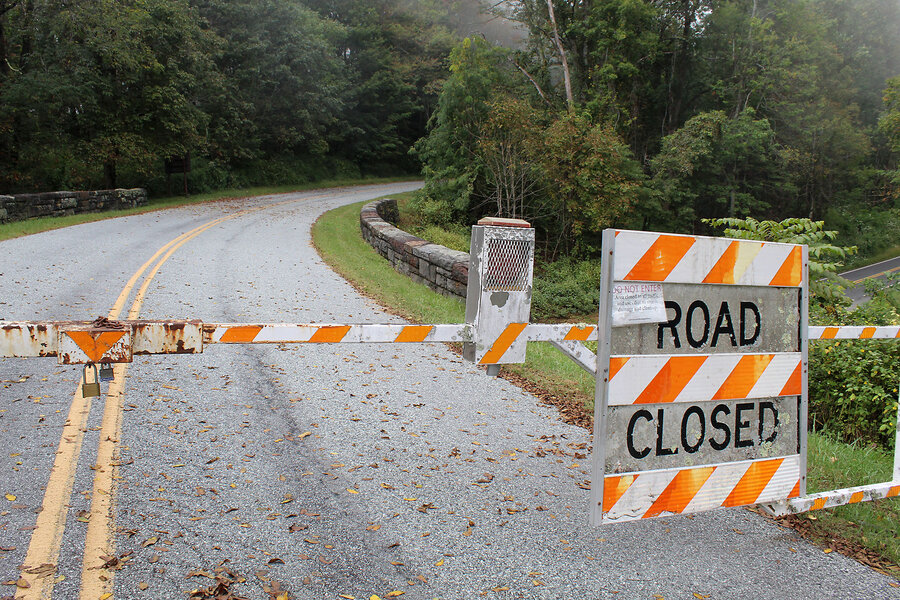
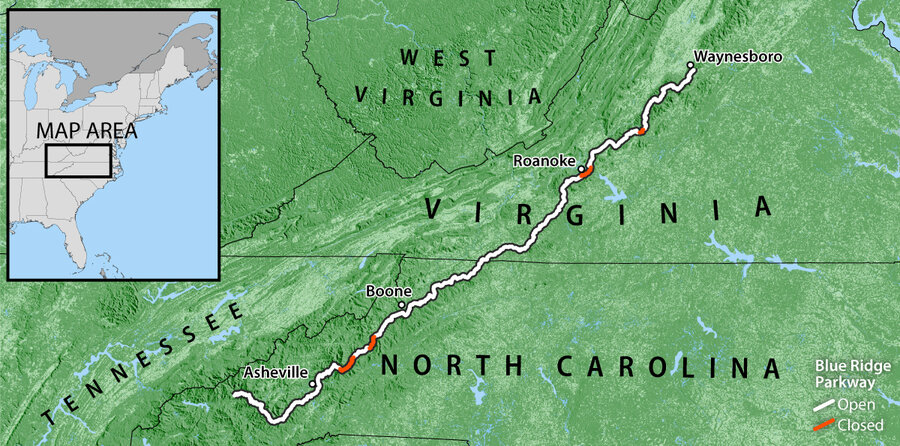
While a significant portion of the parkway – over 40 miles – remains closed as crews continue to clear out debris and rebuild mountainsides, the rest of it is now open, just in time for tourist season, the economic lifeblood of the region.
National Park Service
|
Jacob Turcotte/Staff
By dint of chain saws and log skidders, the National Park Service, aided by American taxpayers, has clawed back control of the route. Last month, a major part of the parkway from Asheville to Mount Mitchell opened, reestablishing access to places like Craggy Gardens.
Still, recovery work can be precarious: These mountains are primarily composed of sedimentary rock, such as sandstone, shale, and limestone, which can crumble beneath the weight of heavy equipment.
And the terrain hasn’t been the only challenge. The federal government’s shutdown – which has resulted in furloughing workers and delaying government services and responses – has also slowed recovery work.
As a result, it has fallen to neighbors and nonprofits to scramble to keep the area’s roads and amenities open, not just for residents, but also for the thousands of annual leaf-peeping tourists who, in the coming weeks, will provide vital income for these mountain towns. Visitors to the parkway bring 16 million people a year and over $1 billion into the region each year, part of why towns like Black Mountain are pushing to attract visitors back to their cafés and bike shops.
Ask residents about the recovery work, and responses resonate with pride, though they are still mixed with deep sadness and a lingering sense of loss.
“Losing the parkway and access to some of these places has been for me almost like losing someone in the family,” says Mr. Silver, who has lived in the mountains for 40 years. “The parkway is linked to Appalachian identity in real ways. It’s a chunk of life that has been taken away.”

Courtesy of Timothy Silver
Mr. Silver is hardly alone in mourning the parkway’s broken contiguity.
Hurricane Helene, in addition to destroying tens of thousands of homes, created a parkway “calamity,” says Duke University historian Anne Mitchell Whisnant.
During the storm, the parkway experienced over 50 major landslides, resulting in destruction spanning approximately 200 miles. The Linville Falls Visitor Center was a total loss. Some 16,000 acres saw severe damage from winds alone.
Early wins, but long way to go
Cobbling the region back together is not just a matter of emotion; it is one of economic survival.
As of mid-September, following calls by Gov. Josh Stein for help from Washington, North Carolina had received roughly 9% of the federal funding it had requested to help cover Hurricane Helene’s estimated $60 billion in damages. So far, the project has been allocated $2 billion in supplemental disaster funding, plus an additional $25 million from the Federal Highway Administration’s emergency relief fund.
But the federal government shutdown that began Oct. 1 now means that work is slowing, and long stretches of road are blocked off – just as peak leaf season approaches. It’s a time when local businesses earn as much as 75% of their annual income.
“We’re on the eve of leaf season when the parkway gets very busy, and we’ve only got a couple of folks from our district coming in a few hours a day,” parkway maintenance worker James Jones, who has been furloughed, told ABC News on Oct. 6. “If I’m not there to maintain that park, then they’re not going to get the visitor experience that they should get.”
Meanwhile, the remaining stretch of parkway from Mount Mitchell, the East’s highest peak, to Little Switzerland – closed as a result of Hurricane Helene’s landslides – is still being rebuilt, meaning a beloved Black Mountain campground remains closed. Contracted crews have to work sequentially to rebuild the road using complex backfill techniques. One slide requires rebuilding 120 feet of mountainside before heavy equipment can be moved to the next slide.

Patrik Jonsson/The Christian Science Monitor
Despite “early wins,” parkway Superintendent Tracy Swartout recently told a press conference that a full parkway reopening will not occur for at least another year, while full recovery could take “the better part of a decade.”
“My fish swim”
Even where the road has been fixed, some places are struggling to reopen. In response, the Blue Ridge Parkway Foundation, a nonprofit based in Winston-Salem, North Carolina, has stepped in to fund operations to keep some amenities going.
The Parkway Visitor Center at parkway Milepost 384 in Asheville, the Museum of North Carolina Minerals at Milepost 331 near Little Switzerland, and the Blue Ridge Music Center at Milepost 213 in Galax, Virginia, will be open the next two weekends with the help of the foundation.
That sense of communal responsibility amid government failures is key to the region’s stubborn strength, says Dustin Coffey, a fly-fishing guide in Boone, North Carolina.
Just as the fish move between streams, locals and businesses have had to adjust to the reshaped landscape using survival instincts, he says.
“Yes, you have to relearn, but you should relearn every day you step up to the stream,” says Mr. Coffey. “People ask me, ‘Did the fish blow out [from the floods]?’ No, my fish swim.”
In the end, Mr. Coffey and others say the parkway’s real value – both in its essence and in its rebuilding – may be about patience. For drivers, the top legal speed is 45 miles per hour, with other sections as low as 25 mph. Just fast enough, as they say, to slow down.
The irony of using a massive amount of mechanical resources to rebuild a mountain parkway that offers spectacular views of nature is not lost on Mr. Silver, the fisherman and a retired environmental historian at Appalachian State University in Boone.
He is eager for the recovery to be complete, so life in the mountains can settle back down.
“The sooner,” he adds, “the better.”