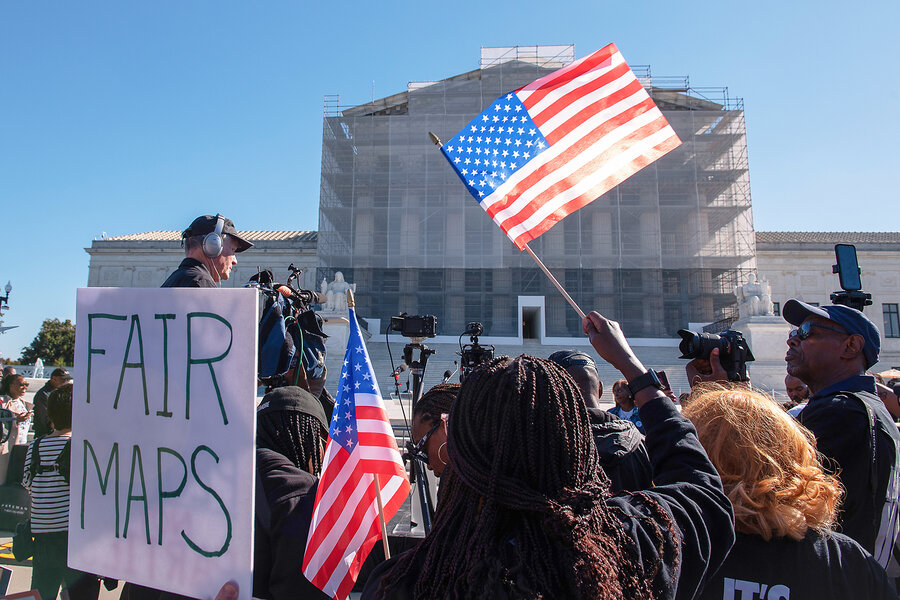
The Supreme Court sounded sympathetic during oral arguments on Wednesday to significantly constraining a crucial provision of the Voting Rights Act – a move that could dramatically strengthen Republicans’ hopes of winning the U.S. House of Representatives in future elections and significantly decrease the number of Black and Hispanic officeholders in the country.
Justices heard arguments in Louisiana v. Callais, a case centered around a congressional map for the state of Louisiana which had created two majority Black districts. The Trump administration and the state of Louisiana argued that using race to draw congressional districts as a remedy for discrimination was in itself a violation of the Constitution. If a majority of the court agrees, that would render toothless the 60-year-old-law, which has paved the way for increased minority representation in the U.S. since the Civil Rights era. It would essentially undo the Voting Rights Act’s last enforcement mechanism and would open the door to allow Republicans to eliminate a slew of majority-minority congressional seats in states that they control.
A ruling in favor of Louisiana could potentially cement Republican control of the House for years to come and upend election maps from Congress down to city council and school district lines. During oral arguments, NAACP Legal Defense Fund attorney Janai Nelson warned that if the court struck down Section 2 of the Voting Rights Act, the portion of the law still intact after an earlier Supreme Court ruling weakened another portion of the law, “the results would be pretty catastrophic” for minority representation.
Why We Wrote This
The Supreme Court heard oral arguments on a case asking whether using race as a factor in congressional maps violates the Constitution. If the justices decide it is, the decision could open the door for Republican politicians to redraw maps to eliminate a number of Black and Hispanic districts.
Hashim Mooppan from the Department of Justice, arguing for the plaintiffs, suggested that there’s “no reason to assume that because there’s a large Democratic population in Louisiana that doesn’t have a district, that that’s a racial reason, rather than a partisan reason.”
Conservatives hold a 6-3 majority on the Supreme Court, and following oral arguments, many scholars predict it will severely limit the law’s application.
“I think it’s very unlikely that the Voting Rights Act will escape unscathed from this court. I think they’re very likely to strike down portions of Section 2 of the Voting Rights Act,” says Harvard University Professor Maya Sen, who researches law and politics.
Should the Voting Rights Act continue on?
The Supreme Court knocked down a different key component of the Voting Rights Act in 2013. In that ruling, Chief Justice John Roberts wrote the majority opinion that de facto ended the federal government’s previous ability to block maps it deemed racial gerrymanders in states that had histories of discrimination. Justice Roberts has long been skeptical of the law – as a young lawyer in the Reagan administration, he unsuccessfully worked to oppose expansion of the Voting Rights Act. That left Section 2 as the law’s main remaining enforcement mechanism.
Ed Blum, a conservative legal activist who led the charge in the case that led to the 2013 decision, predicts the court will chip away further at the law.
“It is unlikely that the Court will rule that Section 2 of the Voting Rights Act is unconstitutional,” he tells the Monitor. “However, it appears that Section 2 will be narrowed in a way that would make race-based gerrymandering for allegedly remedial purposes illegal.”

This court has surprised observers before on voting rights issues. Two years ago, the conservative-majority court ruled 5-4 to uphold an injunction against an Alabama map that lower courts had ruled discriminated against Black voters under Section 2, with Chief Justice Roberts and Justice Brett Kavanaugh joining the court’s three liberals in the majority.
But on Wednesday, Justice Kavanaugh sounded much more sympathetic to arguments presented by the Trump administration and Louisiana, raising questions about whether the VRA’s application should continue on indefinitely. Chief Justice Roberts was fairly quiet during the oral arguments. If just one of those two justices sides with their fellow conservatives, what remains of the Voting Rights Act could be dramatically weakened.
Josh Blackman, a conservative legal scholar and law professor at the South Texas College of Law, believes “there are almost certainly six votes” to rule for Louisiana in the case.
“Justice Kavanaugh came to the argument extremely well-prepared, and seems to have mapped out all of the contours of an opinion. It seemed like he was reading from notes, and articulating different standards that could apply,” he says. “I think he is generally comfortable with the government’s framing of the case.”
Political ramifications
The political ramifications of such a ruling would be profound, likely allowing red-state Republicans to eliminate a number of Democratic-held Black and Hispanic districts in the South and all but locking in their control of the House.
Republicans, at President Donald Trump’s behest, are already undertaking mid-decade redistricting in states including Texas, Ohio, Missouri, North Carolina, Kansas, and possibly Indiana to eliminate Democratic-held seats and shore up their House majority (California Democrats are responding with an attempt to redistrict their state). But that effort pales in comparison to what they’d be able to do without the constraints of the Voting Rights Act.
Republicans could eliminate as many as 19 minority-majority, Democratic-held congressional seats and all but guarantee their House majority in future elections, according to a recent report by the Democratic voting rights groups Black Voters Matter and Fair Fight Action. A New York Times analysis estimates that if the Supreme Court gives Republicans free rein to eliminate these seats, Democrats would need to win the national House popular vote by roughly 5 percentage points in the next election in order to retake control of the chamber, up from just 1.4 points assuming GOP states complete their current gerrymandering efforts.
In an unusual move, the Supreme Court heard this case last year – and sent it back for another round of oral arguments, asking lawyers on both sides to focus specifically on whether the Voting Rights Act violates the 14th and 15th Amendments of the U.S. Constitution. The 14th Amendment offers equal protection under the law, while the 15th Amendment bars governments from denying or abridging citizens’ right to vote “on account of race, color or previous condition of servitude.” Voting rights advocates saw the court’s request itself as ominous, setting up a broader challenge of the law.
David Becker, the executive director of the Center for Election Innovation & Research, says it was “a very troubling question that the Supreme Court asked.”
Conservatives argued in the case that Louisiana’s congressional map was drawn with the intent to maximize Republican representation rather than minimize Black voting strength, and that considering race in gerrymandering defies the 14th and 15th Amendments. Louisiana v. Callais originated after Louisiana redrew its congressional map in 2022 with one majority-Black district out of the state’s six districts. About one-third of the state’s population is Black. A federal judge ruled that map likely violated the Voting Rights Act and ordered the state to draw new maps. In 2024, the state created two majority-Black districts. A group of “non-African American” plaintiffs challenged the newest version and a federal district court upheld their view, leading to an appeal to the Supreme Court.
“Race-based redistricting is fundamentally contrary to our Constitution. It requires striking enough members of the majority race to sufficiently diminish their voting strength, and it requires drawing in enough members of a minority race to sufficiently augment their voting strength,” Louisiana Solicitor General Benjamin Aguiñaga argued during the hearing.
The Trump administration’s Justice Department took a slightly different position that Section 2 doesn’t need to be struck down, just restricted.
Ms. Nelson, in her rebuttal, argued that restricting the Voting Rights Act would lead to a resurgence in racially discriminatory gerrymandering.
The court would need to issue a quick ruling in this case if it’s going to matter for the 2026 midterm elections, and it’s unclear how fast a decision might come. Louisiana Secretary of State Nancy Landry asked the court to rule this winter in order to be able to have a new map in place before the state’s April primaries, a request reiterated by attorneys during Wednesday’s oral arguments.
The Supreme Court usually issues its major rulings in June or July. That wouldn’t leave enough time for most states to redraw their maps in time for their states’ primary election filing deadlines. But it is unclear whether that will be the case this time around, or whether they might issue a faster ruling in time to upend the 2026 midterms and help President Trump’s party keep unified control of Washington.
Staff writer Victoria Hoffmann contributed reporting to this story.