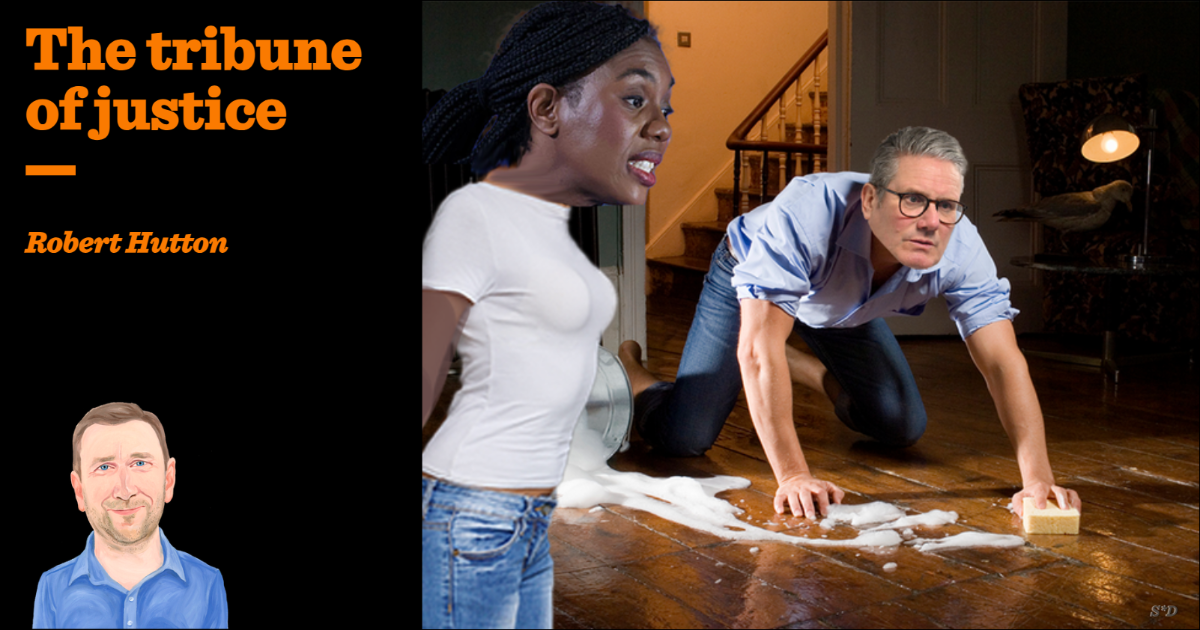
“Exactly as I expected!” Kemi Badenoch was triumphant! The prime minister, she was delighted to be telling the House of Commons, had walked right into her trap. Which left the question of why she was the one lying, metaphorically, at the bottom of a deep pit.
It was very far from clear to those of us watching that Keir Starmer had, in fact, behaved exactly as Badenoch expected. A person who didn’t have her assurance that this was all part of a dazzling plan where she was never less than ten moves ahead would have concluded that the Conservative leader had been completely wrong-footed. Fortunately though we had Badenoch’s assurance that this was all an illusion. Possibly the Conservatives are also trailing in the polls so as to lull Nigel Farage into a false sense of security.
Starmer opened his questions session on Wednesday by deploying one of the tools available to a prime minister: the ability to announce news suddenly to throw off your opponent. It’s customary for ministers to give their opposite numbers advance sight of statements to the chamber, but this rule doesn’t apply to information you drop in at the start of PMQs. In this case, it was a long-ish explanation of the China spy case, and the rabbit from the hat: a promise to publish the witness statements at the heart of it.
It was indeed fortunate for Badenoch that this was exactly what she had expected, because of course securing a promise to publish these statements might otherwise have been the very most she might have hoped to have won in her exchange with the prime minister, and by announcing it before she spoke, he had effectively seized the initiative from her. But she was too cunning for that. This, after all, was exactly what she expected.
Badenoch was furious. Starmer had only read part of her quote!
For some reason, when she made this point, the Labour benches fell about. “I don’t know what they are laughing at,” Badenoch snapped. Was it possible that they did not believe that this was exactly what she had expected? But then, why would she have said such a thing? Were they under the impression that Badenoch is the kind of person who makes extravagant claims about their past thoughts which aren’t necessarily backed up by the record?
This was, as it happened, the question on which their exchanges turned. Starmer’s claim was that, when the Conservatives were in office, they tried quite hard to avoid offending China, and chose their words extremely carefully. He quoted James Cleverly, when Foreign Secretary, explaining why he didn’t want to call China a “threat”. Cleverly puffed with outrage. More, Starmer quoted one Badenoch, K explaining that she had, in office, also avoided using the word.
Badenoch was furious. Starmer had only read part of her quote! This is correct, in that, freed from the burdens of office and keen to appeal to China-sceptic Tories — this was during last year’s leadership contest — Badenoch had indeed gone a bit further. But that didn’t undermine Starmer’s central point that, when she was a minister, she’d followed the standard British line of trying not to upset the big powerful state with all the money.
“Those spies were charged under a Conservative government,” Badenoch declared. “They were let off under Labour!” She got to her devastating question. Ministers had insisted that the only person involved in discussing the government’s evidence in the case was the deputy National Security Adviser. “Are the government seriously saying that only one man had anything to do with this failure?” She was on fire. “Is the prime minister seriously saying that the deputy did not discuss with the National Security Adviser, the Home Secretary or anyone in Downing Street?” She was storming. “Is he seriously saying that?” She sat down triumphant, the tribune of justice.
The prime minister rose. “Yes.” Again, had we not known that this was all part of Badenoch’s masterplan, this would have been the kind of answer to throw her off balance. Starmer went on, quietly confident in his position. “I can be absolutely clear that no minister was involved, no special adviser was involved in this.” This was not the sort of equivocation deployed by ministers trying to weasel their way round a tricky point. If it turns out a minister or an adviser was involved, Starmer will have to apologise to the Commons.
Badenoch complained, as is her wont, that Starmer is a lawyer, not a leader. He had a reply ready: “She’s clearly not a lawyer or a leader.” This is a bit harsh on Birkbeck, University of London, where Badenoch gained a Bachelor of Laws in 2009.
At the end of the session, Cleverly rose to complain that he’d been misquoted, but Starmer’s substantive point had been the extreme reluctance of the last government — and this one, for that matter — to describe China as an enemy, and indeed Cleverly had declined to do that while in office.
Perhaps some evidence will emerge of a meeting where Labour ministers conspired to kill the spy trial. Probably, despite Starmer’s protestations, they’re not sorry to see it go away. But with so many interventions from the Conservative Party, Badenoch’s criticism seems to boil down to “Why haven’t you done a better job of clearing up our mess?”
Which is certainly exactly as the rest of us have come to expect.