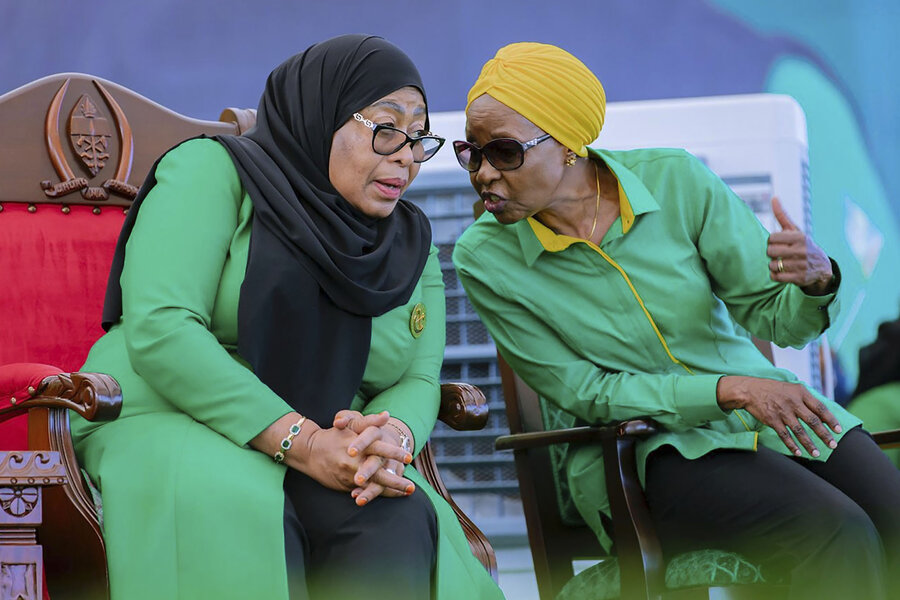
When Tanzania’s first female president, Samia Suluhu Hassan, took office in 2021, many hoped she would prove a more democratic leader than her predecessor, John Magufuli, who was nicknamed “the Bulldozer.” But activists and opposition leaders say Tanzania’s government has become even more repressive under Ms. Hassan. Now, having barred her major rivals from the polls, she will run virtually unopposed in the Oct. 29 general election.
Experts say this mirrors a broader trend of rising authoritarianism in East Africa. Here’s a look at the upcoming election and what is at stake for Tanzania.
What is the current political situation in Tanzania?
Why We Wrote This
Since achieving independence in the 1960s, Tanzania has essentially been ruled by one political party. What might the upcoming election hold for the East African country and others in the region?
Since achieving independence in the 1960s, Tanzania has essentially been ruled by only one political party. Its current iteration, established in 1977, is called Chama Cha Mapinduzi (CCM) – “the party of the revolution.” The CCM was the only political party legally allowed to exist in Tanzania until the 1990s, and even after the introduction of a multiparty system, it continued to rule with a heavy hand.
That wasn’t always unpopular. Mr. Magufuli, for instance, was praised for combating corruption and carrying out public-sector reforms, inspiring a popular hashtag in the region, #WhatWouldMagufuliDo. But he was also widely criticized internationally and by Tanzanian opponents for his autocratic tendencies, including restricting freedom of speech, cracking down on LGBTQ+ Tanzanians, and making COVID-19 denialism official government policy.
When Mr. Magufuli died in office in 2021, Ms. Hassan took over, promising a softer leadership style.
“She struck a more open and conciliatory tone toward civil society and the opposition,” explains Mohamed Keita, senior policy officer for Africa at the Human Rights Foundation in New York. Ms. Hassan lifted a prohibition on political demonstrations in the country, ended bans on four newspapers, and released one of the country’s main opposition leaders from prison.

Why are there concerns about the upcoming election?
Despite Ms. Hassan’s initial openness to reform, experts say the CCM now appears to be reverting to its old electoral playbook.
“The elections will not be free or fair,” says Pauline Bax, deputy director of the Africa program at the nonprofit International Crisis Group. “There’s been a campaign of harassment and intimidation in the lead-up to the elections that is really worrying.”
Notably, Tundu Lissu, the head of Tanzania’s leading opposition party, was arrested in April after holding a rally pushing for electoral reform. Mr. Lissu, who survived an assassination attempt during Mr. Magufuli’s presidency, is now on trial for treason. He faces the death penalty if convicted, and his party, Chadema, is barred from contesting the polls after refusing to sign a “code of conduct” agreement required by all parties.
“The election is already irredeemably compromised,” says Robert Amsterdam, Mr. Lissu’s lawyer, adding that the CCM “is a political party bent on their own political survival at all costs.”
Another opposition candidate, former CCM government-minister-turned-critic Luhaga Mpina, has also been banned from running. He has challenged his exclusion in the High Court of Tanzania, with a ruling expected Wednesday. If the ban is upheld, as expected, Ms. Hassan will run unopposed by any significant rivals.
Meanwhile, reports of torture and abductions have compounded the atmosphere of fear. For instance, in May, two East African civil society activists – Boniface Mwangi from Kenya and Agather Atuhaire from Uganda – traveled to Tanzania to monitor one of Mr. Lissu’s hearings. They say they were abducted from their hotel, kept for days at an unknown location, and then raped, before being dumped at the border. Tanzanian authorities deny the allegations.
What is at stake for Tanzania and East Africa more broadly?
The CCM is expected to win in a landslide.
Mr. Keita notes that the kinds of tactics used by the party are not unique to Tanzania. Across the region, “long-ruling parties have made it impossible for the opposition to win,” he says.
In neighboring Uganda, where President Yoweri Museveni has held office since 1986, opposition leader Kizza Besigye is in jail awaiting trial on treason charges. In Rwanda, opposition leaders have received lengthy jail sentences for challenging longtime President Paul Kagame. One of Mr. Kagame’s fiercest critics, Victoire Ingabire, spent eight years in jail on a terrorism charge and was recently rearrested for “inciting public disorder.”
Ms. Bax says that this kind of repression could have a chilling effect across Africa. “The rise of authoritarianism across the continent is not only shrinking political freedoms, but also increasing the tolerance for such repressive methods,” she says.