Donald Trump has said that Hamas are currently gathering hostages in Gaza before handing them over to Israel as part of a historic peace deal.
The US President said the terror group is gathering hostages ‘now’ to hand over to the Israeli military in exchange with hundreds of Palestinian prisoners, adding that some were being held in ‘some pretty rough places’.
Hamas is set to release about 20 living Israeli hostages by Monday, while Israel is to free some 250 Palestinians serving prison sentences, as well as around 1,700 people seized from Gaza the past two years and held without charge.
The Israeli military has already begun positioning troops on the outskirts of Gaza after it completed a partial withdrawal from the territory as set out in a ceasefire agreement with Hamas which came into effect at 12am on Friday.
The releases have powerful resonance on both sides. Israelis see the prisoners as terrorists, some of them involved in suicide bombings.
Many Palestinians view the thousands held by Israel as political prisoners or freedom fighters resisting decades of military occupation.
Most of those on the Israeli prisoner list are members of Hamas and the Fatah faction arrested in the 2000s.
Many of them were convicted of involvement in shootings, bombings or other attacks that killed or attempted to kill Israeli civilians, settlers and soldiers.
After their release, more than half will be sent to Gaza or into exile outside the Palestinian territories, according to the list.
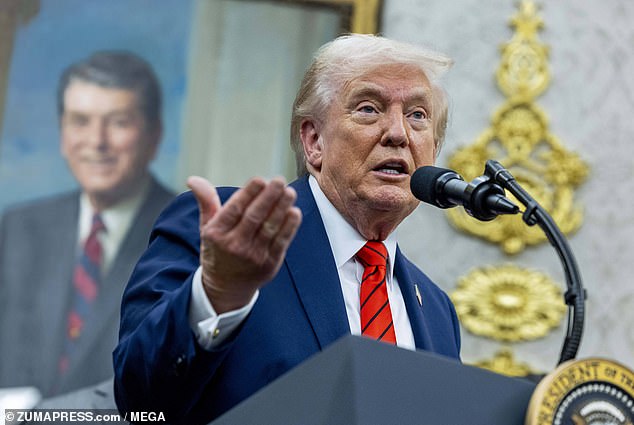
The US President Donald Trump (pictured) has said that Hamas are currently gathering hostages in Gaza before handing them over to Israel
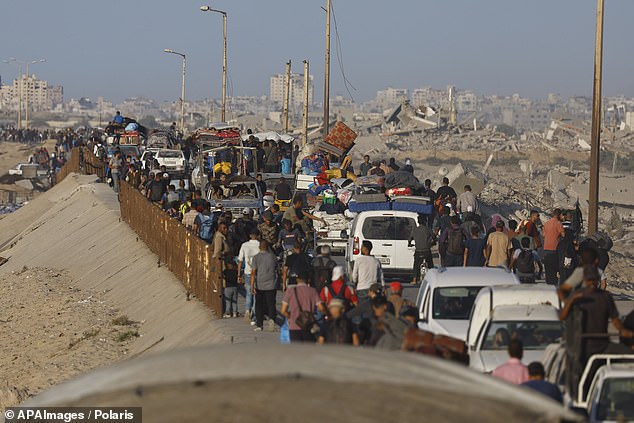
Displaced Palestinians walk with their belongings along the coastal road towards Gaza City
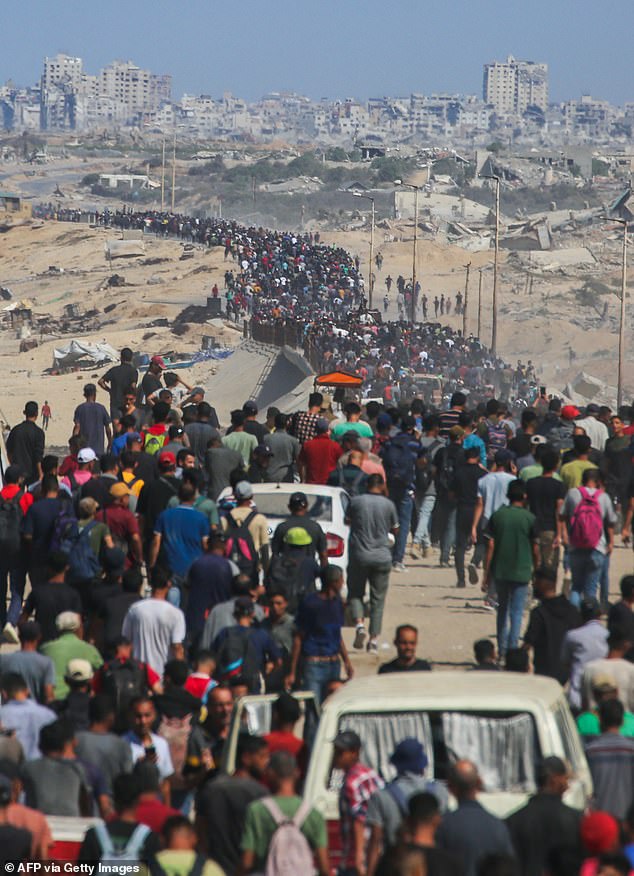
Palestinians, carrying the belongings they managed to take with them, move toward the northern part of the Gaza Strip
The 2000s saw the eruption of the Second Intifada, a Palestinian uprising fueled by anger over continued occupation despite years of peace talks.
The uprising turned bloody, with Palestinian armed groups carrying out attacks that killed hundreds of Israelis, and the Israeli military killing several thousand Palestinians.
One prisoner who will be freed is Iyad Abu al-Rub, an Islamic Jihad commander convicted of orchestrating suicide bombings in Israel from 2003-2005 that killed 13 people.
The oldest and longest imprisoned to be released is 64-year-old Samir Abu Naama, a Fatah member who was arrested from the West Bank in 1986 and convicted on charges of planting explosives.
The youngest is Mohammed Abu Qatish, who was 16 when he was arrested in 2022 and convicted of an attempted stabbing.
Hamas leaders have in the past demanded that Israel release Barghouti, a leader of the militant group’s main political rival, Fatah, as part of any deal to end the fighting in Gaza. But Israel has refused in previous exchanges.
Barghouti, 66, is widely seen as a potential successor to President Mahmoud Abbas, the aging and unpopular leader of the internationally recognized Palestinian Authority that runs pockets of the West Bank.