‘He’s not telling the truth,’ said former Tory leader Iain Duncan Smith when I spoke to him this week. Shadow Home Secretary Chris Philp was even blunter: ‘He’s lying.’ Both were referring to Keir Starmer and the reasons the Prime Minister had given for the collapse of the case against two British citizens accused of spying for China before their trial had even started.
Last May, I wrote in these pages that the Starmer Government had taken lying and deceit to a new level – the worst I’d seen in 55 years of covering Westminster politics. I warned then that it was endemic and likely to get worse.
It has. But the lies and obfuscation are no longer just the usual political porkies about broken election promises, policy U-turns and personal matters, like property portfolios and extravagant gifts from wealthy benefactors. Now they concern matters of national security. It doesn’t get more serious than that.
Starmer claimed last week that the case collapsed because, when the alleged offences were committed (between 2022 and 2023), the previous Conservative Government had failed to designate China as a national security threat.
The accused were being prosecuted under the Official Secrets Act and, without China being officially deemed an ‘enemy’, Starmer’s camp was arguing, the chances of conviction were much reduced.
‘You can’t prosecute someone two years later,’ claimed Starmer, ‘in relation to a designation that wasn’t in place at the time.’ The Tories were to blame, he added, for the case collapsing.
The blatant untruth of Starmer’s claim is breathtaking. But even more astounding is the ease with which his words can be disproved. You’d think a former Director of Public Prosecutions, about which he’s always boasting, would have realised that.
It’s not just Tories calling him out. Starmer’s cavalier attitude to the truth has provoked an unprecedented on-the-record assault on a sitting Prime Minister from a panoply of recently retired panjandrums of Whitehall.

The blatant untruth of Keir Starmer’s claim on the scandal is breathtaking, Andrew Neil writes
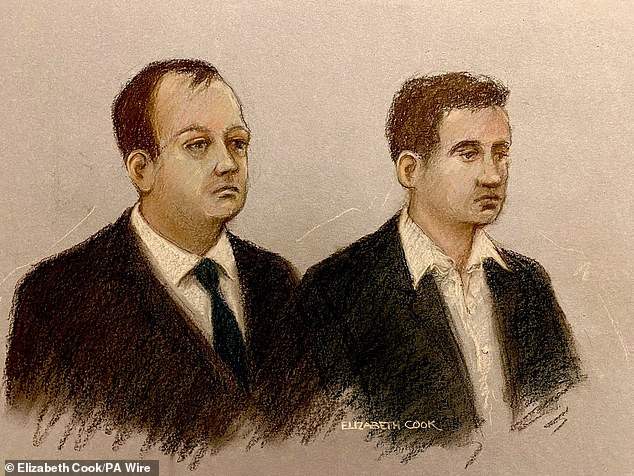
Christopher Berry, left, and Christopher Cash appearing at Westminster Magistrates’ Court
Ex-intelligence chiefs, former senior civil servants, even another one-time DPP have effectively challenged and destroyed his account of events.
This is serious for Starmer. But then the documented evidence refuting his claims is overwhelming.
In 2021, the Tory Government’s review of security and defence stated unequivocally that China presented ‘the biggest state-based threat to the UK’s economic security’. For those jumping in to say, ‘Ahh, but economic security is not the same as national security’, the review went on to add, rightly, that the ‘distinction between economic and national security is increasingly redundant’.
Two years later, in response to an investigation by the House of Commons Intelligence and Security Committee into China, the Government’s official submission reiterated its warning that Beijing’s ambitions posed ‘a national security threat’ to the UK.
This was reiterated in an updated security and defence review published in 2023, which stated: ‘We will increase our national security protections in those areas where Chinese Communist Party actions pose a threat to our people, prosperity and security.’
So just before, during and immediately after the spying is alleged to have taken place the British Government had clearly designated China as a national security threat.
On the very day the accused were arrested, the Government published a report promising to tackle areas in which ‘Chinese Communist Party actions pose a threat to our people, prosperity and security’. The record couldn’t be clearer. I’m mystified, even flabbergasted, as to why Starmer thinks he can get away with claiming the opposite. I’m not alone.
Former national security adviser and cabinet secretary (the most senior position in the British civil service), Mark Sedwill, is ‘genuinely puzzled’ by the PM’s remarks and finds them ‘very hard to understand’.
‘Of course China is a national security threat,’ he said – directly, digitally, through espionage and the through its ‘aggressive’ behaviour in the South China Sea, which threatens our trade routes.
Ken Macdonald, one of Starmer’s distinguished predecessors as DPP, said it was ‘difficult to understand’ why the case had been dropped, as it was ‘self-evident’ that China posed a threat. Another former cabinet secretary, Simon Case, who was in post when Starmer became PM, also challenged his version of events, pointing out that the heads of our intelligence agencies had been describing China as a threat to national security for years. He’s right.
Four years ago the then head of MI6 described China as the biggest of the ‘big four’ threats facing Britain, alongside Russia, Iran and international terrorism.
A year later, the then head of MI5 concurred, describing China as a ‘game-changing strategic challenge’ to the UK. He subsequently highlighted the ‘epic scale’ of China’s espionage efforts in Britain.
Richard Dearlove, who ran MI6 between 1999 and 2004, says the idea that ‘China is not a threat to national security when it’s acting in this manner is completely absurd. It’s sort of inexplicable.’
But is it? In the 15 long, miserable months since Starmer became PM, we’ve had several indications that he regards cosying up to China – its vast domestic market and huge funds for overseas investment – as an essential part of his mission to inject some growth into a stagnant British economy.
This has become ever more evident since former Tony Blair consigliere, Jonathan Powell, became Starmer’s national security adviser. Powell – and organisations he’s been associated with – have long cultivated contacts in the upper echelons of Beijing. He is now spearheading Starmer’s Chinese charm offensive. The aim is to clinch an invitation from President Xi for the PM to visit next year.
So Starmer needed a Chinese spy trial like a hole in the head. When Stephen Parkinson, the current DPP, sought witness statements from the Government to confirm China was (and still is) a threat to national security in the run up to the trial of the alleged spies, none was forthcoming.
There were reports that Powell attended a high-powered Whitehall meeting last month to stop any official designation of China as an ‘enemy’ or a ‘national security threat’ in the trial. The most that could be conceded was that China was a challenge. Who knew?
More evidence of this new softly-softly approach to Beijing accumulated. A dossier compiled by the security services to warn government departments of the scale of the Chinese threat contained ‘hundreds’ of examples of its malign behaviour. But it was not passed to Parkinson at the Crown Prosecution Service.
The published version of the Government’s long-awaited China audit, which came out in June, was thin gruel. Details of the full extent of China’s espionage were left out after Treasury officials said it would damage the push for Chinese investment. Powell is said to have played a role in watering it down.
His deputy national security adviser, Matthew Collins, who had originally assessed Chinese activities as ‘prejudicial to the safety or interests of the UK’ then declined weeks later to say China was an ‘active threat’ to Britain.
So Parkinson pulled the spy case on the eve of the trial, leading to widespread suspicions that the Government deliberately scuppered proceedings to protect its efforts to create a ‘new era of good feelings’ with China.
The Government, of course, denies it did any such thing. But it’s hard to divine any other reason the case was aborted.
Certainly none of the public explanations from the PM down – mired in lies and disinformation – make any sense.
For example, the Government is citing in its support an appeal court ruling last year in another spy case involving Bulgarians in a Russian spy ring.
It seemed to confirm that the use of the Official Secrets Act was best confined to cases in which spies were passing secrets to clear enemies – and the Government was not going to designate China as an enemy. This, the Government argued, raised the threshold for spy convictions.
As is so often the case with the Starmer Government the truth is the opposite. Yes, designating the recipient of our secrets an ‘enemy’ strengthened the prosecution’s case. But the appeal judge went on to rule that ‘any state which presently poses an active threat to the UK’s national security can properly be described as “an enemy” in ordinary language’.
So the Bulgarian spy ring case actually lowered the threshold regarding the ‘enemy’ aspect of any spy prosecution. Yet the official line is that it raised it. Thus has truth become whatever the Starmer Government wants it to be.
The Government didn’t have to call China an enemy for the spy trial to proceed, just a threat to national security, something which the previous government and sundry officials and intelligence wallahs had done multiple times.
But Starmer et al wouldn’t do it – and had the temerity to blame the previous government for the case collapsing. I guess if you’re going to lie, make it a whopper.
Starmer is a lucky man. The Chinese spy scandal blew up last week when he was on his trade mission to India, so not easy to pin down, and when events in the Middle East were dominating the news. But the party conference season is over, Parliament returns on Monday and the PM will not so easily escape being held to account.
Opposition politicians and the media have an obligation to hold his feet to the fire and expose his untruths. No Prime Minister can be allowed to play fast and loose with national security – or bend the truth to secure their own self-serving agenda.
Starmer will also face formidable scrutiny from Jonathan Hall KC, the independent reviewer of terrorism and state threat legislation. He is also unconvinced by official explanations about why the spy case had to be ditched and has mounted an official investigation.
‘I don’t think the public explanation that’s been given so far is at all adequate,’ he says, agreeing that the appeal court ruling – which led the DPP to seek more information and greater clarity from the Government – should have made it easier to mount a prosecution, because it ‘expanded’ the legal test for determining whether China was an ‘enemy’.
There are so many things that don’t add up. Since the DPP had plenty of evidence to prove the UK regarded China as a threat when the alleged spying took place, why did he need confirmation from the Starmer Government that it was still a threat now to proceed?
Why did the DPP go along with the Government’s misreading of the appeal court ruling that it raised the bar for prosecuting spies rather than lowering it? He could have taken it as a green light to proceed. The DPP has almost as many questions to answer as the Prime Minister.
Starmer says government ministers were not involved in the decision to abort the trial. But who in government took the decision to refuse to designate China a national threat – and did they do so on the basis that they knew that would sabotage the case?
The suspicion is this goes to the very top – to a Prime Minister who was once a Director of Public Prosecutions and who would therefore think his professional expertise essential to taking the right decision. I wouldn’t rule that out, by any means.
There are those who think, given it involves national security, that this could bring Starmer down. I rather doubt that. It is certainly no small matter to interfere in the prosecution of those accused of spying simply for China’s convenience. But it’s a complicated matter and the news cycle moves with unprecedented speed these days.
However, more will come out and it will not be to Starmer’s advantage. His untruths will be further exposed and the perception that is already widespread in the land – that you can rarely trust a word he says – will be indelibly imprinted on the nation’s consciousness. There is no coming back from that.