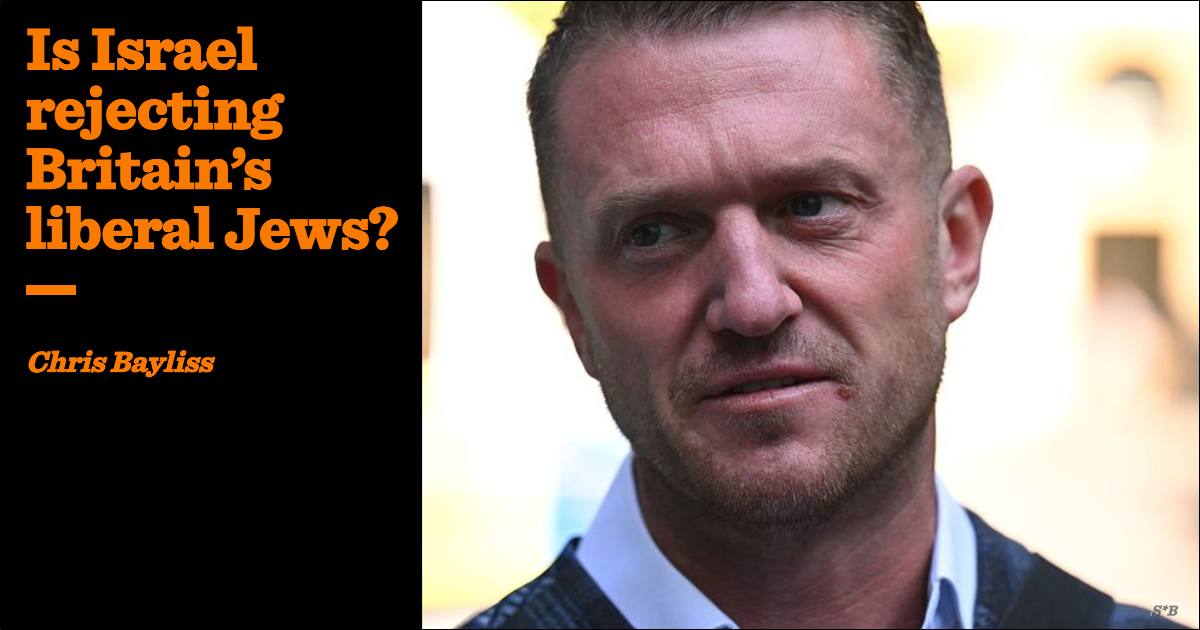
Embracing Tommy Robinson seems to have been calculated to disturb mainstream Jewish institutions
The Israeli Government has not been above trying to embarrass its British counterparts in the past, when they felt the occasion called for it. Who can forget the response of Menachem Begin’s government to the invasion of the Falklands, mimicking the mealy-mouthed “both sides” statements from the Foreign Office to provocations in the Middle East.
But Tel Aviv’s occasional barbs were previously intended for Downing Street and King Charles Street — they were certainly not aimed at horrifying liberal Jewish opinion in North London. We can’t be sure if that was Amichai Chikli’s intention when he announced Israel’s latest partnership in the UK to combat radical Islamism, but that was the result.
Announced the day after the Yom Kippur attack on a synagogue in Manchester which left two Jewish worshippers dead and another four injured, Chikli’s new partnership was with none other than Tommy Robinson. Presumably, the idea had not been cooked up in the space of 24 hours, and it was one that Israel’s Minister of Diaspora Affairs had kept in his back pocket for just such an eventuality — an attack on some part of Britain’s Jewish community clearly being a “when” rather than an “if” scenario.
Robinson, Chikli claimed, was a patriot who had “proven himself a true friend of Israel and the Jewish people, unafraid to speak the truth and confront hate” and was “a courageous leader on the front line against radical Islam”. Robinson would be visiting Israel in mid-October, and it was hinted that he would be involved in discussions and events looking at ways to combat the rising tide of antisemitism in Europe, and the defence of Western civilisation against encroaching Islamic radicalism.
To such people, Robinson symbolises the English working class at its most menacing
It is difficult to put into words quite how dimly this will be viewed in the liberal metropolitan circles inhabited by Britain’s most prominent Jews. It will scarcely be any less distasteful to most Jewish Conservatives in London. Robinson, perhaps more than any other figure, is regarded in bourgeois circles as a street fighter, and is remembered primarily as the founder of the English Defence League (which he later left and disowned). To such people, Robinson symbolises the English working class at its most menacing — beer-fuelled and ruddy cheeked, reveling in its own narrow mindedness.
To some extent, this is an unfair assessment, and it is one that seems to have been marinated in snobbery. Since leaving the EDL in 2013, Robinson has gone to great lengths to keep his political language measured. Several prominent commentators — Douglas Murray being an obvious example — regularly make statements that are far more provocative in content than anything he comes out with, but they seem to get away with it. Melanie Phillips wrote a Substack article lambasting Chikli’s announcement as a “very stupid and dangerous mistake” and essentially declaring Robinson beyond the pale for his boorishness. This was despite Phillips having made a career herself writing — normally very incisive — commentary that pays far less heed to liberal sensibilities than Robinson has for the last 12 years.
In other ways, Robinson really doesn’t help himself. He has no filter when it comes to online misinformation. Despite his extensive following, and his links with all sorts of prominent commentators on both sides of the Atlantic, he also remains wedded to the model of set-piece “marches” by his supporters through the middle of London. Many of the attendees really do view these events as an opportunity for a day out on the razzle with their mates, and a number of them genuinely are men with a background in football-related disorder in their youths.
The most recent demonstration, the “Unite the Kingdom” rally on 13th September, was a far more broadly attended demonstration than most of Robinson’s earlier demonstrations. The crowd included far more women and children, and the family atmosphere ensured that it was a well-behaved event. Keir Starmer’s subsequent attempt to compare it to the rise of the Nazis made the prime minister sound mildly unhinged. Whilst it was unlikely to achieve much in the way of policy, it was widely regarded as a morale-boost which further added to the Labour government’s sense of isolation from public opinion.
Earlier demonstrations were far more embarrassing, though — most notably the counter-demonstration organised on Armistice Sunday in 2023, intended to oppose the planned disruption of the Remembrance Parade by pro-Palestinian activists. This ended with Robinson being scuttled away in a taxi as his supporters clashed with police in Westminster’s China Town. This clearly came as a relief to the Metropolitan Police, who were coming under pressure at the time for their inability to police pro-Palestinian demonstrations. Allowing them instead to focus on “far-right disorder” put the Met back on far more politically comfortable ground.
In any case, reaching out to Tommy Robinson is not a step that is likely to endear the Israeli government to members of the metropolitan professional classes. Either Amichai Chikli is freelancing and being extraordinarily tin-eared in terms of the views of Britain’s Jewish establishment, or the Israeli government has made a calculated decision that their relationship with that group is no longer one they’re particularly bothered about. If that is the case, it points to how ineffectual British Jews in public life have been at influencing the British elite in a manner amenable to the Jewish State.
Unlike in many European countries, the British public is generally not reflexively hostile to Israel. Certainly among those of a more conservative disposition, the contrast between Israel as an orderly and economically successful nation naturally incubates an inclination to support its right to defend itself against its chaotic, terrorist-spawning neighbours. In Britain, the pro-Palestinian cause is associated with the Far Left and with unintegrated minority communities who sit stubbornly outside of mainstream British life. They engage in intimidating and disorderly rallies, desecrating beloved monuments and displaying placards emblazoned with sinister and vulgar messages. This is a group that seems almost deliberately designed to antagonise reasonable public opinion.
While not as numerous as their counterparts in America, prominent Jews play an influential and visible role in British public and professional life. In journalism and broadcasting, in medicine and law, and in government and politics, British Jews are broadly admired and respected for their material and intellectual contribution to the nation. Politicians of Jewish backgrounds have played notable roles in all of Britain’s mainstream political traditions, including the establishment of the Labour Party, the liberalisation of laws around personal morality in the 1960s, and in the Thatcher governments. Additionally, a number of prominent non-Jewish politicians have or had Jewish spouses and children.
And yet despite all this, the British establishment is uniformly and axiomatically hostile to the Jewish State. Any elected British government on the centre-right has to drag the Foreign Office kicking and screaming on the rare occasions they ever try to take a friendly stance to Israel on any issue. On the Left, hostility to Israel is a standard point of principle, any deviation from which has to be justified. This is not merely among the Hard Left, but also among lawyerly centrists. In the world of culture, literature and the arts, meanwhile, anything remotely associated with Israel is likely to generate such controversy and acrimony that one needn’t bother.
In Tel Aviv, this is regarded primarily as evidence of British antisemitism and cowardice, and also of the British authorities’ desperation to placate a large and assertive Muslim minority for fear of disorder and violence. But there is a growing sense that the London-based Jewish commentariat and political establishment have not been particularly invested or effective in promoting Israel’s interests among the British elite.
There is a sense that the diaspora in Britain has prioritised its comfortable and respectable position within the cozy North London bien pensant consensus. There are clear parallels here with the manner in which pro-Israeli voices on the US centre left have seen their influence in the Democratic Party dwindle since 2008. But in America, there is an alternative political pole on the right, among which pro-Israeli voices retain a critical if ultimately limited degree of influence.
Netanyahu’s government senses that there is a clear association in the minds of many European voters between migration and terrorism
The obvious response to this is, does Israel really think that Tommy Robinson is likely to be a more effective ally? Probably not. Of course, Chikli’s most immediate objective is simply to embarrass Keir Starmer and David Lammy. But beyond that, Robinson is a voice who explicitly makes the link between illegal immigration, Islamism and the threat to the safety of Jews in western European countries. This is a link that the Israeli government also wants to make. Correctly, Netanyahu’s government senses that there is a clear association in the minds of many European voters between migration and terrorism, and that the rising populist trend in Europe presents an opportunity to recalibrate its relationship with Europe.
At least in Britain, though, that opportunity risked going to waste. The appalling antisemitism that followed in the wake of October 7th was met with commentary by Jewish and philosemitic voices in the media that emphasised a sense of bewildered despair, and the question of “how did it come to this?”. But this commentary never quite got as far as the most plausible suggestion: “because we’ve let a very large number of people from profoundly antisemitic cultures into the country”. Many of these voices wanted to focus instead on the role of the Corbynite Left as handmaidens of a rising level of general antisemitism, rather than on issues related to immigration.
Many British Jews are unnerved by what they fear is an emerging strain of ethnonationalism on the British Right. Regardless of its historical authenticity, it is quite clear that the concept of an English ethnicity puts question marks around the Englishness of English Jews — even if that ethnic dimension of Englishness exists in parallel to cultural and civic definitions. Beyond that, the focus on immigration in sustaining the rise of a political populism which is seen as threatening to the institutions around which many British Jews have built their careers and professional attachments. Most obviously the Conservative and Labour Parties, as well as elements of the judiciary and legal system.
More profoundly than that, there is the membership of — and tribal allegiance to — the values of the metropolitan, cosmopolitan, professional classes, which preclude anything that even smells of prejudice toward foreigners or immigrants. To be very clear, this is because of the class background of prominent Jewish individuals, not because of their Judaism. There are plenty of British Jews among the provincial middle classes who are as alarmed about illegal immigration and creeping Islamism as the average Reform voter. We just don’t tend to hear from them because they don’t have Times columns or seats in the House of Lords.
But the net result of this is that any explicit attempt in mainstream British discourse to make the link between immigration, Islamism and the risk of antisemitic violence is likely to be met with a chorus of disapproval from certain prominent British Jews. By embracing Tommy Robinson, Israel can isolate those voices and create space for more mainstream immigration sceptics to shift both elite and public opinion in the desired direction.
The entire experience is likely to be extremely uncomfortable for many British Jews. But we are fast approaching the point where these issues can no longer be brushed under the carpet. Britain’s Pakistani and Bangladeshi communities are growing increasingly confident and politically assertive, and they are likely to play a far more prominent role in the organised Left after the next general election. The degree and vehemence of the antisemitism in those communities has been ignored and underestimated, and it is going to be poisonous if it isn’t countered robustly and without compromise. This will create a risk of political violence and physical intimidation. The fact that these groups were willing to organise anti-Israeli demonstrations in response to a specifically antisemitic act of terrorism should leave us in no doubt about how far outside of the current norms of British politics they are willing to act.
The reality of mass immigration is one of Britain becoming more like the rest of the world. This means more people thinking about themselves and others in explicitly ethnic terms, in ways which English people hitherto have not, but most people in the rest of the world do. And without an honest and organised plan of response, it may also mean Britain descending to global averages in terms of the safety of Jewish people. In this new Britain, liberal Jews should note that there are far more sinister voices than that of Tommy Robinson.