This article is taken from the October 2025 issue of The Critic. To get the full magazine why not subscribe? Get five issues for just £25.
Men and women are almost exactly the same — except for the inconvenient reality of childbearing, that is. Human reproduction remains unique in the animal kingdom in the length and intensity of care that is demanded by its highly vulnerable infants, especially by the females of our species. This intense dependence is the thread which unites the authors of two new books: Agustín Fuentes in Sex is a Spectrum and Leah Libresco Sargeant in The Dignity of Dependence.
Despite challenging a binary view of sex, Fuentes acknowledges that the experience of pregnancy, childbirth and lactation is “an actual dimorphism” between males and females, and that “the dynamics of gestation … matter immensely”. For the human species, infant care requires “intense cooperation” from the father and other adults in the community with the mother — the proverbial village.
As Fuentes clarifies, whilst a “mix of very needy infants with little motor development and lots of neurobiological growth outside the womb is found in other primates and some mammals”, the “human pattern of cooperative care of extremely helpless infants is rare”.
Libresco Sargeant similarly critiques the assumption that mothers should be solely responsible for childcare. Whilst “men can more easily separate themselves from relationships with the weak”, she argues those relationships give men a sense of purpose.
The focus on the idea of dependence is a significant convergence point between Fuentes and Libresco Sargeant, but ultimately Sex is a Spectrum and The Dignity of Dependence reflect very different political priorities. Fuentes sets out to prove that “Every human body, and life, is a blend of biological and cultural processes.” He argues that anthropology as a field has moved past the binary view of sex biology to a definition of sex as bimodal (that is, “having two broad ranges that overlap extensively”), but that even this view is “too much of an oversimplification”.

This “spectrum” view of sex leads Fuentes, in the final chapter of his book, to make a progressive argument in favour of policies such as access to adoption for same-sex parents and to single-sex spaces for trans-identifying people. Libresco Sargeant, on the other hand, focuses on the idea that contemporary American society is a culture of “liquid modernity”, where job mobility is expected and putting down roots to prioritise caring for dependents is penalised.
Whilst men can be in positions of dependence — for example, if they are disabled or elderly — “Women, more than men, are physically marked by relationships of care” as only they can bear and nurse children. “A world that is unwilling to acknowledge dependence as foundational to human life,” argues Libresco Sargeant, “is unable to treat women as equal in dignity to men.”
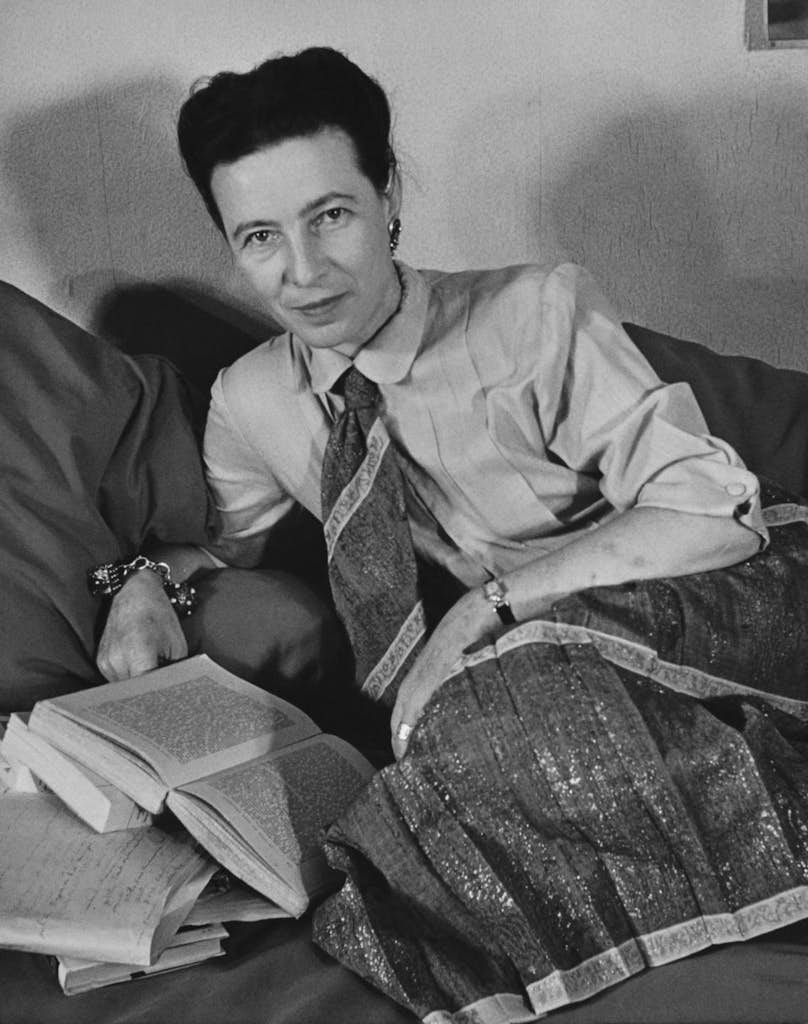
Fuentes’s and Libresco Sargeant’s treatment of Simone de Beauvoir is also symptomatic of two opposing worldviews. Fuentes reminds us of de Beauvoir’s (in)famous claim that “One is not born, but rather becomes, a woman,” and that “civilisation”, not “biological destiny” defines womanhood.
He untethers the concept of “woman” from the category of the human female on the basis that there is variation and overlap within the sexes — think about the usual example that, whilst men are on average taller and stronger than women, there will be some women who are taller and stronger than some men.
Libresco Sargeant draws a different conclusion. She sees, like de Beauvoir, that women’s capacity to bear children makes them more vulnerable to be placed in very strict domestic roles of “household drudgery”.
But instead of attempting to erase the innate biological differences which make women more dependent (de Beauvoir famously didn’t think women should be allowed to stay home to raise their children), Libresco Sargeant calls for husbands and extended family to participate in caregiving, thus dignifying women’s dependence.
Perhaps most telling is Fuentes’s suggestion in the final pages of his book that whilst “gestation” has “distinctive effects”, it is not the “restrictive, debilitating constraint many cultural and gendered assumptions assert they are”. Pregnancy is not actually that hard, he thinks — it’s just a ploy by the patriarchy to convince us females that we are weak! I was not expecting to have a liberal male mansplain how gestation is a breeze, but here we are.
Fuentes claims to champion human diversity, but in the process of dispelling gender stereotypes, he flattens women’s distinctive needs. He should perhaps take a leaf out of Libresco Sargeant’s book — literally — and remind himself that equity is about justice, not sameness.