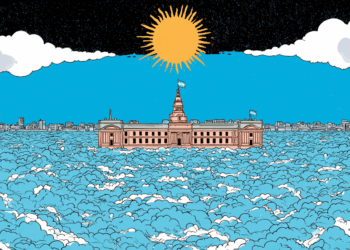
As Europe ramps up defense spending, its nations face a momentous decision about the future of their welfare states.
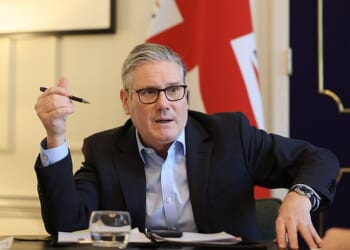
The challenge is best captured in Germany, where Chancellor Friedrich Merz recently told members of his conservative Christian Democratic Union party that “the welfare state as we know it today can no longer be financed by our economy – and that is why we have to change it.”
Germany’s labor minister, a member of the center-left Social Democratic Party, summarily dismissed the chancellor’s comment with a single, blunt obscenity.
Why We Wrote This
The West’s renewed focus on defense has governments looking to offset spending – and social safety nets cost a lot of money. Can Europe retain its welfare systems in the face of competing demands?
But across Europe, welfare states are already under strain. Aging populations and a shrinking workforce mean higher social spending costs and lower tax revenues. Now comes a mounting defense bill. Even Germany, ever financially cautious, reluctantly endorsed record deficit spending this year to cover the tab.
That can’t last, Mr. Merz says. This is the chancellor’s “autumn of reform.” But what reforms? Many Europeans are concerned that they will have to trade social security for military security.
That isn’t inevitable, experts say. Most see reasonable solutions. The catch is that none are politically savory. They involve a measure of sacrifice, such as pushing back pensionable retirement age, or imposing some form of tax. It is, in many ways, a test of the idea of the welfare state itself.
Finding something for everybody
As nations take different paths, one fact is clear: The welfare system’s long-term effectiveness depends heavily on how citizens see it. The healthiest systems are those treated as living social contracts that constantly require new compromises for the general good. When citizens view them more narrowly, troubles build.

“When the debate is only about pensions and not about the broader social contract … these are the examples that people need to worry about,” says Anton Hemerijck, a political scientist at the European University Institute in Florence, Italy.
All of Europe has seen this reckoning coming. The Netherlands and the Nordic countries have made important reforms, Dr. Hemerijck says. France, Italy, and Britain have dallied. Germany is among those that are standing on the springboard, waiting to leap. The question is whether defense spending will give it a push – and in which direction.
Polls show that most Germans believe reforms are needed. In an August survey for the publication WirtschaftsWoche, 54% of respondents say it is “clearly” or “rather” necessary to reduce the scale of the welfare state.
But no one wants these reforms to touch them. Support for reducing health-care benefits shrinks to 17%. While 81% of respondents support cutting unemployment benefits, those costs make up only 3.5% of welfare spending.
The poll shows why no one is talking about abandoning the welfare state. Its benefits are too highly valued. In fact, a study in the Journal of European Public Policy found that attempts to cut the welfare state in favor of defense “could lead to electoral backlash.”
In 2020, Germany was spending $53 billion a year on defense. This year, under Mr. Merz’s new plan, the country will spend $101 billion, increasing to $190 billion in 2029, when spending will reach 3.5% of the budget. The problem is that social spending is increasing, too. Some 31% of the federal budget went to the welfare state in 2024, up from 26% in 1992. The rise isn’t necessarily alarming, experts say. But the increase is not sustainable.
The real question is how the welfare state should look going forward. Mr. Merz has already dismissed the idea of raising the retirement age for pensioners. Germany’s labor minister, Bärbel Bas, insists on taxing the rich, which Mr. Merz rejects as a nonstarter. This points to a persistent inability to make politically unpopular choices.
“The previous government and the present government have avoided decisions that would take care of the problem,” says Eckhard Janeba, an economist at the University of Mannheim.
But there is also the difficulty of agreeing on which solution to try.
“There are several ways to go, and each has its ups and downs,” says Richard Ochmann, health policy project manager for the Berlin-based IGES Institute, a health-care research and consulting organization. “Someone has to pay for them. That means it’s not easy to find a political consensus.”
The result is usually agreement on only the smallest things, he says, with larger problems left untouched. Defense spending has made the conversation harder.
“That is something that we are maybe not that well prepared for. It’s a challenge,” adds Dr. Ochmann.
Economists want to reframe that challenge. To them, the value of the welfare state is that it helps people – and nations – weather shocks and shifts. That can be health care for an injured worker, child care for families, or job training for the unemployed, but all these things “buffer people in times of transition” and keep them from falling out of the labor market, says Dr. Hemerijck.
The idea is to maximize employment, and use the resulting taxes to pay for social benefits.
Nordic countries have been able to make tough changes by building trust. Full employment of all able men and women is a culturally ingrained part of the social contract. The state repays that trust with an effective welfare system.
“There are very high levels of generalized trust,” says Caroline de la Porte, a political scientist at the Copenhagen Business School. “This is partly because the state delivers – and it has to because we pay such high taxes.”
Voters and parties then become partners in reform. “They put such a large emphasis on keeping the welfare state alive in that form,” says Rune Stubager, a political scientist at Aarhus University in Denmark. “That takes precedence.”
In Germany, an April study by researchers at the University of Konstanz found that “more than 70% of respondents have low or very low levels of trust in the effectiveness, fairness, and long-term financial viability of the German welfare state.”
Trust is particularly low among low-income groups – not surprising, as the German pension system favors higher earners. Any solution needs to start with a sense of fairness, says Dr. Janeba of the University of Mannheim. “All types of groups need to contribute.”
Such challenges need not be a sign of failure. After all, similar debates about the future of the welfare state occurred against the background of economic stagnation in the 1970s. The system’s ability to adapt shows resilience, says Peter Taylor-Gooby, a professor of social policy at the University of Kent. “That’s what you’d expect to happen in these circumstances.”
But change is necessary, adds Carlo Bastasin, an economist at Brookings. Otherwise, “there is the danger of saying you have to choose between social security and military security.”